Photo By Lauren Boggs |
ROBINS AIR FORCE BASE, Ga. — Airman 1st Class Kywan Woods, 78th Operational Medical......read moreread more
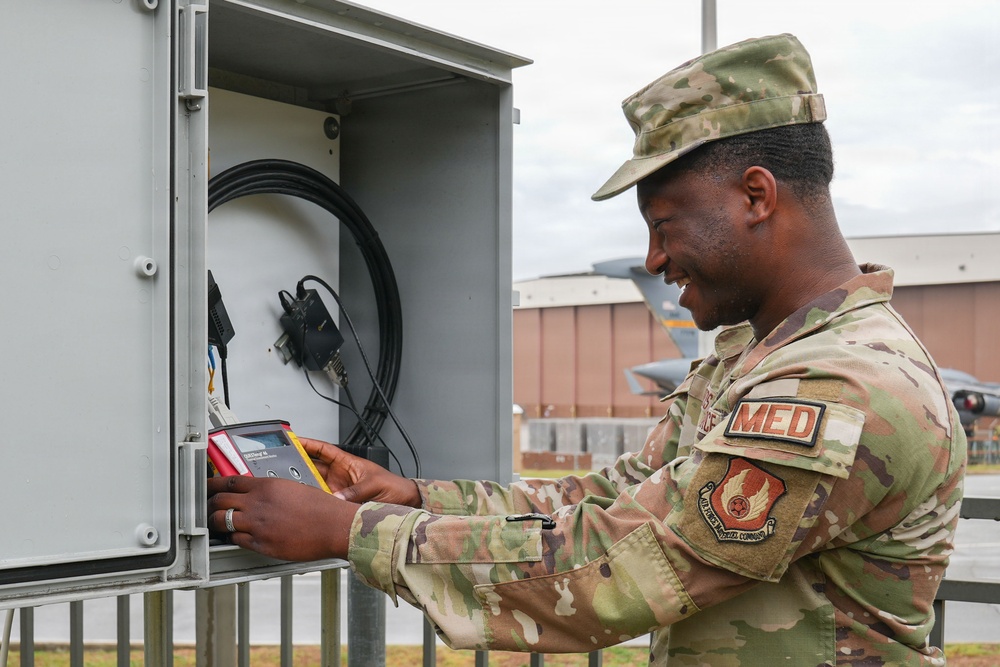
Photo By Lauren Boggs | ROBINS AIR FORCE BASE, Ga. — Airman 1st Class Kywan Woods, 78th Operational Medical Readiness Squadron bioenvironmental engineering technician, reads the Wet Bulb Globe Temperature meter at Robins Air Force Base, Georgia, March 30, 2026. The meter automatically recorded the WBGT throughout the day to determine flag conditions for the base. (U.S. Air Force photo by Lauren Boggs) see less
| View Image Page
With a sweltering summer on the horizon for Robins Air Force Base, Georgia, the 78th Operational Medical Readiness Squadron’s Bioenvironmental Engineering Flight is doing the critical work to keep Airmen safe, healthy and mission ready in the face of extreme heat.
The team monitors temperatures that dictate the flag conditions on the base, which ultimately set the work/rest cycles and hydration schedules for all base personnel.
To do this, the squadron goes beyond the typical heat index, a measurement that only accounts for the temperature and humidity.
“Wet Bulb Globe Temperature is a more accurate measurement,” said Airman 1st Class Kywan Woods, 78th OMRS biomedical engineering technician. “It gives us more accurate readings as far as temperature, humidity, wind speed, sun angle and radiant heat.”
An outdoor WBGT meter automatically measures the WBGT throughout the day while the bioenvironmental team keeps a log of the results. The system also automatically reports conditions to the Base Defense Operations Center, ensuring Airmen are instantly notified when the flag condition changes.
Flag conditions range from 78 to 89.9 degrees while black-flag warnings are issued when the WBGT reaches 90 degrees or higher.
“The automatic system definitely helps reduce work stoppages,” said Woods. “It allows us to gather information to better notify the base of what they need to do when it’s hotter out.”
The WBGT logs also play a significant role in preventing heat-related injuries.
“It’s important that we know the temperature and to make sure we aren’t doing things like physical training tests during black flag conditions,” said Woods. “Keeping a log on what’s going on really helps reduce heat-related illnesses across the base.”
According to Staff Sgt. Joseph Urban, 78th OMRS Environmental noncommissioned officer in charge, Robins AFB reported only four heat-related illnesses in 2025. The WBGT logs are used to investigate those incidents and inform future heat-safety policies.
Although outdoor workers are at a higher risk from the effects of excessive heat, the bioenvironmental team encourages every member of Team Robins to recognize the signs of heat-related illnesses ranging from milder issues like heat cramps and heat syncope, or fainting, to more severe, and even life-threatening conditions like heat exhaustion and heatstroke.
“Between Memorial Day and Labor Day, we see black flag conditions about 90% of the time,” said Urban. “It affects the whole base, whether you work outside or primarily indoors.”
The National Weather Service says early signs of heat illness can include muscle cramps and heavy sweating, while worsening conditions can lead to dizziness, nausea, and a fast, weak pulse.
Ultimately, the team stresses the importance of prevention and looking out for your fellow Airmen. They encourage all personnel to stay hydrated, strictly follow the work/rest cycles, and, most importantly, look out for fellow Airmen who may be showing signs of a heat-related illness.