
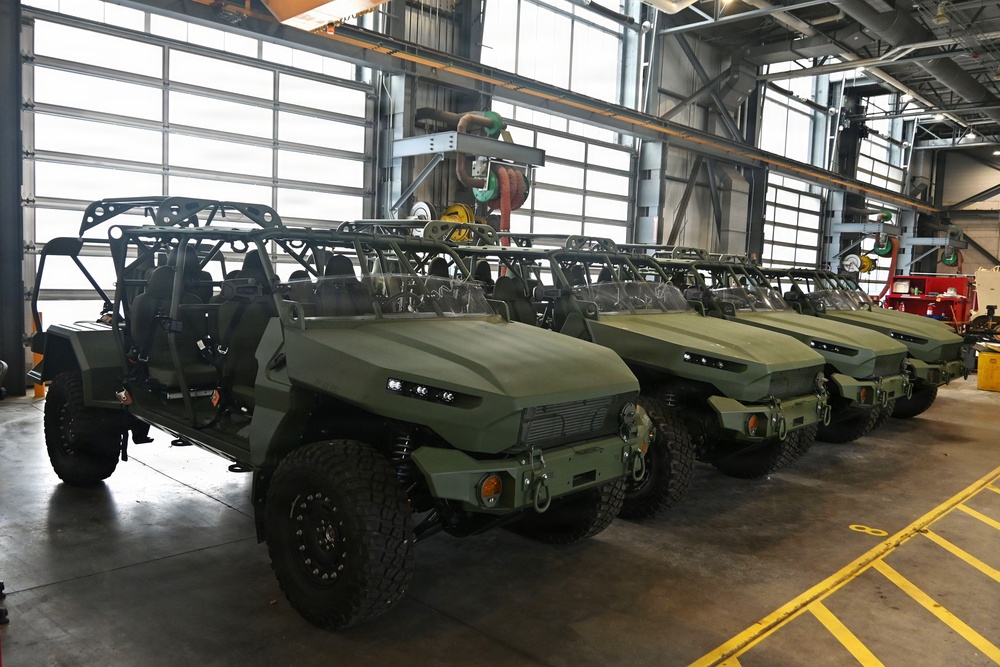
Photo By Brad Rhen | Several Infantry Squad Vehicles, or ISVs, have arrived at Fort Indiantown Gap as part...... read more read more
 Subscribe
FORT INDIANTOWN GAP, Pa. – as of March 31, the former 56th Stryker Brigade Combat Team is officially known as the 56th Mobile Brigade Combat Team.
The change is part of plan announced by the Army in 2025 to transform its force structure to adapt to the changing character of modern conflict. A major part of the plan is the conversion of numerous brigade combat teams in both the active and reserve components to mobile brigade combat teams.
Col. Christopher McLaud, 56th MBCT commander, said the conversion from a Stryker Brigade Combat Team into a Mobile Brigade Combat Team reflects a fundamental shift in how the Army intends to fight in large-scale, multi-domain combat.
“This transition involves significant changes in the organizational structure, equipment, personnel, and alignment of enablers,” McLaud said. “The Independence Brigade will continue to deliberately adjust to all the changes as we increase overall readiness and lethality while managing every Soldier directly impacted by this conversion to accommodate their current military contract and desired drilling location.”
For the 56th SBCT, the conversion means divesting the eight-wheeled, armored Stryker vehicles it has used since being converted to a Stryker brigade in 2006.
As an MBCT, the 56th will instead be centered around the Infantry Squad Vehicle, or ISV, a lightweight, unarmored troop carrier designed to rapidly transport a nine-Soldier squad across varied terrain.
In fact, the brigade has already divested its Strykers. In 2025, prior to the Army announcement, the 56th turned in all its Strykers as part of an initiative to modernize the brigade. It was supposed to receive more than 300 upgraded Strykers.
However, the decision to transform the brigade to an MBCT was made before the upgraded Strykers arrived, except for a few that were used for driver training.
Meanwhile, several ISVs arrived at Fort Indiantown Gap recently to be used for driver training. The remainder of the brigade’s ISVs are expected to begin arriving in 2027.
In addition to the primary vehicle it uses, the 56th MBCT’s force structure is also changing. Two units – the 103rd Brigade Engineer Battalion and 2nd Squadron, 104th Cavalry Regiment – have been deactivated, and several new units have been or will be activated.
Among the new units will be a multi-function reconnaissance company, a combat engineer company-infantry, a signal company and a military intelligence company.
Soldiers from the deactivated units were reassigned to other units in the Pennsylvania National Guard, with some going to the new units.
McLaud cited several key benefits of converting into an MBCT, including improved survivability through dispersion and reduced thermal, visual and electronic signatures; enhanced effectiveness in drone-saturated and electronic warfare environments; better situational awareness, targeting and decision-making in contested environments; a reduced logistics footprint; increased operational reach; force design efficiency; and greater flexibility across complex terrain.
“The bottom line is this, converting from an SBCT into an MBCT provides speed over armor, dispersion over mass, and information dominance over platform survivability,” McLaud said. “This represents a direct response to how modern warfare is evolving.”
The 56th Brigade is no stranger to transformation: In 2006, it converted from a mechanized brigade to a Stryker brigade, becoming the first such unit in the reserve component. It had been a mechanized brigade since 1975.
| Date Taken: | 04.07.2026 |
| Date Posted: | 04.07.2026 15:53 |
| Story ID: | 562191 |
| Location: | FORT INDIANTOWN GAP, PENNSYLVANIA, US |
| Web Views: | 264 |
| Downloads: | 0 |

This work, 56th Stryker Brigade Combat Team converted to mobile brigade combat team, by Brad Rhen, identified by DVIDS, must comply with the restrictions shown on https://www.dvidshub.net/about/copyright.


No keywords found.




