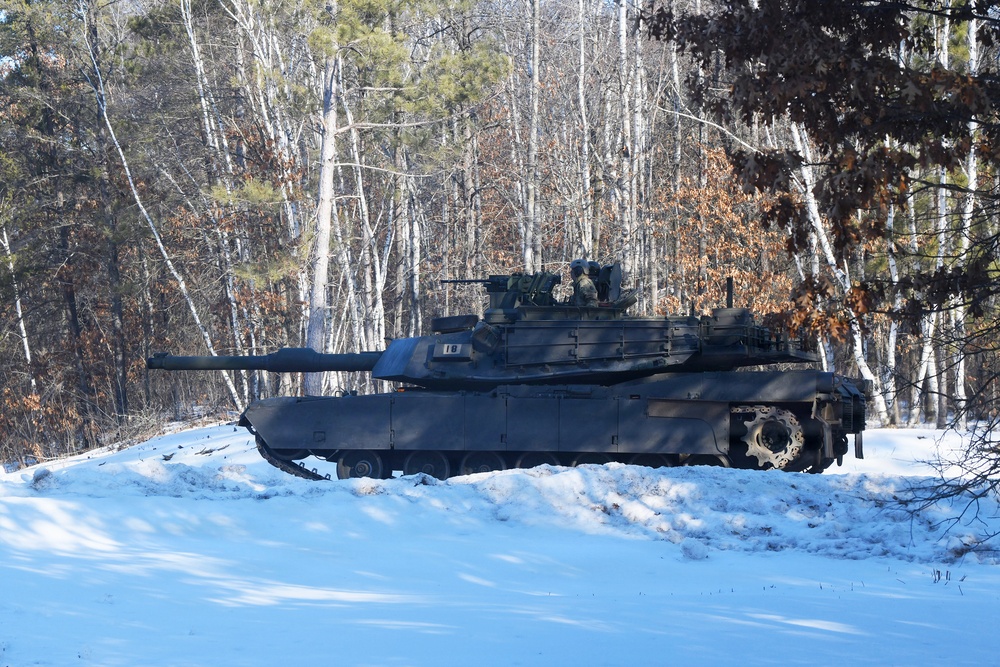
260220 (LITTLE FALLS, Minnesota) – Armor Crewmen of the 1st Combined Arms Battalion – 194th Armor conducted winter gunnery skills testing and qualification training at the Camp Ripley Training Center during the second half of February 2026.
On the windswept lanes of Camp Ripley’s Center Range, a full-scale tank range part of the Miller Range Complex, two Army National Guard tank companies prepare for one of the most demanding events in an armored crew’s training cycle. This challenging event will test the mettle of the weapons platform and crew as their newly fielded M1A2SEPv3 Abrams tanks begin the first of many arduous annual trainings.
“Long before dawn, crews conduct preventive maintenance checks, upload 120mm ammunition, and begin boresighting procedures in order to prepare themselves for the gunnery tables and a first round down range,” said Sgt. First Class Todd Turner, Battalion Abrams Master Gunner.
By sunrise, the familiar grind of turbine engines rolls across Center Range as the tanks move to the “ready line”. The efforts are almost like a dance as 70 tons of American armored power bite into the earth and move to take on their trial.
The M1A2 SEPv3 (System Enhancement Package version 3) represents the latest evolution of the Abrams main battle tank. Developed by General Dynamics Land Systems, the SEPv3 incorporates improved armor protection, enhanced power generation, upgraded communications, and advanced thermal sights. It features improved ammunition data links, an upgraded fire control system, and compatibility with the latest 120mm rounds. These improvements ensure that U.S. Army armored formations are well prepared both defensively and offensively for any battlefield. The fielding of these tanks to the National Guard sustains the Army’s modernization policy for reserve components to remain interoperable and lethal alongside active-duty counterparts.
“The SEPv3 reflects decades of lessons learned from operations in Desert Storm, Iraq, and Afghanistan,” added Turner. Where survivability, precision, and situational awareness proved decisive for mission success.”
Tank gunnery itself has a long and structured history in the U.S. Army. After World War II, the Army formalized standardized gunnery programs to ensure crews could consistently hit targets under combat conditions. This evolved into the Gunnery Skills Test (GST) and later the Gunnery Skills Table (GST/GS Table) system. Over time, the program developed into a progressive, table-based qualification model—commonly known as Tables I through XII.
“Early tables focus on individual and crew-level skills: weapons safety, engagement procedures, and fire commands. As crews advance, they execute increasingly complex live-fire scenarios, including stationary and moving engagements by day and night,” said 1st Sgt. Michael King, Brigade Master Gunner, 1st Armored Brigade Combat Team, 34th Infantry Division.
Table VI remains the culminating crew qualification event. During this live-fire table, crews must detect, identify, and engage multiple stationary and moving targets within strict time standards. Engagements may include tanks, troops, anti-tank guided missiles, and bunker targets at varying ranges. Success demands precision fire control, rapid target acquisition, and disciplined communication between the tank commander, gunner, loader, and driver.
“Every round expended is the deliberate product of extensive individual and crew-level training, strategically guided by the Tank Commander. The objective is to achieve a decisive, first-round neutralization of the target, thereby maximizing mission effectiveness and crew survivability,” added King.
For a National Guard tank company, qualification is more than a regulatory requirement, it is validation of combat readiness. Guard units often balance civilian careers with military service, making focused training time especially valuable. Gunnery brings together months of simulation, maintenance, and dry-fire rehearsals into a high-stakes live-fire evaluation. Achieving a “Distinguished” rating reflects not only technical mastery but disciplined teamwork under pressure.
Crew cohesion is the invisible force behind every successful engagement. Inside the cramped turret of an Abrams, communication must be concise and instinctive. The tank commander identifies and commands; the gunner tracks and fires; the loader maintains the rhythm of ammunition supply; the driver positions the vehicle for survivability and line-of-sight. Trust is built through repetition as well as hours of time together in simulators, maintenance bays, and field exercises. When a target appears, there is no hesitation. Commands are crisp. The main gun recoils. A hit is announced.
As ammunition casings collect on the turret floor and the last target drops, the company’s qualification is complete. But the training never truly ends. Gunnery sustains lethality, reinforces standards, and forges confidence that if called upon, these citizen-soldiers and their M1A2 SEPv3 Abrams tanks are ready to fight and win.
| Date Taken: |
02.19.2026 |
| Date Posted: |
04.03.2026 15:26 |
| Story ID: |
561963 |
| Location: |
MINNESOTA, US |
| Web Views: |
110 |
| Downloads: |
0 |
PUBLIC DOMAIN

This work, Cold Gunnery Qualification Tables see Hot Rounds and Scores, by Anthony Housey, identified by DVIDS, must comply with the restrictions shown on https://www.dvidshub.net/about/copyright.