Photo By Jean Graves |
Maxine “Angela” Kuesters, a psychology technician with Bayne-Jones Army Community......read moreread more
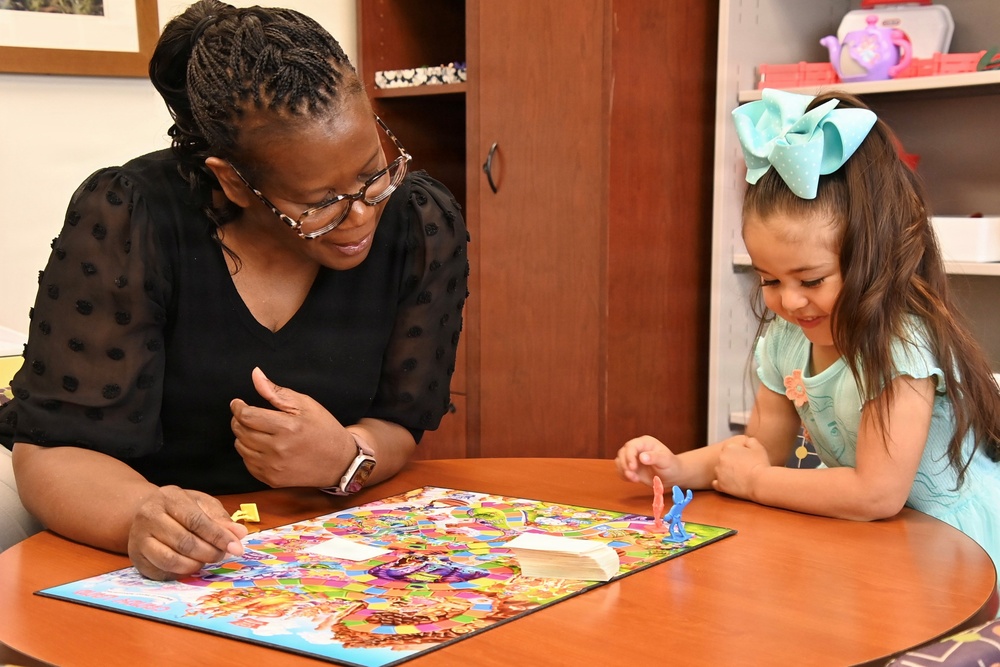
Photo By Jean Graves | Maxine “Angela” Kuesters, a psychology technician with Bayne-Jones Army Community Hospital, plays a board game with Rosemary Pando, daughter of Reyna Pando and Air Force Sgt. Christopher Pando, assigned to the 18th Weather Squadron, during a session focused on building connection and emotional resilience in military children. see less
| View Image Page
FORT POLK, La. — Military children grow up in a world defined by change, from new duty stations to new schools and routines. Through each transition, they develop resilience that sets them apart.
Those moments of laughter, connection and quiet strength often go unseen, but they shape the foundation of military Families.
This April, Bayne-Jones Army Community Hospital is highlighting the strength of military-connected youth and the care that supports them.
Maxine Kuesters, a psychology technician at BJACH, sees that strength every day in her work with children and families.
Kuesters said many military children learn to navigate change early, but that experience can look different for each child.
“Frequent moves can disrupt stability and make it difficult to maintain friendships,” she said. “During deployments, older children may also take on additional responsibilities at home, sometimes placing their own needs second.”
Dr. Ruth Graupera-Frain, a board-certified child, adolescent and adult psychiatrist at BJACH, said constant change is one of the most significant factors affecting military children.
“The main constant is change,” she said. “Not only are kids developmentally changing, but their environment and support system does too. Everyone needs a constant.”
Graupera-Frain emphasized the importance of treating mental health with the same priority as physical health.
“If you had a seizure, you would want to see a neurologist,” she said. “If you have a mental health issue, you should want to see a mental health provider.”
She added that treatment is most effective when it is comprehensive.
“Medications are only part of the treatment for some,” she said. “They never stand alone.”
For providers across BJACH, supporting military children means caring for both their physical and emotional well-being.
Capt. Kiara Schien, a pediatrician in the Patient-Centered Medical Home, said building relationships with her patients is central to that mission.
“I genuinely care for and want the very best for them and am committed to their wellbeing,” Schien said.
She said one of the most rewarding parts of her role is helping military children grow and thrive despite the challenges that come with military life.
“Getting to know my patients and their families and having the gift of playing a role in helping our military children be happy and healthy,” she said.
Capt. Benjamin Tan, chief of pediatrics at BJACH, said his role often involves advocating for children who may not yet be able to advocate for themselves.
“I want to advocate for patients that are unable or unwilling to advocate for themselves,” Tan said.
He said pediatric care is not just about treating illness, but about identifying risks early and advocating for children at every stage of development.
“From well-child to sick visits, each moment is an opportunity to educate and guide,” Tan said. “We educate and counsel hoping to prevent the worst.”
At BJACH, supporting military children extends beyond individual appointments. Through a coordinated system of care, providers work together to address emotional, behavioral and environmental needs while strengthening family support systems.
Marguerite Wilcox, a clinical social worker with Child and Family Mental Health Services, said connecting families to resources is a critical part of that support.
“We connect families to services both on and off post to help build strong support networks,” Wilcox said. “By bringing together those resources, we’re able to promote long-term wellbeing and resilience.”
Anna Pinkelman, a behavioral health consultant in primary care, said early engagement and prevention are key to long-term well-being.
“Being a part of a team that supports readiness from a mental health perspective is often undervalued,” Pinkelman said.
She emphasized the importance of normalizing mental health care within families.
“Mental health is not scary and is rewarding work,” she said.
Pinkelman encourages families to focus on what they can control during times of uncertainty.
“Control your controllables,” she said.
Providers say small, consistent actions can make a significant difference. Maintaining predictable routines, setting aside time to connect and helping children identify and express their emotions can reduce stress during transitions. Modeling healthy coping strategies, such as problem-solving calmly, taking breaks when overwhelmed and engaging in simple family activities, also helps build confidence and emotional stability.
For BJACH, the Month of the Military Child is more than a celebration. It is a reminder of the strength military children carry every day and the importance of supporting them along the way.
Because behind every ready Soldier is a Family, and within every Family is a story worth telling.