
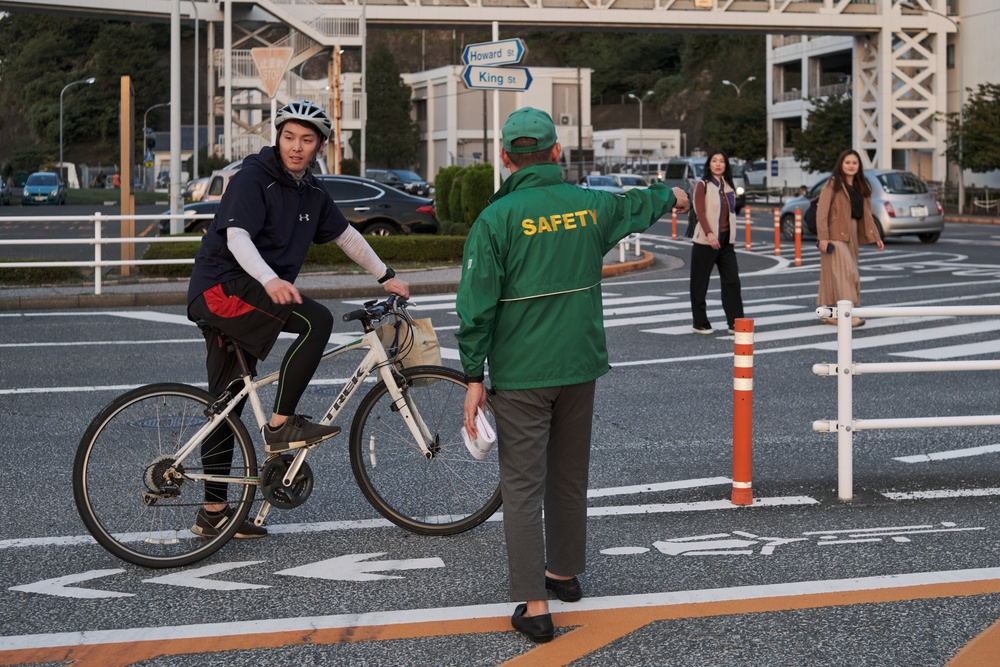
Photo By James Kimber | YOKOSUKA, Japan (Oct. 25, 2023) - Commander, Fleet Activities Yokosuka Safety...... read more read more
 Subscribe
YOKOSUKA, Japan— Kanagawa Prefecture is urging drivers, cyclists and pedestrians to sharpen their awareness during the 2026 Spring National Traffic Safety Campaign, running April 6 through 15. The 10-day campaign, coordinated by the Kanagawa Prefecture Traffic Safety Measures Council, carries the slogan "Protect new school children and kindergarteners from traffic accidents" - a timely reminder as the Japanese school year begins and young children navigate unfamiliar routes for the first time.
April 10 holds special significance within the campaign as Japan's nationally designated "Aim for Zero Traffic Fatalities Day." The Cabinet Office established the observance in 2008 as a citizens' movement to heighten public consciousness around traffic safety. The date was chosen because it ends in zero, reinforcing the aspiration for zero fatalities on the road. The designation is observed twice more each year on Feb. 20 and Sept. 30, for the same symbolic reason.
The spring campaign centers on four focus areas that apply to everyone in the community, whether driving, riding or walking.
**Pedestrian safety on school routes and residential roads.**With new first graders and kindergarteners beginning to walk to school, the campaign calls for increased watch and patrol activities along routes where children travel in groups. Drivers should be mindful that pedestrians have priority at crosswalks, while pedestrians should be encouraged to use crosswalks, avoid jaywalking, and wear reflective materials during low-light hours.
**Eliminating distracted driving and smartphone use.**The campaign targets the dangers of using smartphones while both driving and walking. In Japan, holding a phone or viewing a screen while operating a vehicle carries penalties of up to six months' imprisonment or a fine of up to ¥100,000. Pedestrians also bear responsibility: walking while staring at a phone reduces peripheral awareness at crosswalks and intersections. Community members should stop and step aside when they need to check a device rather than reading or texting in motion. Drivers approaching crosswalks where a pedestrian is waiting must come to a full stop and yield, failure to do so is a traffic violation under Japanese law.
The campaign also calls for a social environment where drunk driving is never tolerated. Japan's laws hold all parties accountable, not just the driver, but passengers who knowingly ride with an impaired driver and individuals who serve alcohol to someone who will drive. The campaign further emphasizes seatbelt use in all seating positions, including rear seats, and proper use of child safety seats. Rear-seat seatbelt compliance remains lower than in front seats across Japan, yet unbelted rear passengers still face serious risk in a collision and can injure front-seat occupants on impact.
**Bicycle and e-scooter rule compliance.**The Kanagawa Prefecture Traffic Safety Campaign further outlines five rules for riding a bicycle safely that community members should familiarize themselves with: ride on the left side of the road, obey traffic signals and stop signs, use a light at night, never ride under the influence of alcohol, and wear a helmet. In Japan, cyclists travel on the left and should check for safety by looking right first.
This year's campaign arrives alongside a major enforcement change. As of April 1, Japan's Traffic Violation Penalty Notice System, commonly known as the "Blue Ticket" system will be enforcing monetary fines for bicycle traffic violations committed by riders aged 16 and older. Previously, most bicycle infractions were handled through either simple warnings or far more serious criminal proceedings.
Under the new system, police can issue penalty notices for violations ranging from riding while using a cellphone (¥12,000 fine) to ignoring traffic signals or failing to stop at intersections (¥5,000 to ¥6,000). Fines must be paid within seven days. Failure to pay can escalate the matter to criminal proceedings and a potential criminal record. Riders who commit two or more dangerous violations within three years will be required to complete a mandatory cyclist training course.
**Motorcycle accident prevention.**Riders are reminded of the inherent risks of two-wheeled vehicles, which include, reduced visibility to other drivers, susceptibility to road surface hazards, and vehicle blind spots, particularly in the narrow streets and dense intersections around Yokosuka. Two accident types account for a disproportionate share of motorcycle fatalities in Japan: single-vehicle accidents where a rider loses control, and collisions between right-turning vehicles and oncoming motorcycles traveling straight. In left-hand-traffic Japan, this means a vehicle turning right across oncoming traffic may fail to see an approaching motorcycle. Riders should assume they are not seen and approach intersections prepared to brake, even when they have the right of way.
Proper helmet use remains the single most effective protective measure as many fatal bicycle and motorcycle accidents in Japan involve head injuries. A helmet only works if it fits correctly and the chin strap is securely fastened. A loose strap can allow it to shift or come off during impact. Riders should also consider chest, back and joint protectors, and regardless of experience level, conduct a pre-ride check of tires, brakes, lights and mirrors before each ride.
Local municipalities across the prefecture are stepping up patrols and educational efforts to align with the spring campaign and ensure compliance. To support these efforts, educational materials in both Japanese and English are available, including:
Five Rule for Safe Bicycle Riding English:
https://www8.cao.go.jp/koutu/kyouiku/pdf/l_bicycle-e.pdf
Five Rules for Safe Bicycle Riding Japanese:
https://www8.cao.go.jp/koutu/kyouiku/pdf/r04_bicycle-chirashi.pdf
Kanagawa Prefectural Police Bicycle Safety Poster:
https://www.police.pref.kanagawa.jp/assets/entry/pdf/eng_inf_007.pdf
Kanagawa Prefecture Blue Ticket Guide in English:
https://www.pref.kanagawa.jp/documents/84974/english_teisei.pdf
CFAY Street Safety Campaign
CFAY will conduct an on-base Street Safety Campaign on April 21 from 6:30 to 8 a.m. and April 22 from 3:30 to 5 p.m.
The campaign's purpose is education, not enforcement. Volunteers and safety representatives will be stationed at three key intersections on base to observe and educate community members on safe practices for bicycling, crossing streets, skateboarding, running and jogging.
At crosswalks, observers will check that cyclists, skateboarders and scooter riders dismount and walk across, and that no one is using listening devices while crossing. In bicycle lanes, they will ensure riders are traveling on the proper side of the street and wearing helmets properly. Observers will raise awareness that sidewalks are reserved for pedestrians and skateboarders riders while verifying that helmets are worn while riding skateboards or scooters, and that listening devices are not in use.
Volunteers interested in participating in the campaign should provide their name, contact information and preferred date to mailto:cfaytrafficsafety@us.navy.mil no later than noon on April 17. The safety office will provide safety vests and bilingual handouts for distribution at each checkpoint. All volunteers will be recognized with safety awards in accordance with CFAYINST 5100.10A.
| Date Taken: | 04.01.2026 |
| Date Posted: | 04.02.2026 19:14 |
| Story ID: | 561897 |
| Location: | YOKOSUKA, KANAGAWA, JP |
| Web Views: | 321 |
| Downloads: | 0 |

This work, Spring Traffic Safety Campaigns Kick Off at CFAY and Yokosuka, must comply with the restrictions shown on https://www.dvidshub.net/about/copyright.

No keywords found.




