
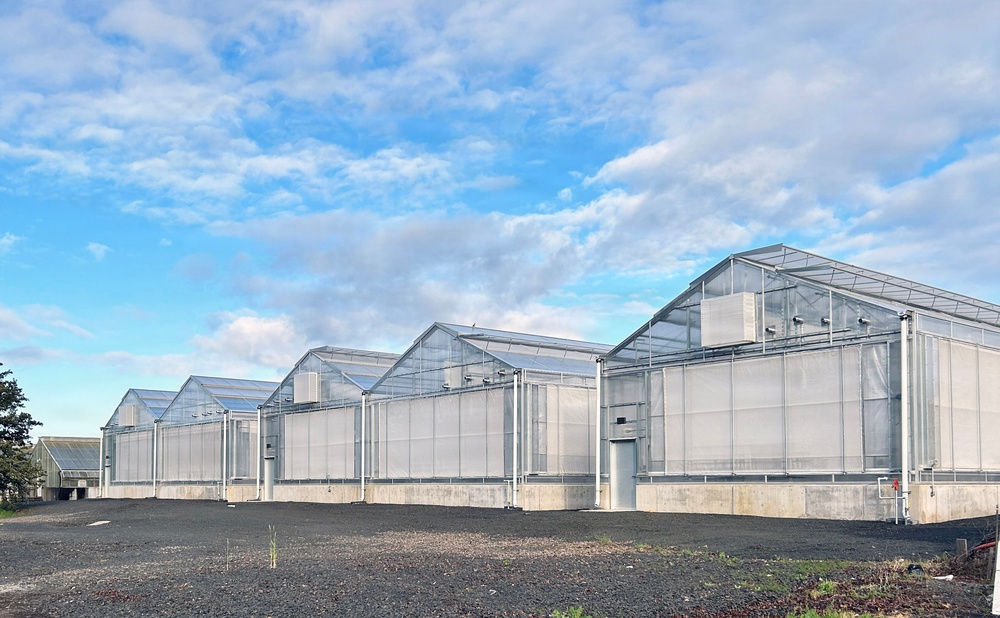
Photo By Louis Velasco | The $13.5 million federally funded project involved the demolition of existing...... read more read more
In the heart of Oregon’s fertile Willamette Valley, Agricultural Research Service (ARS), an agency of the U.S. Department of Agriculture (USDA), is sowing the seeds for agricultural innovation in the Pacific Northwest.
Through a unique interagency partnership with the U.S. Army Corps of Engineers (USACE) Seattle District, they’re celebrating the completion of greenhouses with new climate control systems and screenhouse facilities at ARS’s National Clonal Germplasm Repository (NCGR) in Corvallis, Ore.
The upgraded facilities in Corvallis safeguard a collection of about 12,000 plants representing nearly 700 species of genetically diverse and agriculturally important specialty crops—including hazelnuts, hops, mint, pears, currants, and six kinds of berries.
These genetic resources help preserve crop diversity, breed disease-resistant varieties, and improve the tools used to support growers and breeders.
The new NCGR upgrades completed commissioning and a USACE inspection on March 27, 2026; this celebratory milestone prepares USACE to formally hand over the “keys to the building" to ARS, allowing the research agency to fully utilize their upgraded facilities in the months ahead.
Through its Interagency and International Services (IIS) program, USACE completed the project on behalf of the Agricultural Research Service—USDA’s in-house scientific research arm—providing planning, environmental assessments, contracting, design, and construction contract oversight.
“This is a perfect example of what the USACE offers through IIS,” said Jenna Snow, Seattle District IIS chief. “We’re providing full-service design and construction management support to a customer doing mission-essential work. It’s rewarding to see the impact this project will have for agricultural research nationwide.”
Building Facilities and Collaboration The NCGR, located on Oregon State University’s 20-acre Lewis-Brown Research Farm, holds a living library of plants essential to global agriculture that’s critical to the Nation’s food security.
The repository’s extensive collection of fruit and nut varieties vary in terms of their ability to withstand cold, disease, and sub-optimal soil conditions.
“The collaboration between USDA ARS and the Lewis-Brown Research farm has been a long-standing one,” said Patricia Stock, Ph.D., department head and professor with OSU’s Department of Horticulture. “This is a win-win situation that exemplifies the benefits of collaborations between academia and government to advance plant breeding and genetic research.”
The repository functions much like a library, but instead of books, it offers plant genetic material. Researchers and nurseries rely on the collection to find specific varieties or parent material needed to develop new cultivars.
Originally built in 1981, Seattle District’s role was to ensure Corvallis’ NCGR team could continue its mission with 35,000 square feet of updated greenhouses and new screenhouses designed for modern needs.
For Lorenzo Mastino, the Seattle District project manager, the project stands out because of the close working relationship with ARS.
“We have an extremely collaborative process with ARS. They bring a clear vision and deep scientific understanding, and we bring the project delivery expertise,” he said. “It’s that blend of talents that makes this important mission successful.”
Supporting ARS’s scientific mission requires more than well-designed facilities, it demands engineering know-how and detailed coordination throughout every phase of construction. That’s where the Seattle District’s project delivery team comes in.
Tim Wood, a Seattle District project engineer and administrative contracting officer, leads the district’s efforts in monitoring progress, resolving construction or submittal issues, and coordinating the overall effort.
“My job is to make sure the construction progress continues without interruption,” said Wood. “I’m talking with the contractor, evaluating submittals and negotiating contract modifications. It’s about quality assurance. There’s a lot of nuance in a project like this. It’s not just a box with lights—these are precision environments, and my job is to ensure ARS gets the change orders they need, such as reworking the design to create space to accommodate a new reverse osmosis water system.”
Both Wood and Mastino emphasized the importance of collaboration and responsiveness in a research environment where technical needs shape construction requirements.
“Most of my recent work history is supporting military construction projects,” Wood explained. “There’s a lot that goes into this kind of facility, so I try to keep the communication lines open, listen to their concerns, and get them the information they need quickly.”
“We have a really smooth relationship with ARS,” Mastino added. “They’re proactive, responsive, and committed to getting this right. It’s a very rewarding collaboration.”
Though the project is in Oregon, its impact spans beyond state lines.
With modernized greenhouse and laboratory infrastructure, researchers are better equipped to identify genetic traits and distribute their findings to breeders.
USACE’s role on behalf of ARS is something both Wood and Mastino take pride in.
“It’s a great project, a great delivery team, and a great interagency partnership,” Mastino said. That track record of building trust is why ARS continues to work with USACE on research facility modernization projects across the U.S.
“You can really see the long-term value in what we’re doing,” said Wood. “Being part of that is meaningful. It’s a reminder that construction isn’t just about structures—it’s about people, communities, and the future.”
| Date Taken: | 04.01.2026 |
| Date Posted: | 04.02.2026 16:45 |
| Story ID: | 561880 |
| Location: | SEATTLE, WASHINGTON, US |
| Hometown: | CORVALLIS, OREGON, US |
| Web Views: | 61 |
| Downloads: | 0 |

This work, Building science: USACE delivers high-tech greenhouses for crop research capabilities, by Louis Velasco, identified by DVIDS, must comply with the restrictions shown on https://www.dvidshub.net/about/copyright.


No keywords found.





