
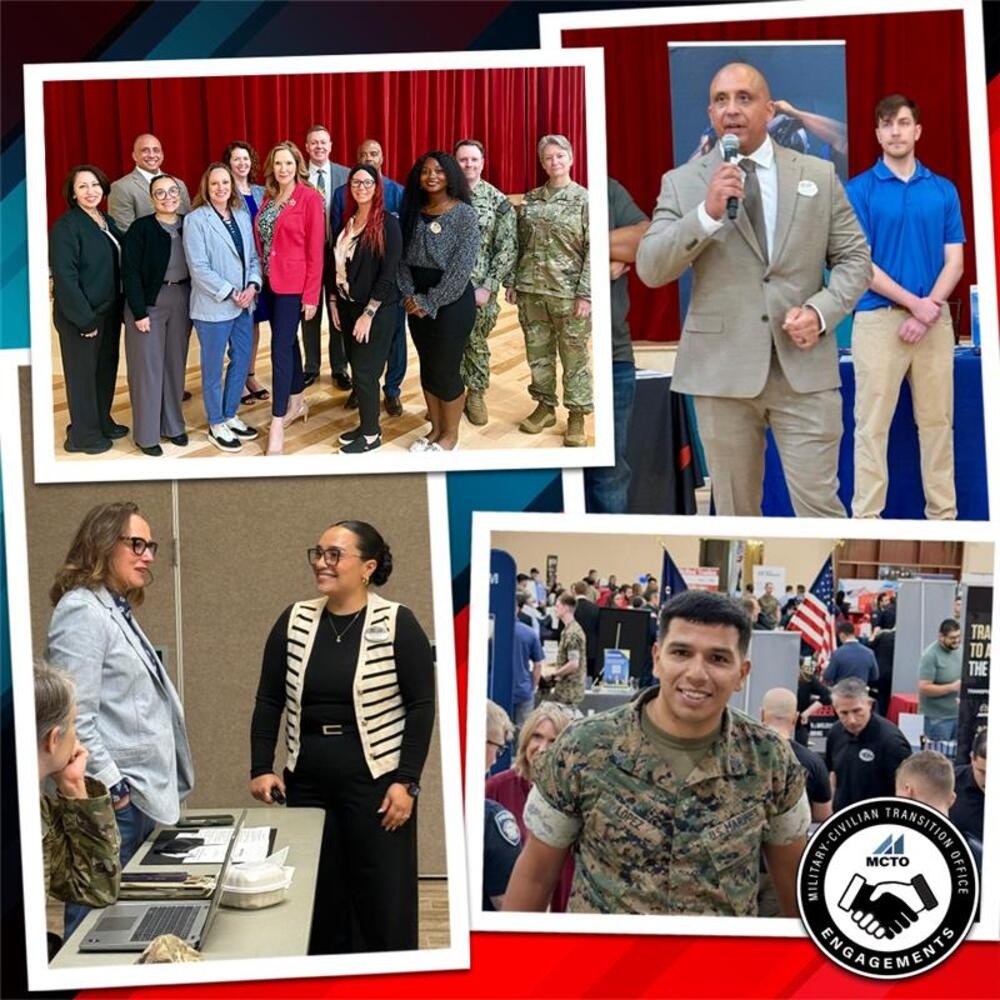
Photo By Anthony Small | When the Camp Pendleton Transition Assistance Program (TAP) instructor asked how many...... read more read more
 Subscribe
When the Camp Pendleton Transition Assistance Program (TAP) instructor asked how many service members wanted to pursue SkillBridge, a noticeable number of hands went up. What followed was not uncertainty about the program itself, but a thoughtful discussion about fit, timing and individual goals.
From the back of the classroom, Dr. Liz Clark watched what came next. The discussion showed that service members were familiar with SkillBridge and understood what the program offered. Some said there were few options in the cities where they planned to live. Others said they already had specific jobs or career paths they wanted to pursue. Rather than revealing a lack of interest, the exchange reflected a more informed reality: service members were weighing their military-civilian transition against their own timelines, locations and post-military goals.
For Clark, Department of War (DoW) Transition Executive Committee (TEC) Co-Chair and director of the Defense Support Services Center, that was exactly why she came. TAP and SkillBridge sit within the broader transition portfolio Clark oversees through the Military-Civilian Transition Office. “It’s important that I see TAP; see how policy is received in practice, identify strengths and gaps, and have candid conversations about how to better support service members beyond service,” Clark said. She served 9.5 years in the Army and did not go through TAP herself, but observed the program offers a level of structure that is difficult to find anywhere else. “There is nowhere else that you are set up like this with actionable tasks for your success. You do not get this in college or high school….there are no other employers dedicating five days to losing you.” Clark noted.
The Camp Pendleton, California TAP visit was a joint TEC endeavor with Department of Labor Veterans Employment & Training Service (DOL VETS) and DOL TEC Co-Chair, Deputy Assistant Secretary, Jessie Jane Duff, a retired Marine Gunnery Sergeant. Clark and Duff observed and participated in TAP core courses of instruction to gain an in-person understanding of delivery and content to strengthen programmatic understanding at the customer level. The secondary purpose was to observe the DOL Employment Navigator Partnership Program (ENPP) operations and delivery as DoW and DOL expand ENPP in support of Administration and DoW prioritization of skilled jobs and Defenses Industrial Base employment.
At Camp Pendleton, that structure unfolded session by session. Over the course of the week observed, service members moved through transition not as an abstract requirement, but as a series of decisions about work, benefits, finances and identity after military service. While the sessions primarily served Marines, a small number of Navy sailors also participated.
Day 1: Consisted of the DoW Transition Day, which included modules on Managing Your Transition, the Military Occupational Code Crosswalk, and Financial Planning for Transition. This initial day was focused on the foundations of transition: preparing for civilian life, translating military experience into civilian terms and planning for the financial realities of leaving active duty. Service members were asked to look beyond employment alone and consider family adjustment, workplace culture, transition-related stress and long-term stability.
Those sessions also asked participants to assess how their military background aligns with civilian goals. Through the Military Occupational Code Crosswalk and related exercises, service members documented their experience, translated their skills and identified gaps in training, credentials or experience that could affect their next steps.
One of the people helping translate that policy into practice was Edwardo Espinal, Camp Pendleton’s TAP manager. As Clark observed the sessions, Espinal helped provide on-the-ground context for what service members were experiencing in the classroom and why those details matter at the installation level. A Marine who served 28 years and transitioned out of Camp Pendleton in 2020, Espinal now works in the same transition space he once navigated himself. “Never feel like you have to do the same job as you did in service. The leadership and soft skills that you develop in service are very valuable in the civilian world” Espinal said.
His own final months in uniform came during COVID, when civilian hiring felt uncertain and in-person opportunities were limited. That experience shaped how he now supports others and the framework the DoW and DOL leaders were there to see: how policy, instruction and timing come together in the lived reality of transition. Espinal said leadership visits matter because they allow senior officials to see how transition support is received, not just how it is designed. That broader view is part of what makes TAP different. Rather than treating transition as a single briefing or final administrative step, the program brings together guidance on employment, benefits, financial readiness and next steps as a multi-agency effort.
Day 2: The Department of Veterans Affairs (VA) Benefits and Services Day focused on how to register, apply for VA health care and navigate the benefits process. The session drew strong engagement, with service members asking detailed questions about service-connected conditions and how eligibility and claims work in practice.
Rather than leaving those concerns at a high level, the instructor walked participants through the process step by step. Service members were shown how to apply for VA health care and better understand the actions they need to take as they prepare to leave service. The discussion made clear that transition is not only about finding a job. It is also about understanding benefits, meeting deadlines and making informed decisions before service ends about VA health care.
Day 3: The DOL One-Day, also known as the Employment Fundamentals of Career Transition, shifted the tone in the room again. The classroom became more active, more conversational and more immediate. The instructor connected quickly with the audience, using humor and familiarity to keep the room engaged. Then they did something simple that made the challenge of transition visible: they turned the classroom into a networking event.
Service members stood up, moved around the room, shook hands and introduced themselves. But there was a catch. They had to explain what they did in civilian terms and describe what they wanted to do next.
The exercise was part introduction, part translation drill, and part reality check. It forced participants to practice one of the hardest parts of transition: turning military experience into language a civilian employer can understand.
That practical focus resonated with people in the room and helped show Clark and Duff what effective TAP instruction resonates like when it connects. Sgt. Dominique Lopez, an intelligence Marine at Camp Pendleton who has served eight years in the Marine Corps, said he initially approached the employment track thinking he already had a resume and just needed to get through the week. That changed once he compared his materials to stronger civilian examples and rebuilt them with the instructor’s guidance.
“They don’t skip a step. They go through every little thing in the book,” Lopez said. “I built my LinkedIn the way they told me to, used the tools they asked us to use, and held on to the handbook because it was that useful. I’ve only been out of TAP for a week, and I already had five interviews.” For Lopez, the impact went beyond resumes and profiles. It changed how he saw his own value in the civilian job market — exactly the kind of real-time outcome leadership came to observe.
“When I got on LinkedIn and saw companies and talent managers looking at my profile, it made me feel good inside,” he said. “I was like, ‘Maybe I’m worth more.’” His advice to fellow service members is to take the week seriously and use it fully. “Take advantage of that time…they give you,” Lopez said. “Learn how to translate who you are and re-value yourself. The military is the golden part of you. Don’t take whatever job just because it’s fast.”
Day 4: Camp Pendleton hosted a Career Fair/Hring Event where over 60 employers met with over 400 Marines to discuss career opportunities. Clark and Duff were able to observe and interact with Department of Homeland Security Customs & Border Protection recruiters, who are active at the main TAP location throughout the site visit, while also walking through and engaging with a diverse set of employers and service members alike on their final day.
Chief Master Sgt. Ashley Damm, senior enlisted advisor to Clark, said that practical emphasis reflects how much TAP and transition support at the installation level has changed over time. Damm, who served 26 years in the Air Force and is retiring in July 2026, has observed TAP in Army, Air Force, and Marine Corps settings. She said one of the clearest lessons from those visits is that TAP works best when it can adapt to the culture and needs of each service, while still giving service members a common foundation for what comes next.
“A lot of people see it as, ‘I have to go,’ but once they’ve gone through it, they see the value of it,” Damm said. “It’s teaching you the first steps to being a civilian.” Damm said TAP today is far more developed than when she first went through as a staff sergeant after separating from active duty in 2010. What once felt more limited has evolved into a more comprehensive effort that offers stronger feedback, better guidance, and a more realistic look at what service members need to do to succeed after leaving the military.
For Espinal, that evolution is part of what makes the work meaningful. “The great part about being in the transition space is that the program never sits stagnant,” he said. “It is always moving forward. We are always trying to grow and provide better for service members.”
By the time the week closed one thing was clear: TAP was not simply a series of briefings. At its best, it was a pause before a major life change — one that gave service members time to assess where they stand, what they still need and how to begin seeing themselves not only as who they have been in service, but as who they can become beyond it.
| Date Taken: | 04.02.2026 |
| Date Posted: | 04.02.2026 15:04 |
| Story ID: | 561853 |
| Location: | ALEXANDRIA, VIRGINIA, US |
| Web Views: | 2,296 |
| Downloads: | 0 |

This work, TAP’s Multi-Agency Approach Supports Service Members in Transition, by Anthony Small, identified by DVIDS, must comply with the restrictions shown on https://www.dvidshub.net/about/copyright.

No keywords found.




