
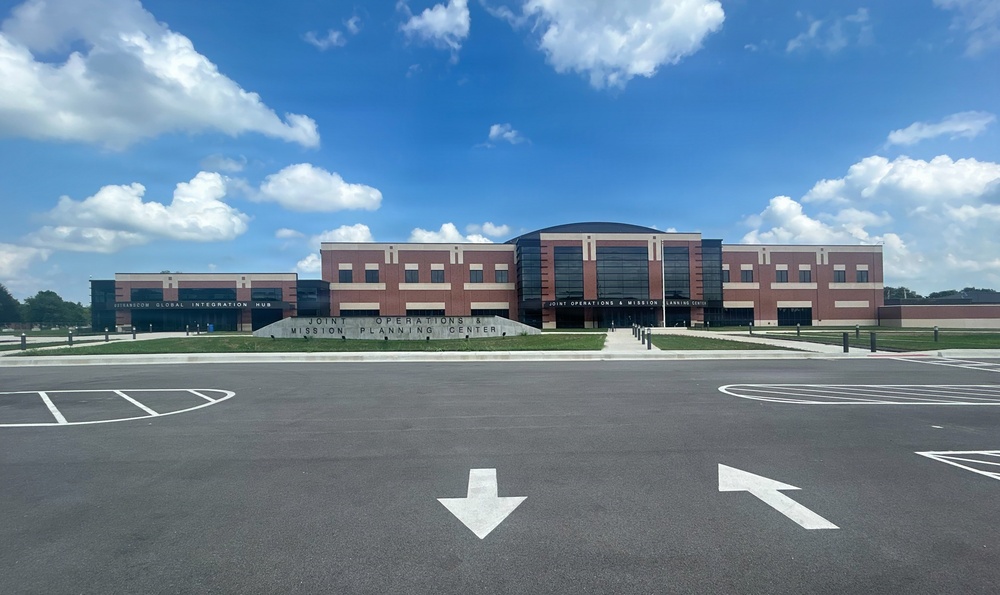
Courtesy Photo | The U.S. Army Corps of Engineers Louisville District completed construction and turned...... read more read more
SCOTT AIR FORCE BASE, Ill. — The U.S. Army Corps of Engineers Louisville District completed construction and turned over the newly built Joint Operations and Mission Planning Center to mission partners at Scott Air Force Base, March 9, 2026. The $111.3 million, 171,804-square-foot facility will be used to plan and execute strategic operations for the Air Force Rapid Global Mobility mission.
The two-story building houses occupants from the Air Mobility Command, U.S. Transportation Command, the 618th Air Operations Center and the Air Intelligence Squadron. Coordinating the construction involved five different organizations, which also included USACE and the Air Force Civil Engineer Center.
To ensure that the district operational needs were met, the USACE team prioritized continuous coordination.
“To bridge the gap between design intent and construction reality, the team implemented several structured communication channels,” said Brad Epplin, USACE Scott AFB resident engineer. “Weekly customer meetings ensured design details continued to reflect mission requirements as construction progressed. Representatives from each stakeholder organization provided a strategic forum for discussing emerging issues, aligning priorities, and conducting regular ‘vector checks’ to keep the project on track.”
The project required flexibility to accommodate shifting military priorities. When construction reached the 60% completion mark, updated operational requirements prompted a reassessment of the facility's interior architecture and technical infrastructure.
“Because this change occurred after construction activities were already underway, it created a significant challenge related to design adjustments, construction sequencing, and certification requirements,” said Nolan Robben, USACE project engineer and contracting officer's representative. “Rather than allowing the issue to delay progress, the USACE team, contractor, end users, and security personnel worked collaboratively to reassess the design and determine the modifications needed to meet the updated security standards.”
Following these assessments, the team integrated additional security measures into the ongoing construction schedule.
“Although the changes required careful coordination and some rework, the strong partnership among all stakeholders allowed the team to address the issue,” Robben added. “The result was a fully compliant, secure facility that meets the updated mission requirements, demonstrating how collaboration and trust between USACE and the contractor transformed a potentially significant obstacle into a successful outcome.”
Throughout the design modifications, routine preparatory, initial and final inspections were supplemented by enhanced oversight measures, including above-ceiling inspections, third-party testing and evaluations.
“One of the things we are most proud of isn’t a single visible feature, but the collective attention to detail that went into constructing a facility capable of supporting the warfighter’s mission,” said Epplin. “Much of the work that enables that mission—secure spaces, communications infrastructure, and the integration of complex building systems—will never be seen by the public, but it is essential to how the building operates.”
The execution of the multi-year build relied on personnel managing daily operations on the ground.
“The field team—led by former Project Engineers Jesse White and Nolan Robben, along with Lead Construction Representative Adrian Roth and Engineering Technician Kevin Winterfield—played a pivotal role in maintaining momentum throughout the project,” said Sean Hoben, USACE project manager for Air Force and DLS Support Section.
When asked to describe the relationship between the project team and the contractor over the duration of the build, project team chose one word: Resilient.
“This project required the team to navigate numerous technical challenges, evolving mission requirements, and significant design modifications during construction,” Epplin said. “Throughout those changes, the contractor and project team consistently worked together to identify solutions, adapt to new requirements, and maintain forward momentum.”
The construction phase concluded with the turnover of the facility to the joint forces.
“Standing on site at that milestone and seeing the finished facility—knowing the challenges the team had worked through together—was an incredibly satisfying moment,” Robben added. “More importantly, it represented the successful delivery of a building designed and constructed to carry out its mission and support the warfighters who will rely on it every day.”
“The term ‘joint’ cannot be overemphasized enough,” said Hoben. This was truly a joint collaboration between six agencies to produce a Joint Operations and Mission Planning Center.”
| Date Taken: | 04.01.2026 |
| Date Posted: | 04.01.2026 16:01 |
| Story ID: | 561769 |
| Location: | SCOTT AIR FORCE BASE, ILLINOIS, US |
| Web Views: | 56 |
| Downloads: | 0 |

This work, One mission. One Team. One build., by Charles Delano, identified by DVIDS, must comply with the restrictions shown on https://www.dvidshub.net/about/copyright.

No keywords found.





