
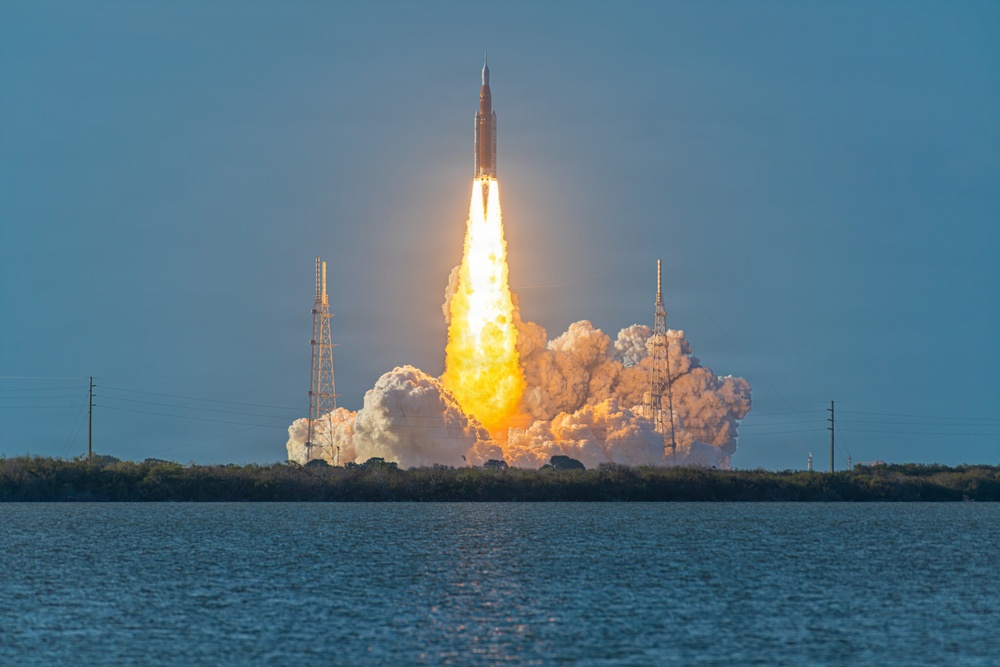
Photo By Gwendolyn Kurzen | A NASA SLS rocket launches the Artemis II mission from Space Launch Complex 39B at...... read more read more
 Subscribe
PATRICK SPACE FORCE BASE, Fla. – At 6:35 p.m. local time, April 1, 2026, NASA’s Artemis II mission successfully launched from the Eastern Range with four astronauts bound for lunar orbit. This historic moment would not have been possible without the dedication and commitment of Space Launch Delta 45 personnel.
There are many steps that go into ensuring a safe and successful launch. From oversight of range operations to planning potential emergency response, members of SLD 45 aim to guarantee all launches from the Eastern Range keep the launch vehicle, range personnel, and local community safe.
The mission starts before the launch countdown begins. Members of the SLD 45 team are responsible for analyzing specific payloads, launch vehicles, and their proposed trajectories in order to compute hazard zones. These zones span land, sea, and air and are a crucial part in ensuring no person or vehicle is operating within a specified distance of the pad.
“Each hazardous area reflects hours of trajectory analysis, debris analysis, and coordination across multiple agencies,” said Emma Cusano, SLD 45 flight safety analyst and aerospace engineer. “When it comes to launch, safety is our number one priority, regardless of whether it is crewed or not.”
Prior to launch, the SLD 45 Office of Emergency Management coordinates with state and local leaders in developing plans in the event of an anomaly. Taking the hazard zones into account, the office proactively makes decisions as to where roadblocks should be placed, how traffic will flow, and where emergency response vehicles will be staged in case of necessary response.
“We are committed to doing everything we can in the planning phase to ensure we are ready to execute our emergency response plans,” said U.S. Air Force MSgt Robert Ridgway, SLD 45 Installation Emergency Manager. “Having effective plans in place is necessary for both ensuring the safety of the local community and the astronauts in the capsule.”
The Office of Emergency Management oversees and activates the Launch Emergency Operations Center. The LEOC’s primary function is to survey and respond to any and all potential dangers a launch could pose to Cape Canaveral Space Force Station. Due to the inherently volatile nature of spaceflight, the LEOC remains staffed during launch to act as a node for disseminating emergency information and direction.
To safely get the launch vehicle from the pad to orbit, the 1st Range Operations Squadron and 45th Weather Squadron are key players in each mission. The 1st Range Operations Squadron is responsible for performing real-time command and control of the Eastern Range. The team continuously analyzes telemetry data, weather, and countless other factors to make an informed decision as to whether a launch is safe to go.
The 45th Weather Squadron supplements 1ROPS in its uninterrupted investigation of current and future conditions. Weather plays a crucial role in safety and launch success as inclement conditions can damage rockets and payloads. Such examination of weather helps to advise SLD 45 personnel on console.
“Access to space would not be possible without the contributions of SLD 45 and its oversight of the Eastern Range,” said U.S. Space Force Col. Joyce Bulson, SLD 45 Deputy Commander for Operations. “These contributions enabled more than 100 launches in 2025, and we aim to only increase the pace.”
South of CCSFS, the 45th Logistics Readiness Squadron postures airfield support to facilitate the U.S. Air Force Detachment 3’s Human Space Flight Recovery Team, which plays the role of overseeing rescue forces at Patrick Space Force Base.
“I am extremely proud of the members of SLD 45 and their continued determination in executing the mission. These professionals train day in and day out to guarantee space access,” said U.S. Space Force Col. Brian Chatman, SLD 45 commander. “They are the driving force to maintaining U.S. presence and superiority in the space domain.”
Outside the already mentioned pieces that support launch, SLD 45 consists of many more teams and organizations that make space launch from the Eastern Range possible. As the pace of launch and mass to orbit increases, SLD 45 personnel remain committed to the safety and facilitation of mission success.
| Date Taken: | 04.01.2026 |
| Date Posted: | 04.01.2026 19:17 |
| Story ID: | 561752 |
| Location: | CAPE CANAVERAL, FLORIDA, US |
| Web Views: | 357 |
| Downloads: | 0 |

This work, Artemis II Soars: Space Launch Delta 45 Supports Historic Mission, by 2nd Lt. Christian Malaniak, identified by DVIDS, must comply with the restrictions shown on https://www.dvidshub.net/about/copyright.


No keywords found.




