
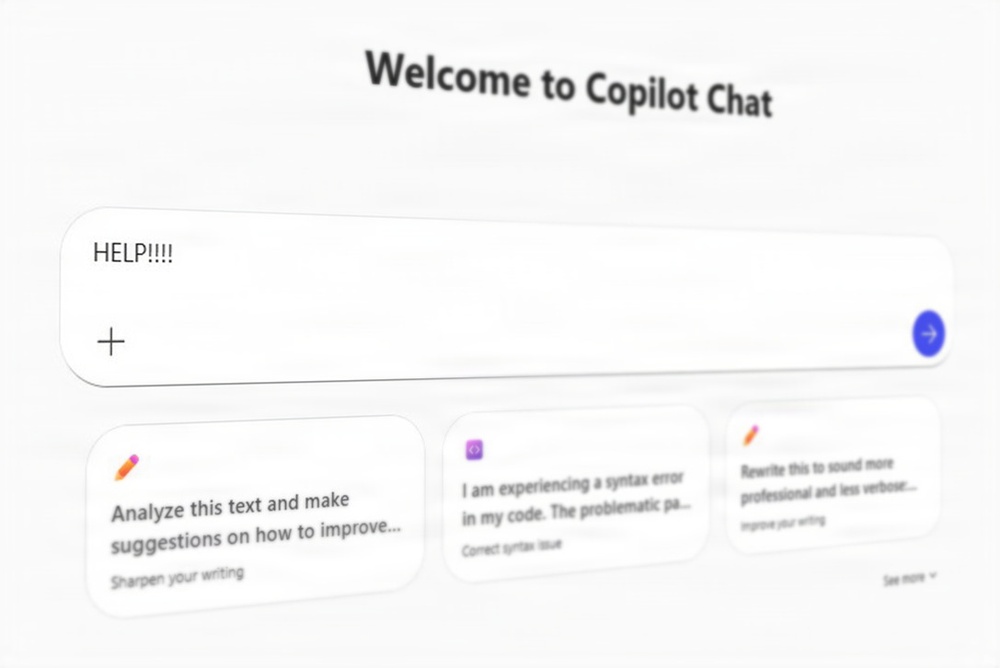
Photo By Patrick Hodges | Microsoft Copilot Chat user interface photo illustration.... read more read more
Every day across the Department of War, government employees and service members find themselves buried under piles of administrative tasks. The number of emails we sift through and send, and the endless demand to distill information into executive summaries and PowerPoint slides, can be a bit overwhelming.
While administrative work is mostly necessary, it often chips away at the one resource we can never get back – time. Nobody would argue that time would be much better spent focusing on the complex, mission-critical duties. This loss of time can sometimes be compounded by an ever-dwindling supply of manpower and resources.
As a Department of the Army civilian, I was lucky enough to be included in the Army’s recent Microsoft Copilot Chat pilot. After a couple of weeks utilizing it for daily tasks, combined with my ongoing use of GenAI, I can say without a doubt that artificial intelligence is value added.
I’m not the type of guy who is quick to adopt an easy path and am often not an early adopter of emerging technological trends, but I am a practical person. AI in general can be a polarizing topic, with some being excited about the productivity boost while others worry about its impact on careers, and others completely refuse to use it as a kind of protest.
If we’re being honest here, we all know AI tools are not going away; it will only continue to evolve and become a more integral part of our daily lives. Like it or not, that ship has sailed.
As with any major technological advance, AI is likely to cause at least some disruption to the status quo.
The primary worry seems to be a concern that it will make some jobs obsolete. It’s understandable, really, and I certainly don’t want to discount those who are worried because this is already happening in some career fields. But again, remember there is no stopping this train. Now that these tools are out in the wild, businesses and government must find ways to utilize them to save money and find efficiencies.
From their standpoint alone, it’s hard to argue against the use of AI.
Then there is also the fear that AI will pose an existential threat to humanity. We’ve all been conditioned by plenty of dystopian Hollywood films that preview the potential consequences of AI for mankind to know where this fear comes from.
Though I wasn’t a member of the workforce at the time, I can imagine when the modern computer was introduced into the office environment in the 1980s, a similar skepticism was expressed.
But is anyone still using a typewriter for work? Is anyone still using snail mail and faxes as their primary means of communication? Do you fear PCs or email that are so ubiquitous today?
Most folks would say no to these questions, but there was a time when people did fear such things. Throughout time, humans have continuously adapted to innovation, and we will continue to do so in the AI age. I say that as a man whose profession could be a likely target of said technology.
Having used GenAI and Copilot Chat firsthand, I don’t see it as a replacement, but as the most powerful productivity tools we’ve been handed in my lifetime – a tireless digital teammate. And I don’t know about everyone else, but I can use all the help I can get.
Probably the best feature of Copilot, in particular, lies in its seamless integration into the Microsoft 365 ecosystem we all use. Notably, the information you feed into it remains contained within your personal account, not floating out in the ether somewhere.
Copilot Chat helps easily refine everyday information and data. Instead of spending hours digging through long email threads, policy documents or sprawling Teams chats, I can ask Copilot for a summary or key points. It can also turn rough notes and data into structured products like Excel spreadsheets, timelines and talking points.
Ultimately, all this helps save me time so I can focus on the substance and tone of such products. When I need to draft a memo, info paper or leader update, Copilot gives me a clean starting point, which I can then polish into a final product.
I can use Copilot Chat to outline communication plans, build checklists, draft meeting agendas or summarize meeting outcomes into tasks and suspense dates. It even helps generate ideas or scenario‑based Q&A when preparing for communication challenges. Oftentimes in public relations, immediacy is the name of the game. There simply isn’t time to spend hours drafting bespoke products when we’re in the middle of a crisis. Quickly merging existing templates with available information about the situation at hand, then spending just minutes to polish and review a product for accuracy becomes much more reasonable.
Beyond just efficiency, I’ve found that AI can serve as an excellent springboard for ideas. By using it to brainstorm approaches to a given problem, it often presents information or a perspective I hadn't previously considered, forging new paths. Do I always agree with its responses? No, but I don’t always agree with my human counterparts, either.
Another huge assist is when it comes to sifting through an endless sea of Department of War, Army regulations and U.S. laws that apply to our actions daily. It is virtually impossible for any single person to have all of that memorized, especially when a situation requires knowledge from a domain outside the normal scope of our duties.
It’s a good idea to double-check the actual source material that AI cites, however. It doesn’t happen often, but I have seen a handful of instances where it names the wrong regulation, law or policy. Sometimes it completely makes stuff up. Again, a human touch is still needed to verify the information, but most of the time, it quickly gets you where you want to go.
These AI tools, while helpful, don't provide a 100% solution, at least not yet. I like to think of the products AI generates as a well-structured first draft. It's on the user to fact-check the resulting product; refine its language to match the intended tone; and most importantly, inject their own experience, knowledge and strategic judgment.
AI is great at quickly assembling information, but it can't provide the wisdom that comes from years of service or replace personal relationships. It can’t accurately replicate human emotion and intuition. It can’t conduct sensitive interviews, build trust with community leaders, or execute a news conference during a crisis.
What it can do is virtually eliminate the repetitive, low-value tasks that get in the way of performing the more important aspects of one’s profession.
Embracing these tools allows you to offload more tedious tasks and amplify your own talent. This technology can’t tell us what to do; that decision remains ours. Either we choose to learn and effectively use it, or we get left behind.
Secretary of War Pete Hegseth said it best in a recent memo to the workforce regarding AI, “AI should be in your battle rhythm every single day. It should be your teammate. By mastering this tool, we will outpace our adversaries. The power is now in your hands.”
| Date Taken: | 04.01.2026 |
| Date Posted: | 04.01.2026 12:51 |
| Story ID: | 561748 |
| Location: | US |
| Web Views: | 24 |
| Downloads: | 0 |

This work, Opinion: How AI augments, not replaces the Army professional, by Patrick Hodges, identified by DVIDS, must comply with the restrictions shown on https://www.dvidshub.net/about/copyright.

No keywords found.





