
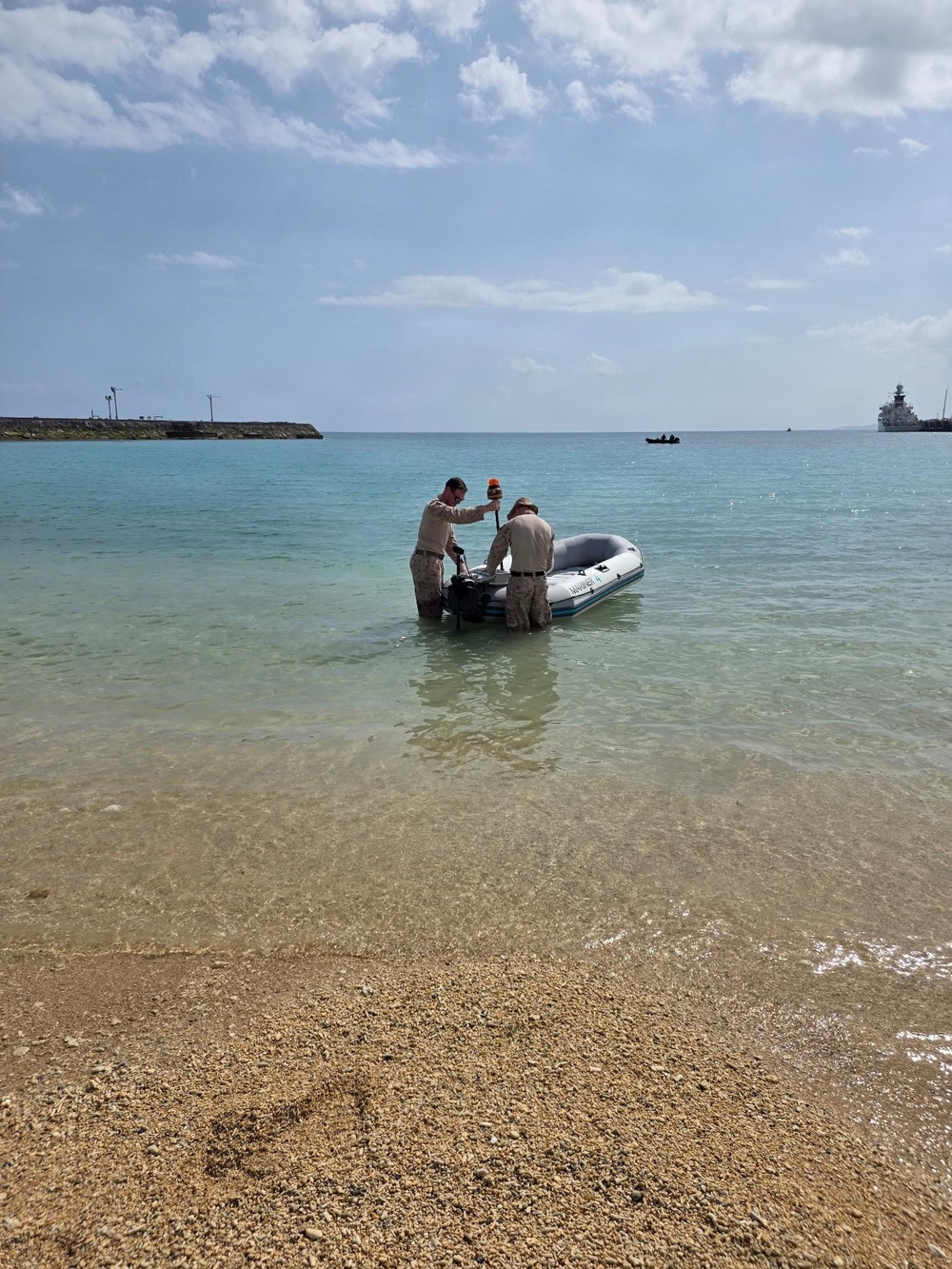
Photo By Cpl. Justin Cledera | U.S. Marines with Expeditionary Operations Training Group, III Marine Expeditionary...... read more read more
 Subscribe
CAMP HANSEN, Okinawa, Japan – In a groundbreaking display of innovation, U.S. Marines from the III Expeditionary Operations Training Group and operators from Naval Special Warfare have executed the Marine Corps’ first live-fire drone strike against a maritime surface vessel from a Naval Special Warfare surface craft. The target? An unmanned surface vessel (USV) also designed and built by III EOTG. The event was a landmark in the increasingly close integration of Special Operations Forces and conventional forces, ushering in a new era where drones, and even their targets, are designed and built by the Marines.
This milestone was more than a successful test; it was a powerful demonstration of a force multiplier on a new scale. The Marines also demonstrated the ability to launch attack drones from their self-built USVs. This event showcases a rapidly growing robotics capability within the Marine Corps, poised to significantly increase sensing and firepower in defense of the fleet.
The driving force for this evolution is III EOTG’s mission to empower individual Marines and prepare them for the challenges of modern expeditionary warfare. Major Brant Wayson, the Unmanned Systems Branch officer-in-charge said, “By training Marines in the construction and operation of these systems, III EOTG is building an arsenal of innovators ready to fabricate and deploy unmanned aerial, surface, and ground systems tailored to specific battlefield needs.”
“The threat from III MEF to our adversaries can change from one day to the next,” Wayson continued. “It is innovative, flexible, and rapidly adaptable. We can create leave-behind sensors, build mesh networks, or develop unique systems across sea, air, or land to deliver payloads.”
The branch’s current focus is twofold: perfecting lethal payload delivery and developing robust counter-unmanned systems.These Marines are not just operators; they are being trained as engineers, prepared to build their own unmanned systems from local economies during conflict, including the design and construction of payloads with mechanical and electronic safety devices.
The impact on modern expeditionary operations is profound. Unmanned systems allow a small team of Marines to densely seed an environment with sensors and communication nodes, making it incredibly difficult for an enemy to target them. They can move supplies silently and autonomously, enabling persistence in contested areas and challenging littoral terrain. They can saturate the environment with lethal threats.
Overall, this event demonstrates how III MEF Marines are learning, innovating, and adapting, drawing from ongoing conflicts to secure key maritime terrain. Using a combination of USVs and aerial drones, Marines can now investigate vessels of interest and, if they are confirmed as hostile, engage them with organic, unmanned firepower.
As Major Wayson puts it, this capability "arms a platoon’s worth of Marines with the organic capability to deny a Brigade-sized element from conducting an amphibious assault." It’s a testament to the ingenuity of the individual Marine and a clear signal that the future of expeditionary warfare is here.
| Date Taken: | 03.31.2026 |
| Date Posted: | 04.01.2026 01:36 |
| Story ID: | 561707 |
| Location: | OKINAWA, JP |
| Web Views: | 364 |
| Downloads: | 0 |

This work, From Workshop to Waterway: Marine Innovation Redefines Naval Strike, by 1LT Tyler Thomas, identified by DVIDS, must comply with the restrictions shown on https://www.dvidshub.net/about/copyright.

No keywords found.




