
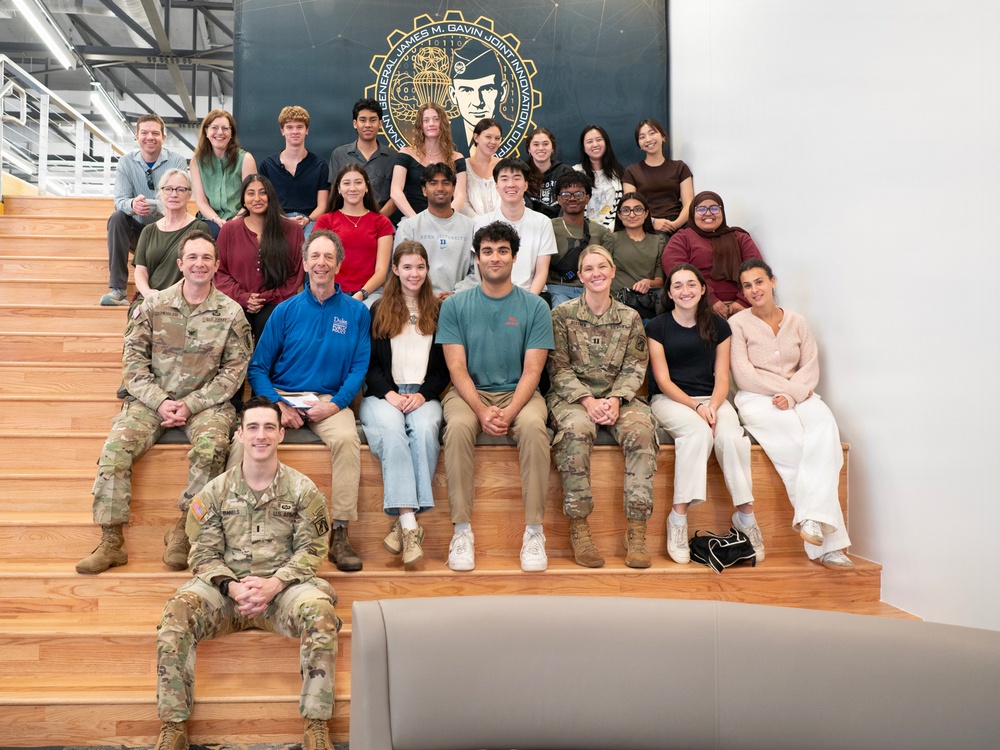
Photo By Sgt. 1st Class Samuel Northrup | FORT BRAGG, N.C. — Students and faculty from Duke University’s "Peace and War: the...... read more read more
 Subscribe
FORT BRAGG, N.C. — Duke University students and faculty stepped inside Fort Bragg’s newest innovation hub March 27, 2026, trading the classroom for a firsthand encounter to better understand military service and the Army’s transformation initiative.
The daylong immersion brought Duke’s "Peace and War: the 21st Century" course to the Lt. Gen. James M. Gavin Joint Innovation Outpost at Fort Bragg, North Carolina. The JIOP is the Army’s proving ground for rapid problem-solving, the bridge that connects tactical challenges with collaborative solutions developed alongside industry and academic partners.
Jennifer Siegel, the Bruce R. Kuniholm Distinguished Chair of History and Policy in Duke's Sanford School of Public Policy, described the visit as a critical capstone for the program.
"All of the students here are part of our first-year constellation series of courses on Peace or War," Siegel said. "The students are taking one of those courses each semester on themes that are related to national security issues, peace or diplomacy – all from different perspectives."
After a year spent examining why nations choose war or peace through competing academic lenses, Siegel said the visit gave students something no classroom can replicate: direct contact with the people executing those missions.
"We were really excited to come to Fort Bragg for our big capstone co-curricular activity for the year in order to give the students the opportunity to see what it looks like on the ground," Siegel said. "We’ve been grappling with the questions in our various classes about conflict, turbulence, diplomacy and the experience of war. Having the opportunity to actually engage with [Soldiers] who are doing this and to see how it takes place is a real privilege for us."
Prerana Kodakondla, a first-year Duke student studying public policy and economics, said the JIOP's mission reframed their understanding of how the Army adapts to emerging threats and how quickly that adaptation unfolds.
"We spend a lot of time in class engaging with abstract concepts on peace or war," Kodakondla said. "These topics are evolving and changing, and we rarely hear about these detailed experiences from those who experience it firsthand. There is the Ukraine-Russia example we studied in class, but it's interesting to see how that adaptation is happening in real life."
Kodakondla added that the visit helped close the understanding gap between civilian and military worlds, a divide she said is more pronounced among younger Americans. The Duke program has already steered her toward a career in foreign policy and national security.
For the Soldiers and civilians staffing the JIOP, engaging the next generation of policymakers and scholars is an investment the military cannot afford to skip.
"We need to leverage our academic partnerships," said Maj. Matthew Millsaps, the JIOP's operations officer. "It is vital to educate students on how the military works alongside the civilian population and the capabilities the JIOP brings to the innovation enterprise. We are also showing the students that Soldiers are regular people, living typical lives on installations that are similar to cities in how they provide much of what a person needs."
1st Lt. Benjamin Daniels, the JIOP's deputy innovations officer, echoed that sentiment, stressing that most Americans never see the vast support apparatus that operates behind the installation's gates.
"It takes a massive synergy of civilian and military manpower to ensure our military functions properly," Daniels said. "It isn’t just about 'green suiters' or combat; it’s the entire support system behind them that makes this the greatest Army in the world."
| Date Taken: | 03.31.2026 |
| Date Posted: | 03.31.2026 14:50 |
| Story ID: | 561676 |
| Location: | FORT BRAGG, NORTH CAROLINA, US |
| Web Views: | 74 |
| Downloads: | 0 |

This work, Fort Bragg’s tech innovation foundry hosts Duke University, must comply with the restrictions shown on https://www.dvidshub.net/about/copyright.


No keywords found.




