
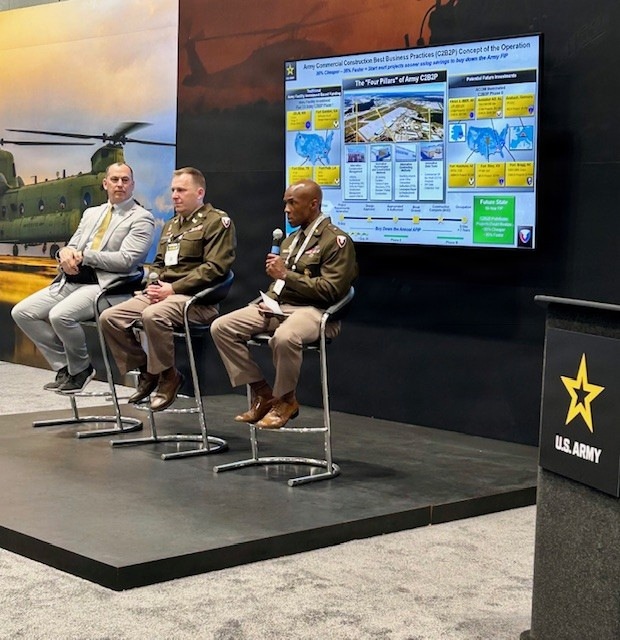
Photo By Tish Williamson | Brig. Gen. Freddy Adams (right), commanding general of the Mission and Installation...... read more read more
HUNTSVILLE, Ala. — Leaders from the Mission and Installation Contracting Command engaged with Army and industry partners during the https://meetings.ausa.org/globalforce/2026/index.cfm, reinforcing the command’s role in advancing contracting solutions that accelerate Army readiness.
Brig. Gen. Freddy Adams, MICC commanding general, attended the symposium March 24–26 alongside Deputy to the Commander Director Clay Cole and Command Sgt. Maj. JennyAnne Bright. The MICC is a subordinate command of the Army Contracting Command and the https://www.bing.com/search?q=Army+Materiel+Command&PC=U531&FORM=ANAB01, headquartered at Joint Base San Antonio-Fort Sam Houston, Texas. Hosted by the Association of the United States Army in Huntsville, the Annual AUSA symposium brought together senior leaders from across the Army enterprise to discuss modernization priorities, acquisition reform and the future of Army installations.
A key highlight for MICC was Adams’ participation in a Warrior’s Corner panel March 25, where he joined fellow panelists to discuss commercial construction best practices and ongoing Army contracting transformation efforts.
“We must leverage every available tool to deliver infrastructure at the speed of need,” Adams said. “That means adopting commercial practices and innovative contracting approaches that reduce timelines without sacrificing quality for our Warfighters.”
Adams touted the use of Other Transaction Authorities, or OTAs, as a critical enabler of that effort. He pointed to the Fort Polk Rotational Unit Bivouac Area, or RUBA project, a roughly $200 million OTA effort executed in just 29 days through collaboration between MICC, Army Materiel Command and installation stakeholders. Traditional contracting timelines for RUBAs and similar projects can range from 183 to 299 days.
“This represents a fundamental shift in how we deliver capability,” Adams said. “We are reducing procurement timelines by up to 90% while also achieving meaningful cost savings.”
Panel discussions also emphasized reducing unnecessary administrative burdens, increasing competition through larger, bundled project opportunities and leveraging architect-engineer firms for cradle-to-grave construction management to maintain a lean and agile workforce.
Additionally, Adams noted the Army’s efforts to reevaluate certain process requirements, such as Unified Facilities Criteria and Leadership in Energy and Environmental Design standards, when they do not align with mission needs or when they interfere with innovation.
“Emerging technologies, including 3D printing and modular construction, also enable faster, more cost-effective project delivery, allowing the Army to build facilities in months rather than years,” Adams said.
He also underscored the importance of early collaboration with industry partners during contracting operations, streamlining the proposal processes and clear technical requirements to accelerate outcomes, improve quality and ensure shared understanding.
In the spirit of improving shared understanding, industry partner and community leaders are invited to register for the 2026 MICC Advanced Planning Briefing for Industry, or APBI virtual engagement event planned May 18-22. The sixth annual event provides industry partners with early insight into the MICC’s mission, priorities, organization and projected acquisition requirements in support of Army Warfighters for the next several years. The five-day event is designed to improve transparency, encourage competition and strengthen communication between the Army and industry during the acquisition planning cycle.
In addition to the panel discussion, the MICC command team met with dozens of industry and military leaders throughout the three-day AUSA symposium.
“Overall, AUSA Global Force was a great opportunity to strengthen partnerships, share best practices and reinforce the MICC’s commitment to delivering innovative contracting solutions in support of the Army, AMC and ACC.”
About the MICC Headquartered at Joint Base San Antonio-Fort Sam Houston, Texas, the Mission and Installation Contracting Command comprises about 1,500 military and civilian members who are responsible for contracting goods and services in support of Soldiers as well as readying trained contracting units for the operating force and contingency environment when called upon. A subordinate command of the Army Contracting Command and the Army Materiel Command, MICC contracts are vital in feeding more than 200,000 Soldiers every day, providing many daily base operations support services at installations, facilitate training in the preparation of more than 100,000 conventional force members annually, training more than 500,000 students each year, and maintaining more than 14.4 million acres of land and 170,000 structures.
| Date Taken: | 03.31.2026 |
| Date Posted: | 03.31.2026 13:51 |
| Story ID: | 561660 |
| Location: | HUNTSVILLE, ALABAMA, US |
| Web Views: | 70 |
| Downloads: | 0 |

This work, MICC leaders highlight contracting transformation at AUSA Global Force Symposium, by Tish Williamson, identified by DVIDS, must comply with the restrictions shown on https://www.dvidshub.net/about/copyright.


No keywords found.





