
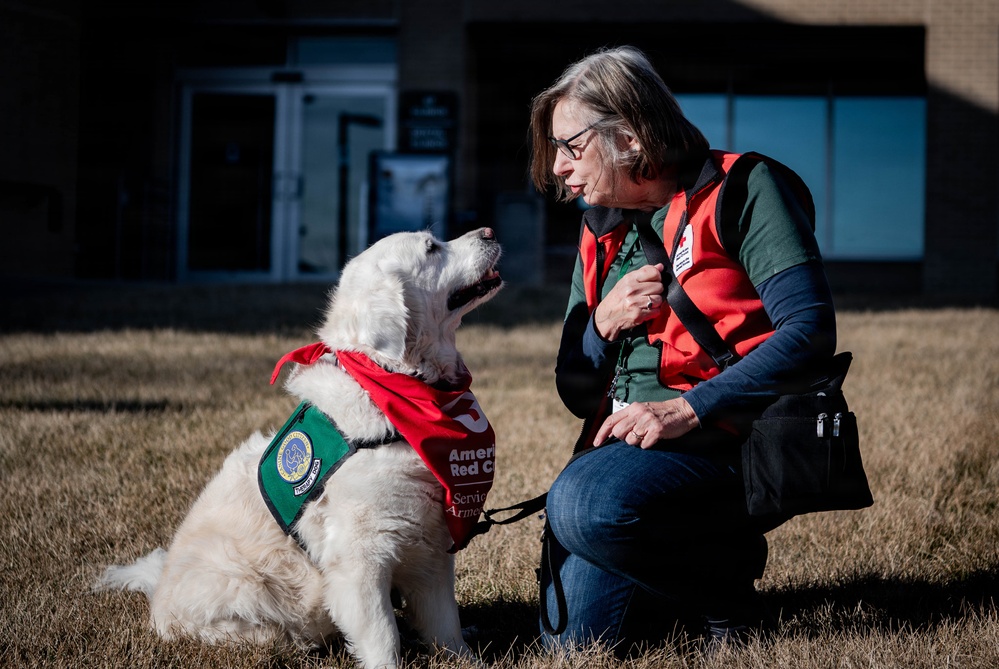
Photo By Daniel Martinez | Sharon Hall, American Red Cross volunteer and therapy dog handler, sits outside the...... read more read more
 Subscribe
Behind a big goofy smile, wet pink nose, and wagging tail, the soft patter of furry white paws gently treads through the halls of the Ehrling Bergquist Clinic in search of the next belly rub or head pat.
A medical facility may be the last place to expect such an encounter, but for a female, nine-and-a-half-year-old therapy dog such as Izy, it’s just another day to make new friends.
“Our purpose is just to brighten [everyone’s] day,” said Sharon Hall, American Red Cross volunteer, therapy dog handler and Izy’s owner. “I think there’s a noticeable difference when you have an animal with you. And so, when you have somebody who’s stressed out at work or is just having a bad day, it’s a little added brightness to that day.”
What started as a love for dogs – golden retrievers in particular – became a mission to provide comfort, support, and reprieve from the stress of being a patient needing medical attention. Hall and Izy visit numerous medical facilities to help those who could use some levity at often difficult times.
“I love dogs – I see the reaction that you get when you come in with a dog,” Hall said. “There’s a lot of benefit to animal therapy, including reducing blood pressure, some hormonal effects in the human as well as on the dog…a little relief from some of the stress that [patients] might be feeling, and it seems like it’s working because everybody looks forward to her visits.”
Izy’s tenure as a therapy dog began eight years ago, but her path toward achieving that status was full of challenges. Canine candidates are thoroughly evaluated on their personality, obedience, and demeanor.
During the evaluation process the dog must consistently walk by their owner’s side, must stay put when told, and be able to go with someone other than the owner who will step out of the room. This determines the dog’s reaction and whether it stays calm or becomes anxious. The dog also must remain patient with the noises they may hear and the people they could meet. Some of those people could be in wheelchairs or have medical equipment on them or could have a disability that may cause them to pet the dog harder than other people. While those scenarios and tasks might test any dog’s patience, Hall said there are a couple of particular things that prove the most difficult.
“One of the more difficult ones is getting the dog to not pick up anything. You walk your dog past either food or a toy, and they can look at it, but they’re not supposed to grab it or take it,” she said. “The other more difficult one is if you meet somebody with another dog. So, the idea is that you greet the other person and not have your dog go greet the other dog.”
Hall, an avid volunteer for more than 15 years, uses and trains her own dogs to provide these services, which she does in the spirit of helping others. Volunteering is not the only service she’s provided. She has also worked in the medical field with a background in clinical nursing, risk management, and education. Izy isn’t the first therapy dog Hall has volunteered either. When her first therapy dog got older and less mobile, she retired her and started Izy on the same path. While Izy has become a fixture at the Ehrling Bergquist Clinic, Hall has also visited the Veteran’s Affairs hospital, in addition to other medical facilities – not just in the Omaha area – but in other parts of the country where she previously resided.
“I moved here about four years ago from the Seattle area, and there I was affiliated with a group called Pet Partners,” Hall said. “Now I’m going through Healing Heart, a non-profit, that provides me with training and testing to make sure she is qualified and a good dog personality wise, temperament wise as well as listening wise to be a therapy dog. We get recertified every two years.”
Hall credits her ability to share Izy’s love through the support she receives from the Red Cross. The organization sets up visits and special events where her and Izy attend. She didn’t realize the in-depth support the Red Cross provides to veterans and military personnel and said the interactions are remarkable and the experience is very valuable.
On Offutt, many Airmen cross paths with Izy and seem happy to nuzzle her fluffy white coat.
“Therapy dogs are great. It’s awesome to see an animal that’s happy to see you and pet her,” said Staff Sgt. Lucas Park, 97th Intelligence Squadron airborne linguist. “She reminds me of our dog who passed away.”
Although she lacks direct military experience, Hall finds her family’s military service influences her support of Offutt personnel. Her dad served in the National Guard, and her husband, who was drafted during the Vietnam War, served in the Army. Offutt became one of the first bases she’s experienced. Hall is now looking toward the future on other ways to get involved and volunteer.
“They do have programs for therapy animals for disaster recovery. Large fires, like in California – they’ve provided therapy dogs for that,” Hall explained. “I think there’s a need for that.”
One example of her working in disaster relief was when she provided support after a fire burned through an apartment complex in a small town north of Omaha. “I drove up an evening where the Red Cross had set up for residents who had lost their home in a fire, an apartment fire,” she said. “That’s another aspect of therapy work support.”
She’s seen firsthand the positive impact animals have on people when they could use a little boost in their day. Hall remembers walking into a hospital with her previous therapy dog, Sydney. One situation at that hospital demonstrated the kind of instinct Hall’s therapy animal had when Sydney approached someone who was waiting to have a worrying medical procedure.
“I was at a hospital and my therapy dog stopped by this person who was on the phone. She stopped talking and said I’ve got to go, there’s a therapy dog here to see me. We chatted a little bit and Sydney was getting petted and everything and then it was time to go. She looked at Sydney and said, thank you, I needed that,” Hall said. “It was Sydney who initiated the stop at that person, not me. We weren’t yet on duty; we were just walking in.”
Providing therapy animal support enables Hall to make a difference in the military and local community.
"I would say that animals have a profound effect on humans, both mental health wise, emotional wise, as well as physical, they are a great source of companionship,” she said. “I love what I do."
| Date Taken: | 03.30.2026 |
| Date Posted: | 03.30.2026 16:17 |
| Story ID: | 561575 |
| Location: | NEBRASKA, US |
| Web Views: | 146 |
| Downloads: | 0 |

This work, The four-legged therapist on duty, by Daniel Martinez, identified by DVIDS, must comply with the restrictions shown on https://www.dvidshub.net/about/copyright.


No keywords found.




