
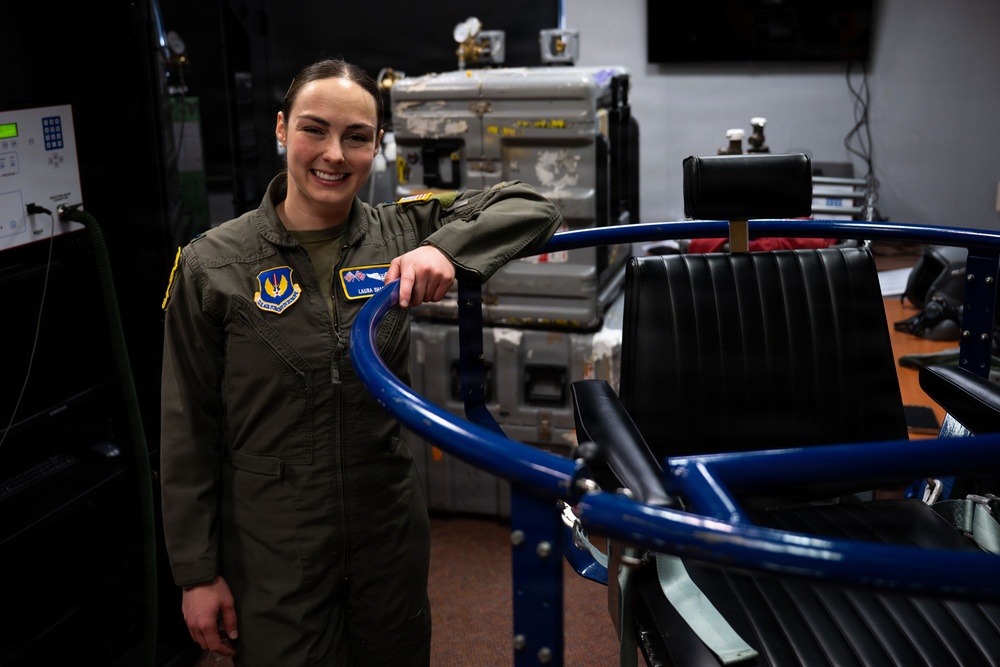
Photo By Airman 1st Class Iris Carpenter | U.S. Air Force 1st Lt. Laura Shafer, left, 100th Operational Support Squadron...... read more read more
 Subscribe
Airmen preparing for high altitude flights must be ready for more than the mission ahead. They must also understand how the human body reacts in an environment where oxygen levels drop and pressure changes rapidly.
That preparation starts with aerospace physiology training, now being offered at RAF Mildenhall.
“It’s been a journey these past six months, especially because this position has never existed here before,” said U.S. Air Force 1st Lt. Laura Shafer, 100th Operational Support Squadron aerospace physiologist.
Even though she’s at RAF Mildenhall now, many aircrew still reach out to RAF Lakenheath.
“A lot of people don’t know what aerospace physiology is, so explaining who I am and what the job is has been a big part of starting the program here,” Shafer said.
By establishing the aerospace physiology program, Shafer is helping ensure aircrew are prepared to recognize physiological threats, protect their health and remain ready to support the mission.
Over the past several months she has worked to introduce the program and educate aircrew about the role aerospace physiology plays in flight safety.
“The main job for an aerospace physiologist is to instruct aircrew on how their body works and how to optimize human performance to negate the negative effects of flight.” said Shafer.
Aerospace physiologists train aircrew on several physiological threats that can occur in flight, including hypoxia, spatial disorientation, fatigue and motion sickness. Hypoxia occurs when the body does not receive enough oxygen and is one of the most important topics covered during training.
“All aircrew, including physiologists, have to complete hypoxia training every five years,” Shafer said. “Everybody is susceptible to spatial disorientation. The mindset of, ‘it's not going to happen to me’, is the mindset we try to break.”
In addition to classroom instruction, Shafer works directly with aircrew members who experience motion sickness. Through exposure based training and coaching techniques, she helps them build tolerance and develop strategies to overcome symptoms that could otherwise affect their ability to perform their duties.
“There have been people who failed multiple check rides and were considering leaving their airframe,” Shafer said. “They walk in already in their head about their motion sickness and slightly don’t believe in themselves.”
Shafer builds confidence in aircrew by focusing on trust and relatability, asking herself, “How can I believe in them to make them believe in themselves?”
She helps them reframe their fear, reminding them that motion sickness is manageable. “The worst thing that can happen is you’re going to throw up. I’ve been there myself,” she said.
Through repeated exposure and guidance, those small victories begin to add up. “Being able to spin without throwing up was a big win,” Shafer said.
“To go back into your aircraft and pass your check ride is phenomenal,” she said.
For the 100th Air Refueling Wing, long duration tanker missions can also introduce risks outside of flying. “Fatigue is one of the biggest threats here,” Shafer said. “These flights are long, and aircrew can be flying for hours before even driving home,” Shafer said.
To help mitigate those challenges, Shafer teaches aircrew techniques that support overall health and performance during flight. “The holy trinity of health is diet, exercise and sleep,” Shafer said. “You cannot neglect one of them if you want to perform at your best.”
The training Shafer provides on the ground ensures aircrew are prepared for these potentially hazardous situations before, during and even after their missions.
| Date Taken: | 03.11.2026 |
| Date Posted: | 04.01.2026 05:45 |
| Story ID: | 561538 |
| Location: | MILDENHALL, GB |
| Web Views: | 121 |
| Downloads: | 3 |

This work, Aerospace physiologist at RAF Mildenhall, by A1C Iris Carpenter, identified by DVIDS, must comply with the restrictions shown on https://www.dvidshub.net/about/copyright.


No keywords found.




