
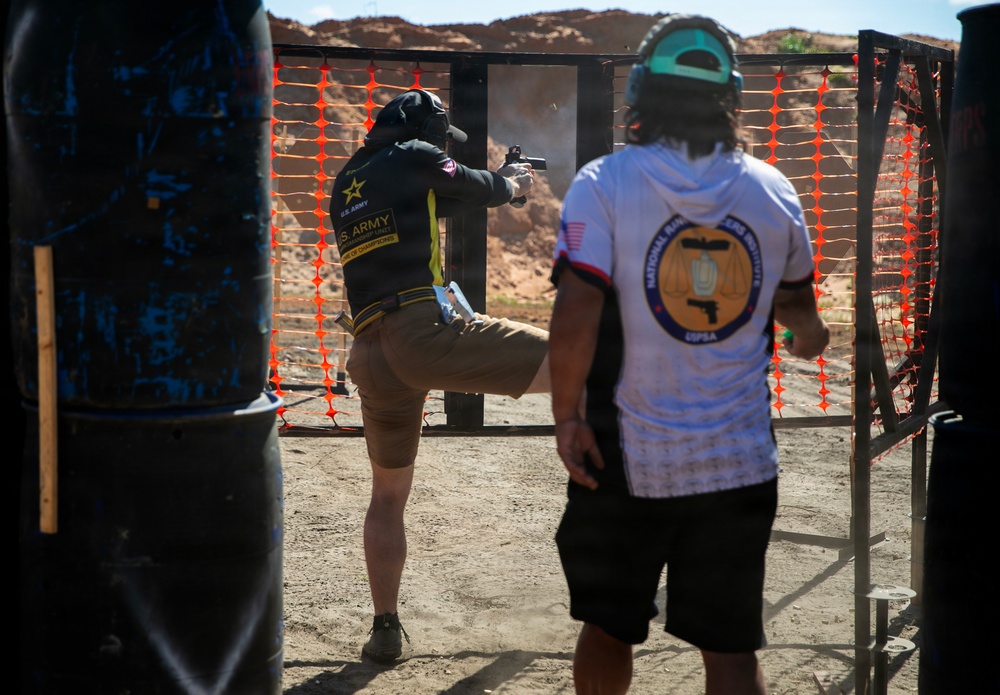
Photo By Lt. Col. Michelle Lunato | Sgt. Aaron Eddins, a competitive shooter and marksmanship instructor with the U.S....... read more read more
The U.S. Army Marksmanship Unit’s Action Shooting Team opened its competition season with several major wins — victories that directly support Army readiness.
The USAMU is widely recognized for its dominance in competitive shooting, but it is less known that these elite marksmen turn their success into training for the force. The Action Shooting Team regularly instructs some of the military’s most capable units. From special operations formations to joint partners across the Department of Defense, the team is frequently requested to teach skills that make personnel faster and more accurate.
At the U.S. Practical Shooting Association’s Aim for the Coast Championships, USAMU Soldiers won three divisions: Limited, Limited Optics and Carry Optics. The 10‑stage pistol match in Holt, Florida, challenged more than 200 competitors to engage multiple targets at varying distances, shoot around obstacles and perform magazine changes — all under intense time pressure. Some stages were completed in under 10 seconds.
Sgt. Aaron Eddins, who won the Limited Optics Division, said the timer does more than induce stress — it teaches performance under stress, which is essential for an instructor.
“We come home and break down each skill, piece by piece, so we can teach Soldiers the most efficient and accurate way of executing the task at hand under added stress,” he said.
Staff Sgt. Jacob Hetherington won the Carry Optics Division, and Pvt. 2nd Class Austin Hull won the Limited Division. Hull, who was recruited to the USAMU after proving himself on the USPSA circuit as a civilian, said the team’s performance set a strong tone for the season.
“A strong showing from all three shooters established a solid baseline as we move forward into the season,” he said.
Meanwhile, on the Precision Rifle Series circuit, the focus shifted to long‑range shooting, but the 18‑stage events shared the same goal as the pistol matches: speed and accuracy.
Sgt. 1st Class Kahl Harmon — a former Marine Corps machine gunner and sniper who transitioned into the Army in 2018 — earned back‑to‑back wins against more than 100 precision rifle marksmen at both the MasterPiece Arms Spring Shootout in Swainsboro, Georgia, and the 2026 Magnolia Madness in Carthage, Mississippi.
With the Action Shooting Team sweeping all three USPSA divisions and winning two PRS matches in March, the unit continues to fulfill the purpose for which it was founded in 1956 — to demonstrate that the U.S. Army has the best shooters in the world, said Sgt. 1st Class Christopher Workman, the team’s chief.
“Results like these highlight the team’s commitment to mastery and directly support our mission to improve marksmanship across the Department of the Army through 25 to 40 training missions annually,” Workman said.
Winning is more than medals and accolades to USAMU Soldiers. It is the foundation of the unit’s training mission, since their credibility rests on their performance, Harmon said.
“We need to put our money where our mouth is. We receive training requests from some of the most elite service members in the world based on our reputation and performance. Too often we encounter instructors who will not compete or demonstrate the techniques they are teaching, and it’s difficult for us to respect this approach. On the Action Shooting Team, we pride ourselves on being able to practice what we preach,” Harmon said.
Marksmanship is a perishable skill, so competing and winning is essential, especially for instructors, according to the USAMU.
“[Winning] helps validate that the content and techniques we are teaching are, in fact, current and relevant. Proficiency in long‑range precision shooting is a moving target. Technologies, equipment and techniques become antiquated quickly, so it is our responsibility as instructor‑competitors to stay up to date on these advancements and bridge the gap from competition shooting to combat marksmanship in order to enhance survivability for our operational forces,” Harmon said.
Harmon’s operational experience helps him identify which competition‑driven skills translate directly to the battlefield.
“My time as an operational sniper has assisted me in being able to differentiate between competition‑specific tricks and new techniques and equipment that can assist our service members. Truthfully, the delineation between a sniper and a precision marksman is what happens before and after the shot. The process for making a perfect shot remains the same, so that’s primarily what I focus on,” he said.
He added that the results he sees in his trainees year after year prove the value of embracing competition.
“Competition culture is cancerous in the most positive way. Often when we work with units for the first time, there is a negative connotation that competition shooting is a gimmick or unrealistic. The reality is that speed and accuracy are objective grading metrics that are undeniable. The individual who embraces competition shooting in his training will always outperform those who do not, and when they return year after year, their growth is undeniable,” Harmon said.
Even the newest Soldier on the team, Hull, works as a trainer.
It is uncommon for a private to serve as a trainer to higher‑ranking Soldiers, but the USAMU is not a typical unit, Workman said.
“The Action Shooting Team is expected to compete and instruct at the highest levels, so we recruit individuals who are already winning national‑level matches and demonstrate the maturity to perform independently,” he said. “Hull is a strong example of that standard. He has already won his first three matches in his division and is currently supporting his third training mission with 7th Special Forces Group.”
Though young, Hull is an experienced marksman who understands how competition directly improves instruction.
“Competition induces stress, which both highlights weaknesses and forces accountability,” he said. “That environment pushes us to develop a higher standard of proficiency. That standard is directly implemented in our instruction and contributes to increasing lethality across the force by producing more capable and confident shooters.”
Eddins, who joined the USAMU in 2021, said the unit’s method of turning competitive experience into training has consistently proven effective.
“We have had a great return on investment with students proving that with proper training, they can put rounds on target faster and more accurately, even under extreme pressure,” he said.
As team chief, Workman tracks the cumulative impact. Since 2022, Harmon alone has trained nearly 30 teams that went on to place within the top 10 at U.S. Army Special Operations Command and International Sniper Competitions.
“Results like these show a direct correlation between competition experience and increased lethality across the force,” Workman said. “That same effect is consistent across the Action Shooting Team, whether we are delivering short‑range marksmanship training or long‑range instruction.”
While no competition can replicate combat, training and repetition build proficiency and preparedness, said Roscoe Castle, Excellence in Competition custodian at the USAMU.
“Competition and training hone lethality skills, which in turn may increase battlefield survival.”
| Date Taken: | 03.30.2026 |
| Date Posted: | 03.30.2026 10:54 |
| Story ID: | 561528 |
| Location: | GEORGIA, US |
| Web Views: | 89 |
| Downloads: | 0 |

This work, USAMU Shooters Dominate Early Season, Turning Victories Into Training Power, by LTC Michelle Lunato, identified by DVIDS, must comply with the restrictions shown on https://www.dvidshub.net/about/copyright.


No keywords found.





