
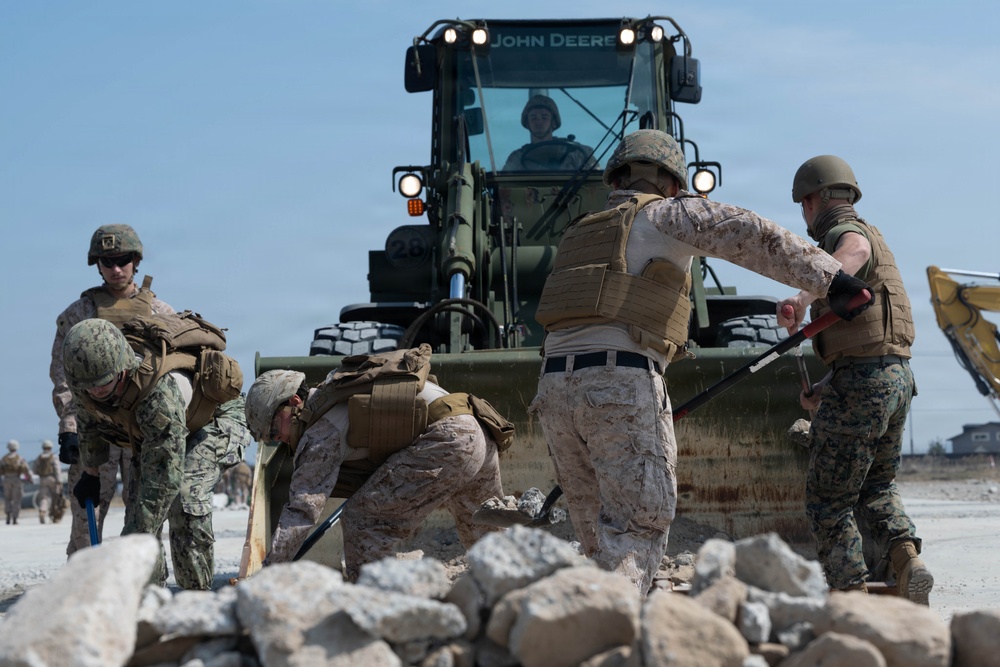
Photo By Senior Airman Tabatha Chapman | U.S. service members assigned to the Marine Wing Support Squadron 174, Marine Corps...... read more read more
 Subscribe
KUNSAN AIR BASE, Republic of Korea -- U.S. Airmen assigned to the 8th Civil Engineer Squadron, Marines assigned to the Marine Wing Support Squadron 174, Marine Corps Base, Hawaii and Sailors assigned to the Naval Mobile Construction Battalion, Chinhae, Naval Base, Korea, honed their skills in joint-service Rapid Damage Repair training on March 23, at Kunsan Air Base, Republic of Korea.
RDR focuses on assessing damage and restoring flight line functionality in a short time span with the goal to make it operational as quickly and safely as possible.
Teams begin by assessing the extent of the damage, identifying hazards and prioritizing repair zones. Debris clearance follows, including the removal of loose materials that could pose risks to aircraft. Crews then repair the crater, using rapid set concrete and compaction techniques to stabilize the surface. The final phase involves surface finishing and inspection to ensure the runway can safely support aircraft operations.
Coordination and communication between branches is essential to enable swift flight line restoration and ensuring continuous air operations. When runways are damaged by attack or natural causes, the ability to restore them quickly can determine the success or failure of a mission.
“Increased integration is crucial to improve interoperability,” said U.S. Air Force Staff Sgt. Uriel Ortiz, 8th Civil Engineer Squadron pavements and equipment supervisor. “Many practices and procedures do not translate from one branch to another, so getting the opportunity to interoperate with sister services increases communication understanding. Every time CE units from other branches conduct exercises on our base, we attempt to integrate with them. Every opportunity we get, we take.”
During the training, personnel were expected to adapt quickly and become well versed in each other’s damage repair process. Safety remains a priority, with procedures in place to mitigate high-tempo operation risks such as loud noise exposure, getting struck by machinery, overhead obstacles, the use of sharp tools and material exposure. Hands-on experience and combined instructions between military services can strengthen their understanding of branch-specific terminology and gain familiarity with various equipment models.
“Training together is important because it helps strengthen the trust and communication between branches,“ explained Senior Airman Jakhi Brown, 8 CES pavements and equipment journeyman.”In real world situations we aren’t out there by ourselves, we’re expected to depend on each other to make sure we can effectively complete our mission.”
Ultimately, RDR training highlights a fundamental principle of military readiness, the ability to adapt and respond quickly under pressure. Through coordinated efforts across multiple branches, service members ensure that even in the face of disruption, critical operations can continue.
| Date Taken: | 03.22.2026 |
| Date Posted: | 03.30.2026 20:52 |
| Story ID: | 561517 |
| Location: | KUNSAN AIR BASE, KR |
| Web Views: | 56 |
| Downloads: | 0 |

This work, Joint forces hone RDR training at Kunsan AB, by SrA Tabatha Chapman, identified by DVIDS, must comply with the restrictions shown on https://www.dvidshub.net/about/copyright.


No keywords found.




