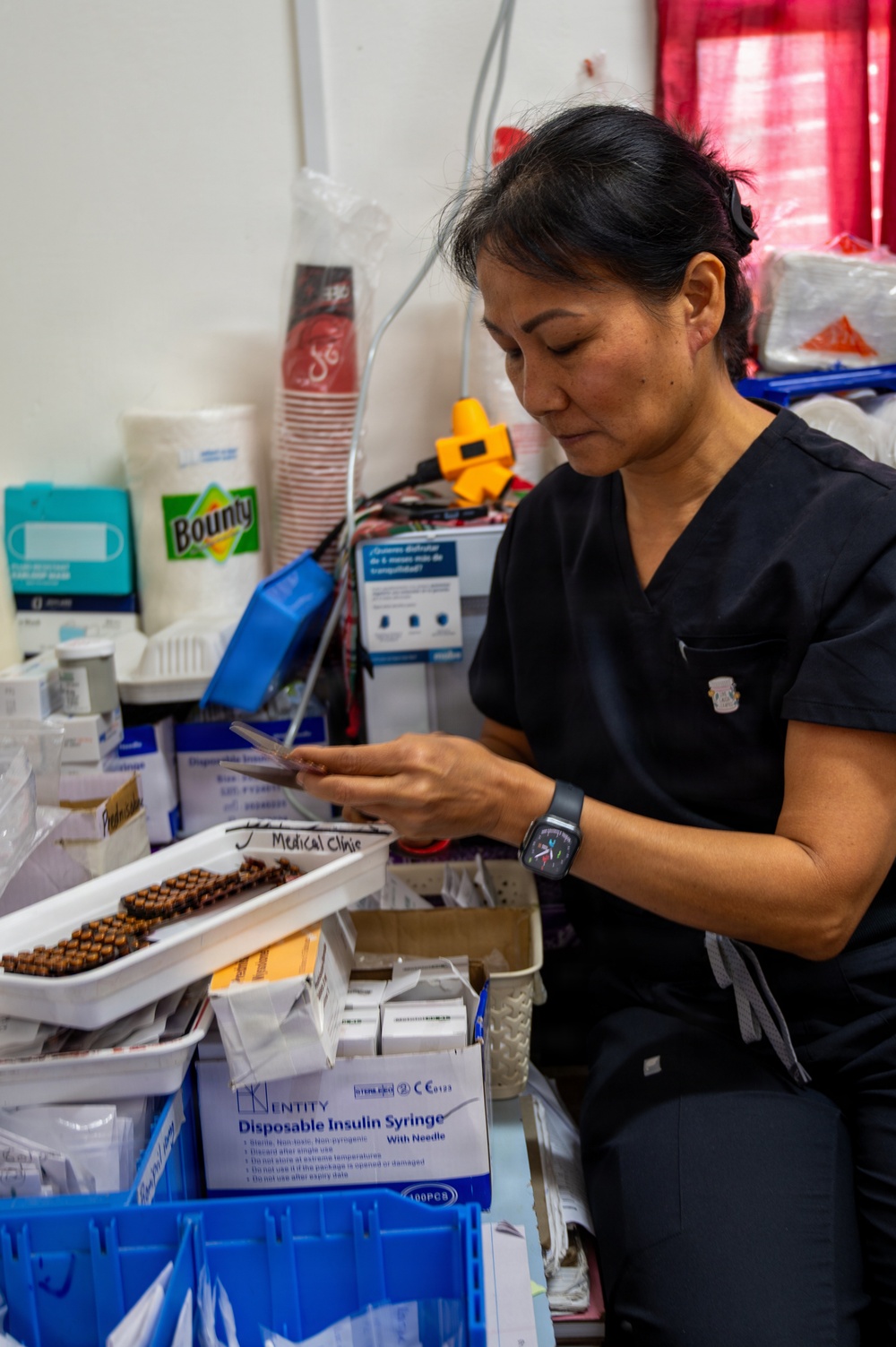
Photo By Maj. Stephani Schafer | U.S. Air Force Lt. Col. Hiep Tran, 349th Medical Squadron pharmacist, prepares medication for patients at the West Demerara Regional Hospital in Vreed en Hoop, Guyana, March 19, 2026. U.S. Air Force medical personnel provided pharmacy support during the Lesser Antilles Medical Assistance Team 2026 mission, ensuring safe medication distribution while enhancing readiness and strengthening partnerships with Guyana Ministry of Health providers. (U.S. Air Force photo by Maj. Stephani Schafer) see less
| View Image Page
LAMAT 2026: Guyana, U.S. Pharmacy Team play critical role in building lasting care
In a tiny satellite pharmacy in one of Guyana’s busiest hospitals, patients wait in a steady line to fill prescriptions. Many arrive with prescriptions in hand, managing chronic conditions like diabetes, hypertension and high cholesterol. Behind the counter, a single pharmacist, backed by a small team of technicians, moves quickly to fill orders. Their work extends beyond dispensing medications, confirming dosages and supporting patient needs.
The Lesser Antilles Medical Assistance Team (LAMAT) 2026 mission highlights how healthcare is sustained through collaboration, not delivered in isolation. LAMAT brings together U.S. military medical professionals and host-nation providers in Guyana to deliver care while strengthening partner nation capability. Within that effort, pharmacy connects diagnosis to treatment and helps ensure continuity of care during the two-week health security cooperation mission.
At the West Demerara Regional Hospital satellite pharmacy, the value is evident in the daily workload.
Pharmacist Feleina Davidson, who has worked at the facility for more than three years, describes a workload shaped by both routine and unpredictability.
“We work as one unit,” Davidson said. “It’s not just about counting medicine. You’re listening, you’re learning and you’re working with everyone.”
The integration demonstrated in the pharmacy reflects a broader theme of the LAMAT mission: healthcare as a multidisciplinary effort. While physicians diagnose and prescribe, pharmacists and technicians serve as critical safeguards -- reviewing allergies, confirming prescriptions and ensuring patients understand their medications. These interactions are essential to patient safety and long-term care.
For both U.S. and Guyanese teams, the mission has also become a space for shared knowledge. Over the past two weeks, pharmacists exchanged ideas on workflow, organization, and clinical practice, from how medicines are stocked to how prescriptions are documented and communicated.
“There’s no single way to do pharmacy,” said U.S. Air Force Lt. Col. Hiep Tran, 349th Medical Squadron pharmacist. “It’s about learning best practices. So, when I go to a different pharmacy, I often find that, ‘oh I never thought of arranging certain things this way,’ and maybe that way is easier than my way.”
That collaboration extends beyond clinical knowledge. Discussions have focused on practical systems that support safe and effective operations including storage security and accountability.
During LAMAT 2025 in Guyana, the Air Force pharmacist worked with local staff to improve medication storage and security, introducing locks and strengthening inventory controls.
“Last year we had a pharmacist with us; and he helped us with little things, like maintaining organization and getting shelves,” Davidson said. “He helped us a lot by putting a lock on our doors to help secure the pharmacy better.”
Building on that progress, this year’s team reinforced accountability measures such as controlled substance tracking and additional security improvements, small changes that play a critical role in patient safety and system reliability.
The teams also discussed implementing a simple ticketing system to improve patient flow at the pharmacy window, reduce crowding and create space for counseling and confidentiality, demonstrating how practical solutions can strengthen care without requiring advanced technology.
For many of the Guyanese staff, the presence of the LAMAT team has also provided mentorship opportunities. Pharmacists and pharmacy assistants alike have had the chance to learn directly from experienced professionals, gaining exposure to new medications, treatment approaches and clinical considerations.
“I mostly work on the inpatient side,” Tran said of her more than 22 years of experience as a pharmacist. “In addition to that, I also have experience in ICU, infectious disease and more. I have a background that not every pharmacist has. But LAMAT goes both ways because I’m also learning from Ms. Davidson and her team and exchanging our knowledge.”
That exchange supports the mission’s broader goal: strengthening healthcare systems, not replacing them. Each interaction contributes to a more resilient system capable of sustaining care long after the mission ends.
“[Lt. Col. Tran has] been sharing knowledge with us,” said Ashley Abrams, a pharmacy technician who has been at the hospital for nearly five years, said of Tran’s participation in the mission. “Even in a short time, we’ve learned things we can use every day. She’s been doing this a long time, so she knows a lot and she shares that with us.”
Pharmacy, in this context, becomes more than a support function. It is a cornerstone of continuity. It ensures that treatments initiated during LAMAT can be safely continued, that patients understand their medications and that healthcare providers have the systems in place to manage patients and their long-term care effectively.
It also reinforces a larger idea at the heart of the mission -- healthcare is inseparable from partnership. By working side-by-side, U.S. and Guyanese professionals are not only improving immediate patient care, but they are also building relationships, trust and shared standards that extend beyond the clinic walls.
As LAMAT 2026 draws to a close in Guyana, impact is already visible—in organized shelves, improved security and the confidence of patients receiving care.
In the end, the busiest window in the clinic may also be one of its most important. Not because of the number of prescriptions filled, but because of what it represents, where collaboration meets care, and where a two-week mission helps strengthen a healthcare system for years to come.

 Subscribe






