
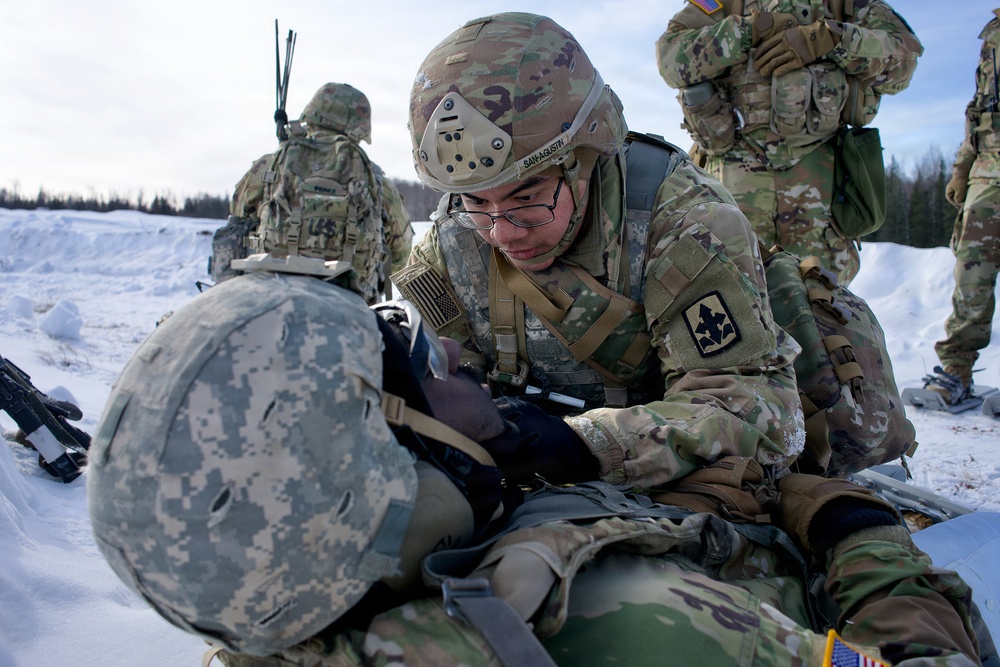
Photo By Maj. David Bedard | Spc. William Goosby as a simulated battlefield casualty during March 21, 2026,...... read more read more
 Subscribe
An avalanche is an inexorable force of nature.
The frozen tidal wave forms after successive winter storms layer marching loads of snow across the mountain face. When a strongly bonded slab rests atop a weaker layer, a solitary fracture can suddenly trigger a singularity of physics like a switchblade knife.
Snow becomes fluid, then cloud, then force, culminating in a churning current of ice and powder that can uproot trees, swallow sound and erase the boundary between immovable mountain and cold winter sky.
In Alaska’s mountains, avalanches are not anomalies – they are inevitabilities, specters of physics waiting for vulnerability.
And so it is for the Soldiers of Avalanche Company, 1st Battalion, 297th Infantry Regiment, Alaska Army National Guard.
The company occupied the JBER Infantry Platoon Battle Course March 20-22 during the unit's annual training.
Avalanche Company commander, Capt. Andrew Viray, maneuvered the company through the IPBC one squad at a time. Donning snowshoes to stay aloft the blanketed boreal floor and overwhite pants to conceal their movement, squads infiltrated through thick forest on their way to successive assaults on a group of hapless popup targets defending a frozen complex of berms.
Viray said the exercise was the culmination of months of foundational training including individual movement techniques, marksmanship, as well as team and squad infantry battle drills.
“The purpose of the squad live fire is to train and evaluate a squad’s ability to effectively fight, move and communicate under realistic combat conditions using live ammunition, and ensure confidence in our leaders that they can control their squads and teams, and that we can keep building our lethality,” Viray said.
The IPBC is part of the U.S. military’s vast portfolio of range complexes and capabilities designed to offer troops unparalleled realism and instrumented data collection to hone formations to a fine edge, capabilities not afforded to adversaries.
Squads rehearsed the attack lane with dry- and blank-fire iterations to get a sense of the mission and to work out kinks in their final execution. Locking and loading live ammunition, the units marched through the wood line setting up an objective rally point that was then temporarily left behind by the squad leader who reconned forth to get eyes on the objective.
Coming back to rally their unit, the leader tactically marched the squad toward a position overlooking the objective with good fields of fire, leaving a support-by-fire (SBF) element to concentrate fire on enemy targets to keep their heads down.
The squad leader then took the remainder of the element to flank the objective, signaling the SBS element to shift fires off the objective before lifting fires entirely as the assault element plowed through the enemy positions.
It’s a relatively simple drill, but there is no margin for error as far as safety goes, and there is a marked difference between marginally achieving the mission and aggressively assaulting the bunker line with overwhelming speed and violence of action.
Talking guns
Though other squads employed an assault element and an SBF element, the Soldiers of the Weapons Squad from both 1st and 2nd Platoon, composed a dedicated support by fire using their M-240L 7.62mm machine guns.
The M-240L is a lightened version of the legacy M-240B, used by combat support units, shedding 5 pounds through the fitting of a collapsible stock, a 4-inches shorter barrel, a titanium receiver and a polymer trigger frame resulting in a more agile and lethal gun.
Throughout the lane, Weapons Squad leader Staff Sgt. Brendan White used a “talking guns” dialogue to ensure optimum suppression while preventing the guns from prematurely exhausting ammunition and overheating the barrels.
“The goal and purpose of talking guns is to make it seem like only one machine gun is in the position to mask our numbers,” White explained. “So, we have rates of fire that we choose, and each gun fires in sequence to mask our numbers.”
Upon leading the squad to quietly infiltrate into an SBS position, White ordered his three guns to convert from lighter bipods to much heavier but more stable tripods.
Once all three fitted out for a rock-solid platform, White ordered Gun 1 to fire in short bursts.
“Gun 2, fire,” the squad leader intoned, never raising his voice above a calm conversational volume.
Gun 2 assistant gunner Pfc. Edgar Guevara firmly patted gunner Spc. Sean Foley’s Soldier, signaling the release of controlled bursts of withering fire.
While White orchestrated the staccato symphony of destruction, the gun teams created three piles of brass cartridges and aluminum links steaming hot cordite into the frigid winter air.
Tracer rounds signaled the devastating effect the guns had on targets huddled behind pock-marked berms.
The lethal demonstration of firepower was a solitary example of dozens of iterations of squad attacks. Viray said the weekend’s work was indicative of the company’s fighting spirit.
“Carrying through the objective, reaching the limit of advance, everybody fights in the Avalanche Company,” Viray said before invoking Avalanche Company’s motto: “Bury them.”
| Date Taken: | 03.26.2026 |
| Date Posted: | 03.26.2026 13:58 |
| Story ID: | 561373 |
| Location: | ALASKA, US |
| Web Views: | 98 |
| Downloads: | 0 |

This work, Avalanche Company hones lethality at JBER Infantry Platoon Battle Course, by Maj. David Bedard, identified by DVIDS, must comply with the restrictions shown on https://www.dvidshub.net/about/copyright.


No keywords found.




