
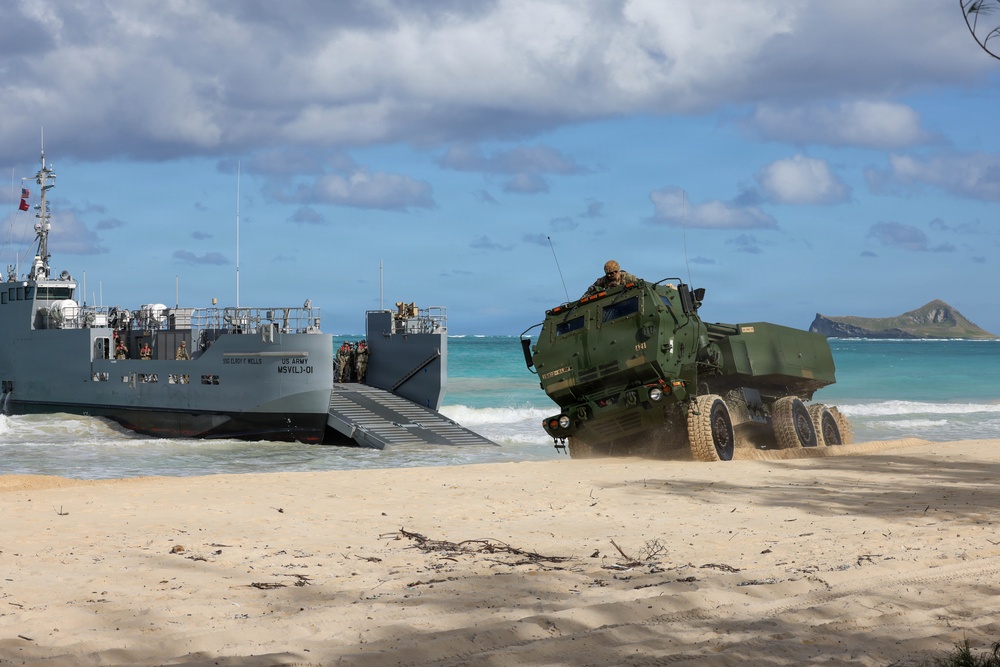
Photo By Sgt. Devin Davis | U.S. Soldiers assigned to the 7th Transportation Brigade execute a littoral rapid...... read more read more
 Subscribe
FORT SHAFTER, Hawaii — U.S. Soldiers with the 8th Theater Sustainment Command in coordination with the 2nd Battalion, 11th Field Artillery Regiment, 2nd Stryker Brigade Combat Team, 25th Infantry Division, and the 7th Transportation Brigade (Expeditionary), executed a first-of-its-kind littoral rapid infiltration, or LORAIN, on Feb. 24, 2026, using a Maneuver Support Vessel (Light) assigned to the 8th Theater Sustainment Command to transport a High Mobility Artillery Rocket System launcher to an unimproved beach landing site.
The operation marked the first time a HIMARS platform has been inserted and extracted using the MSV (Light), a new Army watercraft capability designed to maneuver in the shallow, reef-lined waters that are common throughout the Indo-Pacific.
“This is the first time we’ve used the MSV Light to transport a HIMARS,” said Maj. Andrea Swett, operations officer for 2nd Battalion, 11th Field Artillery Regiment. “It’s a first for the platoon, a first for the battery and likely a first for the Army.”
During the rehearsal and execution, crews focused on rapidly loading and unloading the launcher, moving to a simulated firing point, executing a fire mission and quickly repositioning off the firing line. Swett said the primary objective was to test how efficiently the team could move long-range precision fires from sea to shore and back again.
Unlike traditional land-based operations or High Mobility Artillery Rocket System Rapid Infiltration missions conducted via aircraft, the maritime environment presents unique challenges.
“The landing is much slower,” Swett said. “We have to reacquire GPS signals once we’re ashore and maintain communications over a maritime platform, which we’re not used to doing.”
She added that crews conducted extensive rehearsals, including rigging procedures and a test movement from Waipio Point to Pearl Harbor, to ensure the launcher was properly secured and could safely mount and dismount the vessel.
From a tactical perspective, speed and survivability remain critical considerations.
“We’re working against the clock to reduce vulnerability to counter-battery fire,” Swett said. “But this gives us another capability, especially in an island chain where air superiority is not guaranteed.”
Chief Warrant Officer 5 Derrick Swetnam, senior Army watercraft systems advisor for U.S. Army Pacific, said the operation demonstrated joint interoperability between Army watercraft and theater fires forces in an archipelagic environment.
“Today is about proving we can reposition long-range precision fires into locations previously inaccessible by other means,” Swetnam said. “The MSV Light can transit shallow waters, clear reefs and land in less than four feet of water with a dry ramp.”
Beaching operations carry inherent risk, particularly in the surf zone, where vessels can broach if not properly handled. Swetnam said the MSV (Light)’s shallow draft and waterjet propulsion system provide advantages over legacy landing craft, but success depends on experienced operators.
“It has to happen fast, and it requires a highly qualified vessel master,” he said. “We have that.”
Chief Warrant Officer 2 Matthew Davis, vessel master of the U.S. Army Vessel Staff Sgt. Elroy F. Wells (MSV-L 01), led the insertion and extraction of the HIMARS strike package.
“Our role is the insertion and extraction of the HIMARS to an unimproved beach landing site,” Davis said. “LORAIN is essentially a raid using a high-speed, shallow-draft landing craft. Instead of treating water as an obstacle, we treat it as maneuver space.”
Davis said the mission helps close a capability gap in the Indo-Pacific, where anti-access and area-denial threats may limit the use of airfields and ports.
“In an anti-access, area-denial environment, the enemy can target predictable locations like airfields or seaports,” he said. “If we can land on any number of beaches across an island, that creates a dilemma for the enemy and gives commanders more options.”
The MSV (Light) is the Army’s newest landing craft and does not require a larger support ship to conduct operations. Its ability to operate independently over long distances in shallow water expands operational reach across dispersed island chains.
Leaders said the training also supports the Army Transformation Initiative by integrating emerging platforms and concepts into realistic scenarios.
“At the tactical level, this makes us more lethal in a training environment where the stakes aren’t as high,” Davis said. “The more we sweat in training, the less we bleed in combat.”
As the Army continues to refine littoral operations in the Indo-Pacific, leaders emphasized that the integration of watercraft and long-range precision fires offers commanders additional flexibility to maneuver forces and impose costs on potential adversaries.
“This is about options,” Swetnam said. “If successful, this opens up entirely new firing locations across the theater and provides commanders another way to position combat power when and where it’s needed.”
| Date Taken: | 02.26.2026 |
| Date Posted: | 03.27.2026 14:07 |
| Story ID: | 561323 |
| Location: | HAWAII, US |
| Web Views: | 263 |
| Downloads: | 0 |

This work, 8th TSC's MSV-L executes first littoral HIMARS insertion in Hawaii, by SGT Devin Davis, identified by DVIDS, must comply with the restrictions shown on https://www.dvidshub.net/about/copyright.


No keywords found.




