
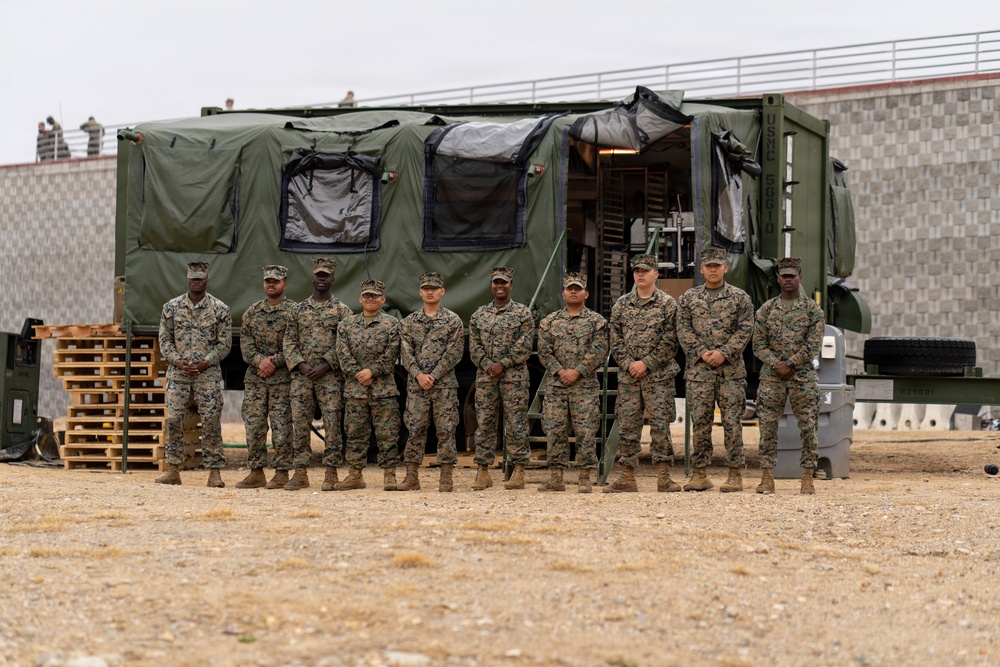
Photo By 1st Lt. Taiyo Tatara | U.S. Marines with Food Service Company, Combat Logistics Regiment 37, 3rd Marine...... read more read more
 Subscribe
CAMP MUJUK, South Korea — U.S. Marines with Food Service Company, Combat Logistics Regiment 37, 3rd Marine Logistics Group, are cooking food in an Expeditionary Field Kitchen during the Korean Marine Exchange Program 26.1 in Camp Mujuk, South Korea, March 25, 2026. KMEP is a semiannual exercise that provides opportunities for ROK Marine Corps and U.S. Marine Corps units to train together, improving their combined capabilities to deter threats and maintain peace on the Korean Peninsula.
While rifle squads train and logisticians plan across the South Korean countryside, this eight-Marine team quietly ensures the force stays fueled, producing an average of 300 meals per sitting across two hot meal periods each day.
"The role of Food Service Company during KMEP is to support the [III Marine Expeditionary Force] with wholesome and nutritious meals," said Gunnery Sgt. Kadine Mora, mess chief of Food Service Company, CLR-37, 3rd MLG.
Sustaining KMEP requires more than ammunition and fuel. It requires food, and getting food to Marines training in austere field conditions is precisely what the Expeditionary Field Kitchen is designed to do. Unlike a permanent dining facility, the EFK is a modular, transportable system that can be set up, operated and broken down in a field environment with no permanent kitchen infrastructure. Every piece of equipment has to be transported to the site, assembled and made operational before a single meal can be prepared. That process demands careful planning, physical effort and the kind of adaptability that defines expeditionary logistics.
"Working inside the EFK, you have to manage your time wisely," Mora said. "You're limited on space and equipment, so you have to prioritize how you want to cook each item and figure out which items require more cooking time. That's the biggest difference from working in a garrison environment."
The team is serving Unitized Group Rations – A Rations, a field-feeding system built around frozen and fresh ingredients: steak, semi-cooked chicken, raw noodles and other items a cook might find at any grocery store. Unlike Unitized Group Rations – Heat and Serve, which are warmed in their containers, or meals, ready to eat, UGR-As require active preparation, careful temperature management and significantly more attention to detail, all within the constraints of a mobile kitchen. "With the A's, you have frozen and fresh items," Mora said. "They require more cooking time and more attention to detail, because we've got to make sure that the cooking temperatures are correct. We can't miss with those."
The Marines running the EFK have fed as many as 590 service members in a single sitting during the exercise. Cpl. Jacob Cuenca, a food service specialist with Food Service Company, said the day starts well before sunrise. His team conducts a cook's mount inspection, a check of personal hygiene and appearance, before beginning breakfast prep. A second shift picks up in the early afternoon for dinner service, with lunch covered by distributing MREs to Marines in the field. "A typical day would be waking up at 0300, getting ready, and then working the morning shift," Cuenca said. "Once we close, we clean up, plan for the next meal period, and prep it." That level of care has not gone unnoticed. Cuenca, now on his third rotation through KMEP, said the reaction from Marines eating UGR-A meals has been noticeably different from previous exercises where the team served heat-and-serve rations.
"We get a lot of compliments from Marines from different units and sections," Cuenca said. "They would always tell us that they would eat steaks in the morning and then somehow get steaks for dinner. Something unexpected they would get from being at a field exercise. It's more like garrison meals."
Operating any field kitchen in an expeditionary environment introduces friction that a permanent galley never encounters. Storage and cold chain management must be maintained without fixed refrigeration infrastructure. The physical footprint of the EFK means every square foot of workspace has to be used deliberately. Mora said her Marines have met each of those challenges and overcome them.
"Their versatility, how they're able to adapt to whatever is thrown at them, that's what I'm proud of the most," she said. "They work long hours and they don't complain. We have multiple deliveries coming in, which extend their work hours, and they understand the mission. They just tough it out." For Cuenca, the harder work of running an EFK on UGR-As is worth the result. "There's [sic] more steps and more preparation day by day," he said. "But it comes out way better than UGR-Heat and Serves." He said he hopes the effort his team puts in earns a wider appreciation for what food service Marines do, in garrison and in the field alike. "The long hours that we put in, the hard work, eventually it pays off," Cuenca said. "We're the very least and most appreciated at the same time, because there's not much that Marines know about us and what we do."
CLR-37 is the combat logistics regiment assigned to 3rd MLG, the logistics combat element of III Marine Expeditionary Force.
| Date Taken: | 03.24.2026 |
| Date Posted: | 03.25.2026 20:35 |
| Story ID: | 561322 |
| Location: | KR |
| Web Views: | 827 |
| Downloads: | 3 |

This work, KMEP 26.1: Food Service Marines Keep the Force Fed During KMEP, by 1LT Taiyo Tatara, identified by DVIDS, must comply with the restrictions shown on https://www.dvidshub.net/about/copyright.


No keywords found.




