
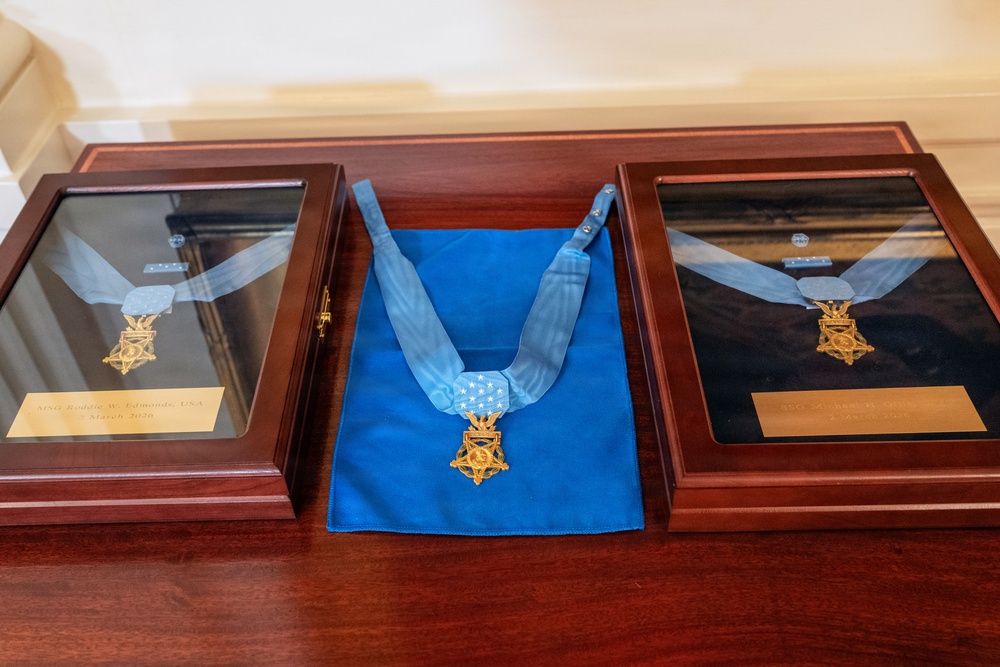
Photo By Christopher Kaufmann | Three Medals of Honor are displayed in the East Room of the White House prior to a...... read more read more
 Subscribe
Each year on March 25, the nation observes National Medal of Honor Day, dedicated to recognizing the extraordinary courage of service members who distinguished themselves at the risk of their own lives, “above and beyond the call of duty,” during combat operations.
As the United States approaches its 250th birthday, the U.S. Army Corps of Engineers (USACE) reflects not only on the nation’s history, but also on the engineer leaders whose efforts helped shape it.
Among them are two former Chiefs of Engineers whose actions during the Civil War exemplified the bravery, courage, sacrifice, and integrity that continue to define Army engineers today: Brig. Gen. John Moulder Wilson and Brig. Gen. George Lewis Gillespie Jr.
Wilson, who later served as Chief of Engineers from 1897 to 1901, received the Medal of Honor for his actions during the 1862 Battle of Malvern Hill as a first lieutenant. His citation award notes that despite severe illness, he remained on duty on the battle line. Even after transferring to a staff role during the campaign, he continued supporting combat operations under demanding conditions.
Following the Civil War, Wilson continued a distinguished career that included leading various waterways improvement projects, serving as Superintendent of the U.S. Military Academy at West Point and the Northeast Division, and later guided USACE during the Spanish-American War.
Gillespie, who became Chief of Engineers in 1901, also received the Medal of Honor for actions during the Civil War. A native of Tennessee who remained loyal to the Union, Gillespie received the award for his actions at the Battle of Cold Harbor in 1864. Tasked with carrying critical dispatches to and from Gen. Philip Sheridan, Gillespie repeatedly crossed areas under intense enemy fire to maintain vital communications across the battlefield. He faced enemy capture twice during battle, yet managed to escape on both occasions.
After the Civil War, he worked on port and coastal improvement projects and served on the Board of Engineers, as president of the Mississippi River Commission, and as commanding general of the Department of the East. Gillespie was Chief of Engineers from 1901 to 1904 and, for a short time in 1901, he served as Acting Secretary of War. He also played a role in shaping the Medal of Honor itself, advocating for design improvements that led to the more ornate version approved by Congress in 1904 that influenced the modern-day form.
Beyond the two Chiefs of Engineers, USACE’s legacy of valor includes numerous other Medal of Honor recipients whose courage spans conflicts from the Civil War to present-day operations.
Civil War:
1st Lt. William H. H. Benyaurd, with one companion, voluntarily advanced in a reconnaissance beyond the skirmishers, where he was exposed to imminent peril; also, in the same battle, rode to the front with the commanding general to encourage wavering troops to resume the advance, which they did successfully.
Sgt. Maj. Frederick W. Gerber was recognized for distinguished gallantry in many actions and in recognition of long, faithful, and meritorious service spanning 32 years.
World War I:
Volunteering with two other soldiers to locate machine-gun nests, Sgt. Wilbur E. Colyer advanced on the hostile positions to a point where he was half surrounded by the nests, which were in ambush. He killed the gunner of one gun with a captured German grenade and then turned this gun on the other nests, silencing all of them before he returned to his platoon. He was later killed in action.
World War II:
Technician Fourth Grade Truman Kimbro, on Dec. 19, 1944, as scout, he led a squad assigned to the mission of mining a vital crossroads near Rocherath, Belgium. At the first attempt to reach the objective, he discovered it was occupied by an enemy tank and at least 20 infantrymen. Driven back by the withering fire, Kimbro made two more attempts to lead his squad to the crossroads, but all approaches were covered by intense enemy fire. Although warned by our own infantrymen of the great danger involved, he left his squad in a protected place and, laden with mines, crawled alone toward the crossroads. When nearing his objective, he was severely wounded, but he continued to drag himself forward and laid his mines across the road. As he tried to crawl from the objective, his body was riddled with rifle and machine-gun fire. The mines laid by his act of indomitable courage delayed the advance of enemy armor and prevented the rear of our withdrawing columns from being attacked by the enemy.
Sgt. Joe C. Specker, on the night of Jan. 7, 1944, Sgt. Specker, with his company, was advancing up the slope of Mount Porchia, Italy. He was sent forward on reconnaissance and on his return, he reported to his company commander the fact that there was an enemy machine-gun nest and several well-placed snipers directly in the path and awaiting the company. Specker requested and was granted permission to place one of his machine guns in a position near the enemy machine gun. Voluntarily and alone, he made his way up the mountain with a machine gun and a box of ammunition. He was observed by the enemy as he walked along and was severely wounded by the deadly fire directed at him. Though so seriously wounded that he was unable to walk, he continued to drag himself over the jagged edges of rock and rough terrain until he reached the position at which he desired to set up his machine gun. He set up the gun so well and fired so accurately that the enemy machine-gun nest was silenced and the remainder of the snipers forced to retire, enabling his platoon to obtain their objective. Specker was found dead at his gun.
Pvt. Nathan K. “Junior” Van Noy Jr., received the Medal of Honor for conspicuous gallantry and intrepidity above and beyond the call of duty in action with the enemy near Finschafen, New Guinea, on Oct. 17, 1943. When wounded late in September, Van Noy declined evacuation and continued on duty. On Oct. 17, 1943, he was gunner in charge of a machine-gun post only five yards from the water's edge when the alarm was given that three enemy barges loaded with troops were approaching the beach in the early morning darkness. One landing barge was sunk by Allied fire, but the other two beached 10 yards from Van Noy's emplacement. Despite his exposed position, he poured a withering hail of fire onto the debarking enemy troops. His loader was wounded by a grenade and evacuated. Van Noy, also grievously wounded, remained at his post, ignoring calls of nearby soldiers urging him to withdraw, and continued to fire with deadly accuracy. He expended every round and was found, covered with wounds, dead beside his gun. In this action, Van Noy killed at least half of the 39 enemy taking part in the landing. His heroic tenacity at the price of his life not only saved the lives of many of his comrades, but enabled them to annihilate the attacking detachment.
Pfc. Herman C. Wallace, while helping clear enemy mines from a road, he stepped on a well-concealed S-type antipersonnel mine. Hearing the characteristic noise indicating that the mine had been activated and, if he stepped aside, would be thrown upward to explode above the ground and spray the area with fragments, surely killing two comrades directly behind him and endangering other members of his squad, he deliberately placed his other foot on the mine even though his best chance for survival was to fall prone. Wallace was killed when the charge detonated, but his supreme heroism at the cost of his life confined the blast to the ground and his own body and saved his fellow soldiers from death or injury.
Korean War:
Pfc. Melvin L. Brown, while his platoon was securing Hill 755 (the Walled City), the enemy, using heavy automatic weapons and small arms, counterattacked. Taking a position on a 50-foot-high wall, he delivered heavy rifle fire on the enemy. His ammunition was soon expended and although wounded, he remained at his post and threw his few grenades into the attackers, causing many casualties. When his supply of grenades was exhausted, his comrades from nearby foxholes tossed others to him and he left his position, braving a hail of fire, to retrieve and throw them at the enemy. The attackers continued to assault his position and Brown, weaponless, drew his entrenching tool from his pack and calmly waited until they, one by one, peered over the wall, delivering each a crushing blow upon the head. Knocking 10 or 12 enemy from the wall, his daring action so inspired his platoon that they repelled the attack and held their position.
Sgt. George D. Libby, while breaking through an enemy encirclement, the vehicle in which he was riding approached an enemy roadblock and encountered devastating fire, which disabled the truck, killing or wounding all the passengers except Libby. Taking cover in a ditch, Libby engaged the enemy and despite the heavy fire crossed the road twice to administer aid to his wounded comrades. He then hailed a passing M-5 artillery tractor and helped the wounded aboard. The enemy directed intense small-arms fire at the driver, and Libby, realizing that no one else could operate the vehicle, placed himself between the driver and the enemy, thereby shielding him while he returned the fire. During this action, he received several wounds in the arms and body. Continuing through the town, the tractor made frequent stops and Libby helped more wounded aboard. Refusing first aid, he continued to shield the driver and return the fire of the enemy when another roadblock was encountered. Libby received additional wounds but held his position until he lost consciousness. Libby's sustained, heroic actions enabled his comrades to reach friendly lines.
Cpl. Dan D. Schoonover was in charge of an engineer demolition squad attached to an infantry company which was committed to dislodge the enemy from a vital hill. Realizing that the heavy fighting and intense enemy fire made it impossible to carry out his mission, he voluntarily employed his unit as a rifle squad and, forging up the steep barren slope, participated in the assault on hostile positions. When an artillery round exploded on the roof of an enemy bunker, he courageously ran forward and leaped into the position, killing one hostile infantryman and taking another prisoner. Later in the action, when friendly forces were pinned down by vicious fire from another enemy bunker, he dashed through the hail of fire, hurled grenades in the nearest aperture, then ran to the doorway and emptied his pistol, killing the remainder of the enemy. His brave action neutralized the position and enabled friendly troops to continue their advance to the crest of the hill. When the enemy counterattacked, he constantly exposed himself to the heavy bombardment to direct the fire of his men and to call in an effective artillery barrage on hostile forces. Although the company was relieved early the following morning, he voluntarily remained in the area, manned a machine gun for several hours, and subsequently joined another assault on enemy emplacements. When last seen, he was operating an automatic rifle with devastating effect until mortally wounded by artillery fire. Schoonover's heroic leadership during two days of heavy fighting, superb personal bravery and willing self-sacrifice inspired his comrades and saved many lives, reflecting lasting glory upon himself and upholding the honored traditions of the military service.
Vietnam War:
Cpl. Terry T. Kawamura sacrificed his life to protect fellow soldiers from an explosive attack, while serving as a member of the 173rd Engineer Company. An enemy demolition team infiltrated the unit quarters area and opened fire with automatic weapons. Disregarding the intense fire, Kawamura ran for his weapon. At that moment, a violent explosion tore a hole in the roof and stunned the occupants of the room. Kawamura jumped to his feet, secured his weapon and, as he ran toward the door to return the enemy fire, he observed that another explosive charge had been thrown through the hole in the roof to the floor. He immediately realized that two stunned fellow soldiers were in great peril and shouted a warning. Although in a position to escape, Kawamura unhesitatingly wheeled around and threw himself on the charge. In completely disregarding his safety, Kawamura prevented serious injury or death to several members of his unit.
Operation Iraqi Freedom:
Sgt. 1st Class Paul R. Smith received the Medal of Honor for his actions near Baghdad International Airport, Baghdad, Iraq, on April 4, 2003. On that day, Smith was engaged in the construction of a prisoner of war holding area when his Task Force was violently attacked by a company-sized enemy force. Realizing the vulnerability of more than 100 soldiers, Smith quickly organized a hasty defense consisting of two platoons of soldiers, one Bradley Fighting Vehicle, and three armored personnel carriers. As the fight developed, Smith braved hostile enemy fire to personally engage the enemy with hand grenades and anti-tank weapons and organized the evacuation of three wounded soldiers from an armored personnel carrier struck by a rocket-propelled grenade and a 60 mm mortar round. Fearing the enemy would overrun their defenses, Smith moved under withering enemy fire to man a .50-caliber machine gun mounted on a damaged armored personnel carrier. In total disregard for his own life, he maintained his exposed position in order to engage the attacking enemy force. During this action, he was mortally wounded. His defeat the enemy attack and resulted in as many as 50 enemy soldiers killed, while allowing the safe withdrawal of numerous wounded soldiers.
Operation Enduring Freedom:
Sgt. 1st Class Christopher A. Celiz, a 12B combat engineer, served as master breacher and staff engineer for 1st Battalion, 75th Ranger Regiment. He was later assigned to lead a mortar platoon in combat. On July 12, 2018, Celiz, leading a special operations unit comprised of partnered forces and members of 1st BN, 75th Ranger Regiment, engaged an attacking enemy force in Paktia Province, Afghanistan. He repeatedly exposed himself to intense fire to engage the enemy with a heavy weapon, regain the initiative, and direct medical evacuation. Celiz was mortally wounded after placing himself directly between a medical evacuation helicopter and the enemy, ensuring the aircraft was able to evacuate a partnered force member.
Since its creation during the Civil War, the Medal of Honor has stood as the nation’s highest military award for valor in combat. Of the more than 41 million Americans who have served in the Armed Forces, just over 3,500 have received the distinction.
This year, USACE is proud to celebrate 251 years of engineering independence and service to the nation. For generations, Army engineers have supported the defense, growth, and prosperity of the United States, responding to the nation’s most complex challenges with unmatched expertise and dedication. On National Medal of Honor Day, USACE honors all recipients while taking pride in the Army Corps’ own history of valor, recognizing that the courage demonstrated by past engineers continues to inspire those who serve today and into the nation’s next century.
| Date Taken: | 12.31.1969 |
| Date Posted: | 03.24.2026 10:58 |
| Story ID: | 561183 |
| Location: | DISTRICT OF COLUMBIA, US |
| Web Views: | 96 |
| Downloads: | 0 |

This work, USACE Honors Its Recipients on Medal of Honor Day, by Kathryne Gest, identified by DVIDS, must comply with the restrictions shown on https://www.dvidshub.net/about/copyright.

No keywords found.




