
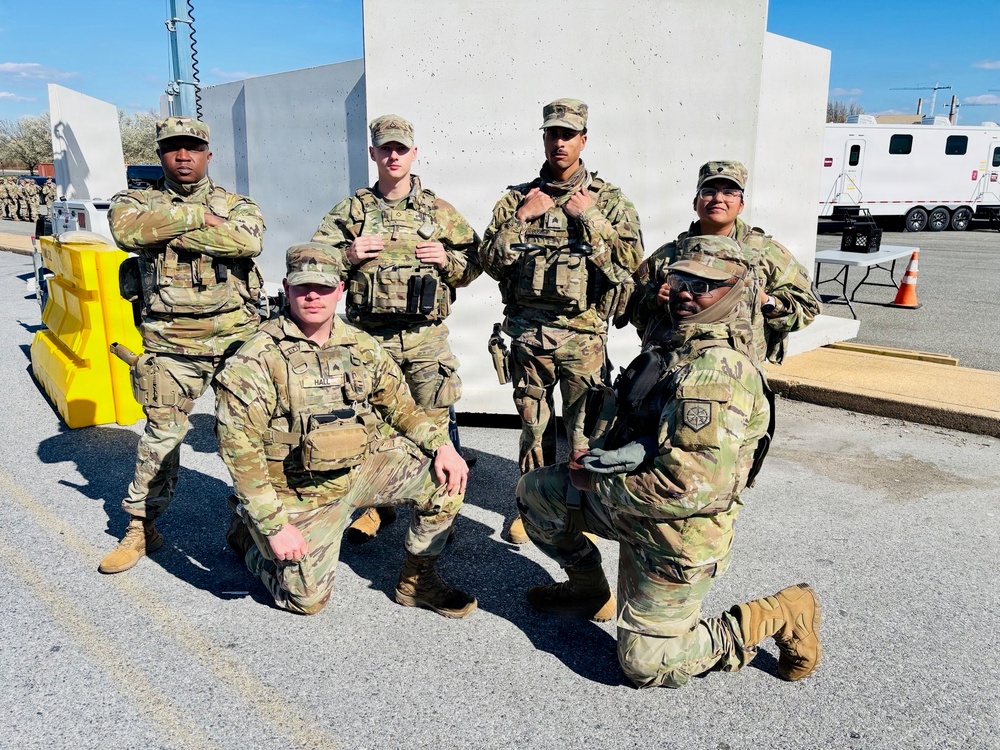
Courtesy Photo | A patrol team with the Georgia Army National assigned to Joint Task Force-DC pose for...... read more read more
WASHINGTON — What began as a routine presence patrol quickly became a real-world test of mission readiness, adaptability, and joint partnership for Soldiers assigned to Joint Task Force-District of Columbia currently serving in the nation’s capital.
The coordinated response between the National Guard and law enforcement led to discovering a missing juvenile.
“You’re never supposed to expect anything,” Sgt. Jacob Hall assigned to the Georgia National Guard said. “When you’re on patrol, you expect everything and nothing at the same time.”
That mindset proved critical when a distressed juvenile suddenly entered their area.
According to Spc. Ke’andre Flemming, assigned to the 848th Engineer Battalion, Georgia National Guard, the moment unfolded quickly.
The child came down an escalator in a frantic state, attempting to enter restricted areas of the station.
“He looked confused, he looked frightened,” Flemming said. “He wasn’t verbal… and he was clearly overwhelmed.”
Recognizing the signs of distress, Soldiers immediately shifted from a routine security posture to a coordinated response.
They began assessing the situation—watching for potential threats, assessing the area, and preparing to engage safely.
“So I surrounded the area to make sure there were no other pedestrians or anything that would interfere with the situation,” said Flemming.
This rapid transition reflects a core component of National Guard training: the ability to move seamlessly between mission sets while maintaining control and awareness.
As the situation developed, Hall and his team applied lessons ingrained through training—maintaining composure, establishing control, and prioritizing safety for everyone involved.
“The more the kid feels scared, the more overwhelmed he’s going to get—especially with a lot of people in uniform,” Hall explained. “So the first thing I did was tell everybody to take a step back.”
By reducing the visible pressure on the child, the team created space to de-escalate. A small element remained nearby, while others established a perimeter to ensure the safety of bystanders.
The Soldiers also identified a potential hazard: the child was holding a small plastic utensil. While not inherently dangerous, in the wrong circumstances it could still pose a risk.
Rather than escalating the situation, the team relied on restraint, communication, and positioning—demonstrating disciplined decision-making under stress.
As the situation stabilized, coordination with partner agencies became essential.
Soldiers quickly contacted Metro security personnel and local law enforcement, ensuring the right authorities were brought into the response.
Throughout the engagement, communication flowed between Georgia National Guard personnel, Metro security, and police officers.
“It was really good to see the teams collaborating,” Hall said. “We had different roles, different responsibilities—but we came together.”
“My mom is also a special needs teacher,” Sgt. Michael Bushey also assigned to the 848th Engineer Battalion said. “So I’m definitely familiar with things of this nature.”
Security personnel with experience handling individuals with special needs provided valuable insight, helping guide the interaction and improve the outcome.
Their expertise complemented the Guard’s presence and control measures.
This seamless coordination highlights the strength of joint partnerships—where each organization contributes its capabilities toward a shared objective.
As more information became available, it became clear the juvenile was nonverbal and had special needs, increasing the urgency and sensitivity of the situation.
Soldiers adjusted their approach accordingly.
“We didn’t want to overwhelm him,” Hall said. “We wanted to make sure he felt safe.”
Maintaining a careful balance, the team shadowed the child at a distance, ready to intervene if necessary while allowing space for him to calm down.
At the same time, they tracked his movements, ensuring he did not enter traffic or other hazardous areas.
“We had to look out for every little situation—anything that could happen,” Hall said.
Eventually, law enforcement arrived and took custody of the child, who was later identified as a missing juvenile.
For the Soldiers involved, the incident reinforced a key truth: mission readiness extends far beyond combat scenarios.
“I’ve been on different missions… but this showed me we can help in smaller situations too,” Hall said. “Situations that really matter.”
The experience underscored the importance of adaptability, communication, and trust within a team.
It also highlighted how leadership development and decentralized decision-making empower junior Soldiers to act confidently in dynamic environments.
“You know they put us in charge of teams to make sure that their readiness is beyond ours,” Hall said. “And Sgt. Bushey gave a very adequate and outstanding performance in that he made sure we had a sergeant on the floor to be able to handle certain presences and situations.”
From maintaining accountability to making real-time decisions, every aspect of their training played a role.
“Accountability, readiness—being at the right place at the right time,” Hall said. “That’s what made the difference.”
Though the patrol area was considered relatively calm, the incident served as a reminder that no environment is without risk.
“Anything can happen in even the most peaceful areas,” Hall said.
For these Soldiers, readiness wasn’t just about equipment or posture—it was about mindset. The ability to remain composed, think critically, and act decisively ensured a positive outcome.
“Don’t ever second-guess yourself in those situations,” Hall said. “As long as you’re doing the right thing, you can always prevail.”
What began as a standard patrol became a powerful example of the National Guard’s role in domestic operations—supporting communities, strengthening partnerships, and staying ready for whatever comes next.
Through disciplined response, effective teamwork, and strong interagency coordination, Soldiers turned a moment of uncertainty into a successful recovery.
And in doing so, they demonstrated that mission readiness isn’t just about preparing for the fight—it’s about being ready to protect and serve, at any moment, in any situation.
| Date Taken: | 03.20.2026 |
| Date Posted: | 03.20.2026 16:49 |
| Story ID: | 561047 |
| Location: | WASHINGTON, DISTRICT OF COLUMBIA, US |
| Web Views: | 166 |
| Downloads: | 0 |

This work, Beyond the Patrol: How a routine mission became a lifesaving discovery, by SPC Shretha Broderick, identified by DVIDS, must comply with the restrictions shown on https://www.dvidshub.net/about/copyright.

No keywords found.





