
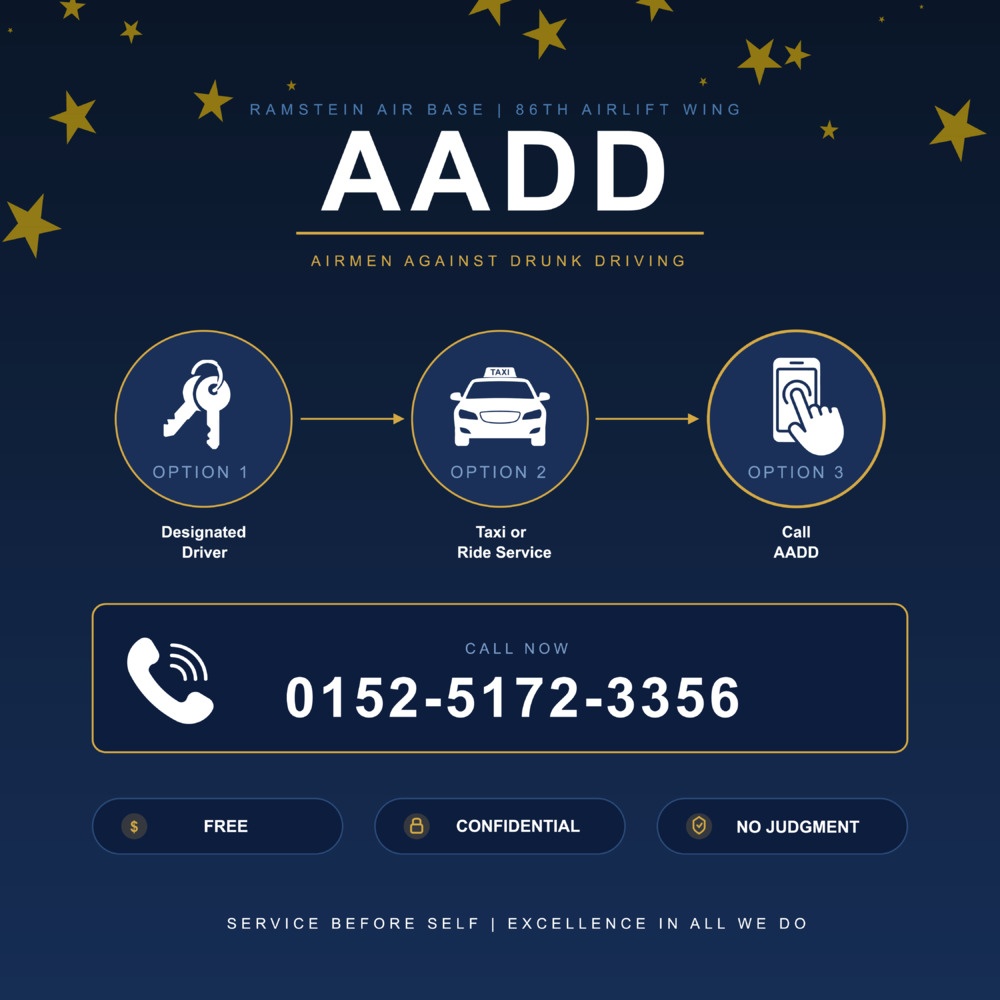
Photo By Senior Airman Trevor Calvert | This graphic was created to spread awareness about the Airmen Against Drunk Driving...... read more read more
 Subscribe
Before the first drink is poured on a Friday night, a team of volunteers across the Kaiserslautern Military Community is already preparing to answer the phone.
Airmen Against Drunk Driving is a volunteer-based organization that provides free, confidential rides home to service members who have been drinking and are not in a condition to drive safely. Operating on weekends and during special events, the program exists because even one alcohol related incident is one too many. For the Airmen who run the program at Ramstein Air Base, AADD represents more than a free ride. It is a direct expression of two Air Force core values: Service Before Self and Excellence in All We Do.
“AADD is a service-before-self job that you're doing. You look at it at a bigger picture, you're helping 10 individuals out each night make it home safe”, said Tech. Sgt. Nicholas Carroll, AADD council president. “That is potentially 10 DUIs you are stopping, 10 careers, and more importantly 10 lives that you are saving.”
Germany presents a different environment for service members, especially those stationed overseas for the first time. The legal drinking age is 18 and the blood alcohol content limit is lower than in the United States. Host nation law enforcement can also conduct traffic stops at their discretion, meaning service members are held to a higher standard on the road.
“The standards here are different from what a lot of people are used to back home,” Carroll said. “You don’t have to be visibly intoxicated. Even if you’ve only had one drink and think you’re fine to drive, you could still be pulled over. That’s why awareness is so important.”
Tech. Sgt. Khadijah Rosario, AADD council vice president, said the AADD team works to get that information out as early as possible, including briefing newcomers upon arrival to the installation.
“We just try to push that information out as best as possible and let people know it’s not like how it was stateside,” Rosario said. “Some people don’t know that, unfortunately, so we’re making sure they hear it early.”
The program is designed to be simple and judgment free.
“An Airman who needs a ride calls the hotline number, gets connected with a volunteer dispatcher who takes down the details, and then that dispatcher informs the volunteer drivers to be dispatched,” said Senior Airman Chance McGee, AADD unit point of contact coordinator. “The service is free and completely anonymous.”
AADD operates with a minimum of one dispatcher and three drivers each night. Volunteers use their personal vehicles and come from every branch of service across the KMC.
The program also plays a direct role in supporting mission readiness.
“We are keeping Airmen safe and mission capable,” Rosario said. “Any Airman we lose to an incident is being taken out of the fight and leaving us short handed. The program is a force multiplier. It’s keeping people in the fight and ensuring the health, welfare and readiness of Airmen across the board.”
One of the most important messages the AADD team delivers is that calling for a ride is an act of responsibility, not a sign of weakness.
“Asking for a ride takes courage,” McGee said. “Admitting that you need help in that situation shows that you are mature enough to prioritize your safety and the safety of others. You’re committing to the Air Force over any sense of pride or embarrassment. It’s the ultimate act of taking responsibility for your actions.”
McGee and Caroll agree that the choice comes down to how an Airman wants to be known.
“I would much rather be known for ‘He called AADD’ than ‘He got a DUI,’” Carroll said. “You’re not only putting your own life at risk when you get behind the wheel. You’re putting someone else’s life at risk, someone who could not even be associated with you tonight, whether that’s somebody in our host nation or back stateside. You’re making a decision for them, and that’s not responsible.”
Rosario said being part of the program is about leading by example and bringing that standard back to her section.
“As a supervisor, we try to have behavior that our troops can model,” she said. “By signing up and being part of the council, I’m trying to set an example and bring that information back to my section. It’s about being a good Wingman for real. Not just saying it, but truly looking out for the person next to you and holding them accountable.”
For Carroll, the program reflects what it means to represent the United States while serving overseas.
“Excellence in all we do, on and off duty,” Carroll said. “If you’re excellent at work, be excellent at home. I don’t like it when people shed a bad light on us personally. That’s why I think this program is so important.”
For any Airman heading out this weekend, the AADD team has one message.
“Before you take your first drink, know how you’re getting home,” Carroll said. “Have your designated driver. Have money for a taxi. And above all else, have our number. You have multiple chances to make the smart choice. Please make it.”
| Date Taken: | 03.20.2026 |
| Date Posted: | 03.20.2026 05:48 |
| Story ID: | 560984 |
| Location: | RAMSTEIN-MIESENBACH, RHEINLAND-PFALZ, DE |
| Web Views: | 82 |
| Downloads: | 0 |

This work, The call that keeps Airmen in the fight, by SrA Trevor Calvert, identified by DVIDS, must comply with the restrictions shown on https://www.dvidshub.net/about/copyright.

No keywords found.




