
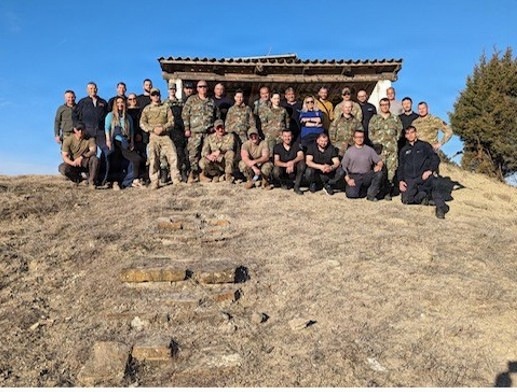
Courtesy Photo | Representatives from North Macedonia’s Protection and Rescue Directorate (PRD),...... read more read more
 Subscribe
SOUTH BURLINGTON, Vt. — When a suspicious bazooka round turns up in a Vermont garage or a decades-old artillery round is uncovered at a construction site overseas, Master Sgt. Andrew Borgens and his team are often the ones called to respond.
Borgens serves as the 158th Explosive Ordnance Disposal flight chief with the Vermont Air National Guard’s 158th Fighter Wing, where he leads Airmen charged with protecting people and property from explosive hazards.
“The easiest definition would be that we’re in charge of protection of personnel and property when it comes to explosive hazards,” Borgens said.
Protecting Vermonters from Explosive Hazards
EOD technicians are trained to identify, render safe and dispose of explosive devices. In Vermont, the team’s primary mission is supporting aircraft operations at the 158th Fighter Wing, ensuring the safe handling of flares and other ordnance components.
Beyond the flight line, they also respond across the state under the military munitions rule. When military ordnance is discovered in civilian areas, the Department of War is responsible for its disposal.
The Vermont State Police frequently contact the 158th EOD team to investigate and mitigate those hazards.
On average, the unit responds to about one call per month. Some years bring as few as six or seven calls; others are busier. During the COVID-19 pandemic, activity increased significantly.
“Everyone was home cleaning out garages, going through their grandparents’ old belongings,” Borgens said. “We had a lot of calls in 2020 and 2021.”
Many of those discoveries involve hand grenades brought home decades ago as war souvenirs. Other responses have included bazooka rounds, mortars and artillery shells.
Museums also occasionally request assistance to determine whether display items are inert. In some cases, items believed to be safe are found to be live.
When possible, the team works to properly inert historical items and return them for display. When they are unsafe, the technicians take custody and dispose of them.
One call that stands out for Borgens came during a winter blizzard shortly before a 2019 deployment. The team responded to a rural Vermont residence after a man reported having suspicious items.
On arrival, the technicians found a live fuze sitting on the passenger seat of a vehicle. In the garage, they discovered additional munitions, including a bazooka round and a mortar round that had been spray-painted and did not appear authentic at first glance.
After diagnostics, the team confirmed the items were live and transported them for safe disposal.
“That’s kind of how a lot of the responses go,” Borgens said. “You get new information that you weren’t expecting and you have to adjust and be ready for anything.”
Despite the inherent risk, Borgens said the extensive EOD training pipeline prepares technicians to rely on repetition and teamwork rather than emotion in high-stress situations.
“We train so intensively that when you go on a real response, you fall back on muscle memory,” he said. “We operate in teams. We discuss everything on site and make sure everyone’s thought process is going in the right direction.”
Building a Safer Future in North Macedonia
Since 2020, Borgens and members of the 158th EOD flight have also supported Vermont’s State Partnership Program with North Macedonia.
Under a humanitarian mine action initiative, the Vermont team is helping North Macedonia develop its own self-sustaining EOD capability. The effort focuses on a “train the trainer” model, enabling Macedonian personnel to certify and train their own technicians to international standards.
“We’re there to teach them how to help themselves,” Borgens said. “Once they’re capable of self-sustainment, we can step back and it becomes more of a partnering effort.”
Although North Macedonia has declared itself free of land mines, the country continues to contend with large quantities of explosive remnants of war dating back to World War I and other conflicts. In one instance, construction workers in Bittola uncovered a massive stockpile of buried artillery rounds.
According to Borgens, official reports indicate that tens of thousands of ordnance items are found annually across the country.
During each engagement, Vermont Airmen conduct classroom instruction followed by hands on training using inert munitions. In the final phase, Macedonian technicians conduct live disposal operations while U.S. personnel observe and advise, ensuring safety and adherence to international standards.
The work has been among the most rewarding of Borgens’ career.
“To be honest, I think it’s some of the most satisfaction I’ve gotten out of my career as anEODtechnician… maybe you’ve left a fingerprint on the safety of civilians in a foreign country—it’s a really fulfilling experience,” he said.
Supporting National Security Missions
In addition to state and international missions, the 158th EOD flight supports very important person protection details in coordination with the U.S. Secret Service. The team has provided support for presidential inaugurations and visits by national leaders, searching for explosive hazards to safeguard protectees and the public.
Answering the Call
Borgens enlisted in December 2015 and earned his EOD badge on March 2, 2018, after completing the demanding training pipeline. Originally a math major at Norwich University, he made the decision to pursue EOD after scoring highly on the Armed Services Vocational Aptitude Battery and learning more about the career field. “I don’t know that I could have done anything else,” he said. “I’ve fallen in love with it. I wouldn’t change a thing.”
| Date Taken: | 03.19.2026 |
| Date Posted: | 03.19.2026 15:32 |
| Story ID: | 560956 |
| Location: | SOUTH BURLINGTON, VERMONT, US |
| Web Views: | 278 |
| Downloads: | 0 |

This work, Disarming Danger: VTANG EOD's Dual Mission, by MSgt Ryan Campbell, identified by DVIDS, must comply with the restrictions shown on https://www.dvidshub.net/about/copyright.


No keywords found.




