
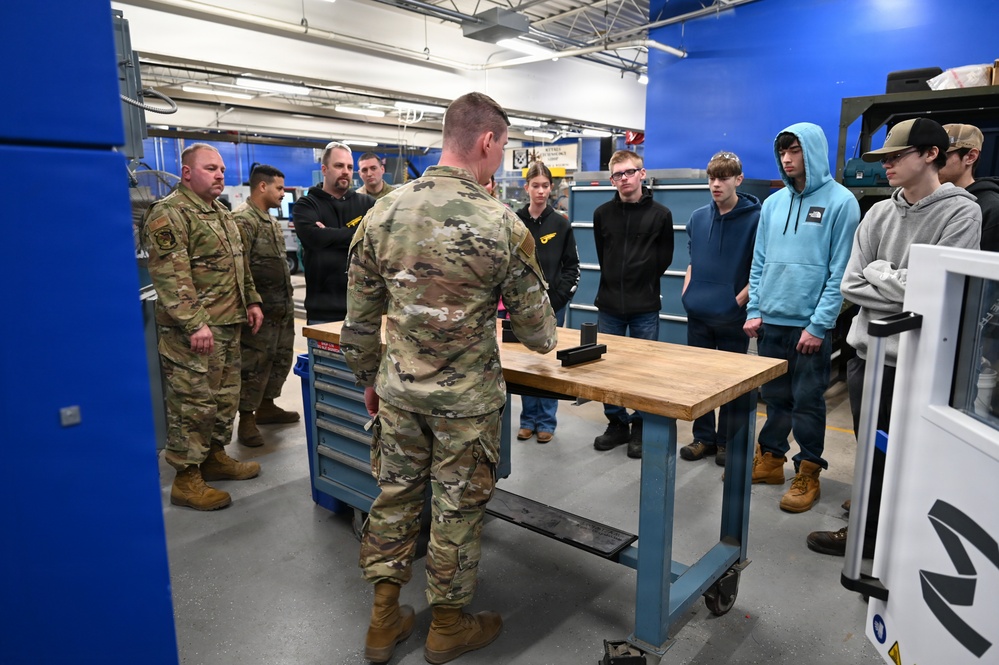
Photo By Melanie Casineau | U.S Air Force SSgt. Ryan Krasnecky, 104th Fighter Wing Metals Technology shop, speak...... read more read more
 Subscribe
BARNES AIR NATIONAL GUARD BASE, WESTFIELD, Mass. — Members of the 104th Fighter Wing Metals Technology Shop spoke with sophomore students in the Advanced Manufacturing class from Smith Vocational School on Thursday, March 12, 2026, at Barnes Air National Guard Base in Westfield, Massachusetts.
U.S. Air Force MSgt. Travis Miller, 104th Fighter Wing metals technology supervisor, explained the differences between manufacturing in the civilian sector and in federal service.
“In this shop, we handle everything from manufacturing and fabrication to 3D printing, scanning, project assembly, and fixture assembly,” said Miller. “We do everything from start to finish, which is very different from the civilian world, where each of these tasks is typically a separate job.”
Another key difference is the type of projects and missions supported. Certain bases across the country produce their own aircraft parts. When engineers encounter an issue, they may turn to metals technology shops for solutions. For example, technicians can scan a section of an aircraft and fabricate a custom part, such as a stiffener, to meet specific needs.
Some components for aircraft like the C-5 can also be produced in-house. For instance, small wedge-shaped parts used in snubber panels on the wings are created using 3D printing.
Currently, 3D printers are not authorized to produce parts for aircraft in flight, but they can be used to create parts for grounded aircraft, subject to FAA regulations. Some bases across the country already have this capability.
Miller emphasized that while civilian companies focus on generating profit, federal shops prioritize mission readiness and cost savings. “Civilian companies produce products to make a profit,” he said. “Our focus is making sure the aircraft can fly while saving money.”
He also noted that metals technology skills are transferable across platforms. “Machining is machining, drilling is drilling, and heat treating is heat treating,” Miller said.
Miller shared a personal example from his time deployed in the United Arab Emirates. While working on a KC-10 refueler, he encountered a critical issue with the aircraft’s refueling boom—the last one available in the entire inventory.
“If we couldn’t fix it there, it would have had to be shipped back to the United States,” he said. “In four hours, we saved about a million dollars.”
The issue involved a bearing that had become misaligned, going out of round by 60 thousandths of an inch. Despite initial doubts, the team successfully repaired it on-site.
Looking ahead, Miller highlighted the growing potential of 3D printing in federal operations, including the possibility of printing drones and deploying mobile 3D printing units. These units could be transported on cargo aircraft, set up on location, and used to produce mission-essential parts on demand.
Overall, the differences between civilian and federal careers in metals technology come down to purpose and structure. Civilian roles are typically profit-driven and highly specialized, while federal positions focus on mission readiness, cost efficiency, and the ability to manage multiple aspects of production within a single shop.
| Date Taken: | 03.12.2026 |
| Date Posted: | 03.17.2026 14:40 |
| Story ID: | 560736 |
| Location: | WESTFIELD, MASSACHUSETTS, US |
| Web Views: | 74 |
| Downloads: | 0 |

This work, Metals Technology Shop Highlights Differences Between Civilian and Federal Careers for Students, by Melanie Casineau, identified by DVIDS, must comply with the restrictions shown on https://www.dvidshub.net/about/copyright.


No keywords found.




