
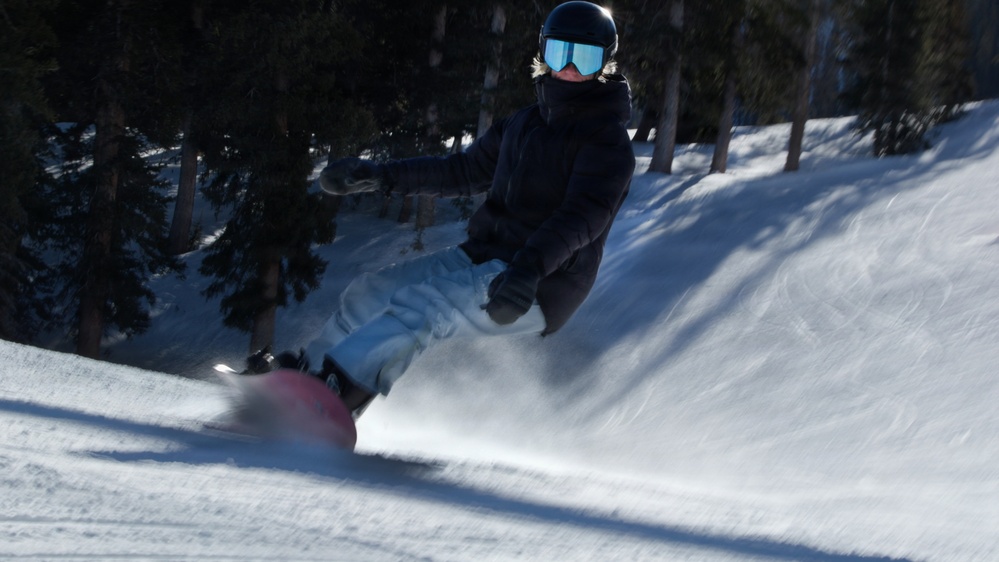
Photo By Travis Weger | Olympic medalist Shannon Dunn-Downing carves a turn while snowboarding on National...... read more read more
 Subscribe
For Shannon Dunn-Downing, the path to the Olympics did not begin in a training facility or in a private club, it began on public lands in the mountains of Colorado. The Olympic medal that would later define her place in snowboarding history was earned through access and determination.
Dunn-Downing is the first American in history to win an Olympic medal for snowboarding, at the 1998 Olympic Games in Nagano, Japan. This was also the year where the sport made its Olympic debut. At the time, snowboarding was still viewed as counterculture, a sport finding its footing on the world’s stage. Dunn-Downing’s success not only helped legitimize the sport, but snowboarding also eventually became one of the most watched sports during the Winter Olympics.
“Every Olympian that I know has started with humble beginnings,” said Dunn-Downing. “You just go up with their family because your family likes to be in the outdoors, and you just learn how to ski or snowboard.” As a child, Dunn-Downing moved to Steamboat Springs, Colorado, from the suburbs of Chicago. The transition was major, but she quickly found that in rural Colorado, entertainment was not something consumed indoors, it was earned outside. The mountains became her backyard, and she explored them at every opportunity.
Throughout the 1980s and 1990s, snowboarding was still new and often unwelcome at popular ski resorts. Her newfound freedom was rooted in access to public lands managed by the U.S. Forest Service. Dunn-Downing’s early training did not require a membership, it required space and snow. The trails and slopes where she practiced were not traditional ski areas, they were in the backcountry and were available to anyone willing to show up and hike to the top. “Public lands are my life. I grew up snowboarding the mountains, hiking the trails, and building my life around being outdoors,” said Dunn-Downing. “That’s where I felt alive, it was just where life happened for me.”
Across the country, there are 116 active ski resorts that operate on National Forest System land, which accounts for more than 60% of the skiable terrain in the United States. These resorts function through long-term special use permits that allow private operators to build and maintain infrastructure, while the land remains publicly owned. This partnership between Forest Service land managers and resort operators created a system that supports recreation, conservation and high-performance sports. This allows operators to invest in the local community, while planning for the future, knowing that the land will remain dedicated to recreation.
This system serves multiple purposes, from supporting athletes chasing Olympic dreams, to supporting local economies built around recreation and tourism. It also supports families seeking connection to the outdoors and supports conservation by keeping land publicly owned and responsibly managed. While the Olympic Games last for two weeks every four years, the training happens year-round. Athletes often live and train in the mountain communities, and they dream of Olympic success in places that are open to the public.
“They live in these communities, they train in these communities, and they dream of Olympic gold in these communities,” said Roger Poirier, Recreation Staff Officer in the White River National Forest. “It’s important that we’re here to support them, and the Forest Service is the backdrop to all of it.” For Dunn-Downing, that partnership is personal. Her Olympic story is inseparable from where she grew up, where the mountains served more as a classroom than just as a backdrop.
Today, she turns to the outdoors as a source of grounding and connection, spending time with her family, creating experiences more than accumulating things. She describes those shared moments as relationship builders and a way to stay connected in a fast-paced world. “When we’re outdoors in the elements, we’re pushing our bodies and our minds,” said Dunn-Downing. “We’re doing something together away from our phones and are completely disconnected. Because of that disconnection, we are completely connected.”
Looking back, Dunn-Downing does not frame her Olympic achievement as an isolated event, it was part of a larger arc that began with a move to a small mountain town and continued through years of spending time outdoors.
Across the country, skiers and snowboarders are outdoors learning on the same slopes that host World Cup races, sharing ski lifts with athletes that are dreaming of winning an Olympic medal. Public lands make that dream possible. It transforms open space into opportunity, and is quite literally, where Olympians are made.
| Date Taken: | 02.06.2026 |
| Date Posted: | 03.17.2026 12:39 |
| Story ID: | 560726 |
| Location: | US |
| Web Views: | 56 |
| Downloads: | 0 |

This work, How Public Lands Help Shape Olympic Athletes, by Travis Weger, identified by DVIDS, must comply with the restrictions shown on https://www.dvidshub.net/about/copyright.


No keywords found.




