
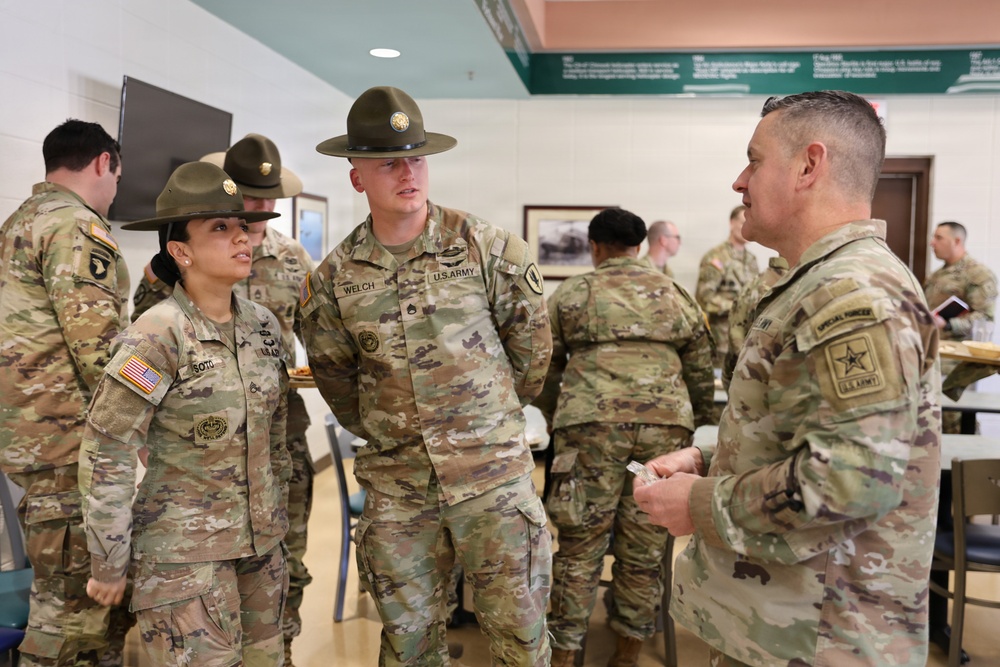
Photo By Leslie Herlick | Sgt. Maj. of the Army Michael Weimer talks with Staff Sgt. Joccelyne Soto and Staff...... read more read more
FORT RUCKER, Ala. — Sgt. Maj. of the Army Michael R. Weimer visited the U.S. Army Aviation Center of Excellence and Fort Rucker, Alabama, on March 12 and 13,2026, meeting with leaders, instructors and Soldiers across the installation to discuss talent management, training realism, modernization and the enduring purpose of military service.
Across two days of engagements, Weimer repeatedly returned to the idea that service in the Army is rooted in purpose rather than incentives. During a working lunch with Fort Rucker’s command sergeants major, he noted that many in the room had more than 20 years of service and could be doing something else, yet they chose to remain in uniform, a commitment he said reflects the professionalism that sustains the Army’s strength. He added that protecting the American way of life, despite the “messy realities that come with it,” remains central to why soldiers continue to serve.
That sense of purpose shaped many of the conversations that followed. Weimer encouraged leaders to think deliberately about how they cultivate meaning within their formations and to understand what motivates their Soldiers. He urged them to mentor consistently, provide honest feedback and ensure that purpose, not convenience or careerism, remains at the heart of service.
Talent management was another major theme throughout the visit. Weimer stressed the need to move beyond a simple plug and play approach to filling positions and encouraged leaders to understand Soldiers’ strengths, experiences and personalities so they can be placed where they will be most effective. He also highlighted shortcomings in the NCO Evaluation Report (NCOER) system and said evaluations must more clearly differentiate performance if the Army is to identify and develop talent. Honest assessments, transparent feedback and thoughtful placement decisions, he said, are essential to building cohesive and capable teams.
Training realism and informed risk management were also central to his discussions. Weimer cautioned against overly protective training environments and said Soldiers must learn to manage risk before facing it in combat. “Training should not be stopped simply because it carries risk,” he told leaders, emphasizing that operational challenges must be solved in training rather than discovered in real missions. He noted that Soldiers often leave the Centers of Excellence with strong standards that are not always maintained at operational units and urged leaders to ensure those standards are sustained at the first duty station.
Modernization and adaptation were woven throughout the visit as well. Weimer discussed the Army’s need to move faster in response to emerging threats and pointed to artificial intelligence, unmanned systems and data driven decision making as essential components of future readiness. At AVCOE headquarters, he praised efforts to integrate AI into training and highlighted the importance of collecting real time operational data, noting that many modern battlefield challenges “should not come as surprises to the force.” He also underscored the growing need to operate manned and unmanned aircraft in shared airspace and encouraged leaders to address these challenges in training rather than in conflict.
During the visit, Weimer also recognized two NCOs whose actions reflected the professionalism he highlighted throughout his engagements. He presented a coin to Staff Sgt. Nicholas Cruz, 164th Theater Operations Group, for his decisive role in locating a runaway child and to Sgt. 1st Class Collin Chapman, Fort Rucker Noncommissioned Officer Academy, for organizing and hosting more than 100 Junior ROTC students during a physical fitness competition at the NCO Academy. Weimer noted that he gives coins judiciously for truly exceptional examples of excellence.
At another working lunch with NCO instructors, Weimer emphasized that the Army is driven by purpose and mission rather than financial incentives. He said that sense of purpose that comes from protecting the American way of life is difficult to replicate outside of military service. He reminded leaders that advancement begins with competence, discipline, fitness and being a good teammate and that Soldiers who are not strong teammates are unlikely to become effective leaders.
Weimer closed several engagements by urging leaders to challenge outdated mindsets, embrace data and remain agile in the face of evolving threats. He said the Army must become more predictive, more transparent and more decentralized to remain effective.
| Date Taken: | 03.17.2026 |
| Date Posted: | 03.17.2026 15:33 |
| Story ID: | 560710 |
| Location: | ALABAMA, US |
| Web Views: | 20 |
| Downloads: | 0 |

This work, SMA Weimer emphasizes purpose, talent management and modernization during Fort Rucker Visit, by Leslie Herlick, identified by DVIDS, must comply with the restrictions shown on https://www.dvidshub.net/about/copyright.


No keywords found.





