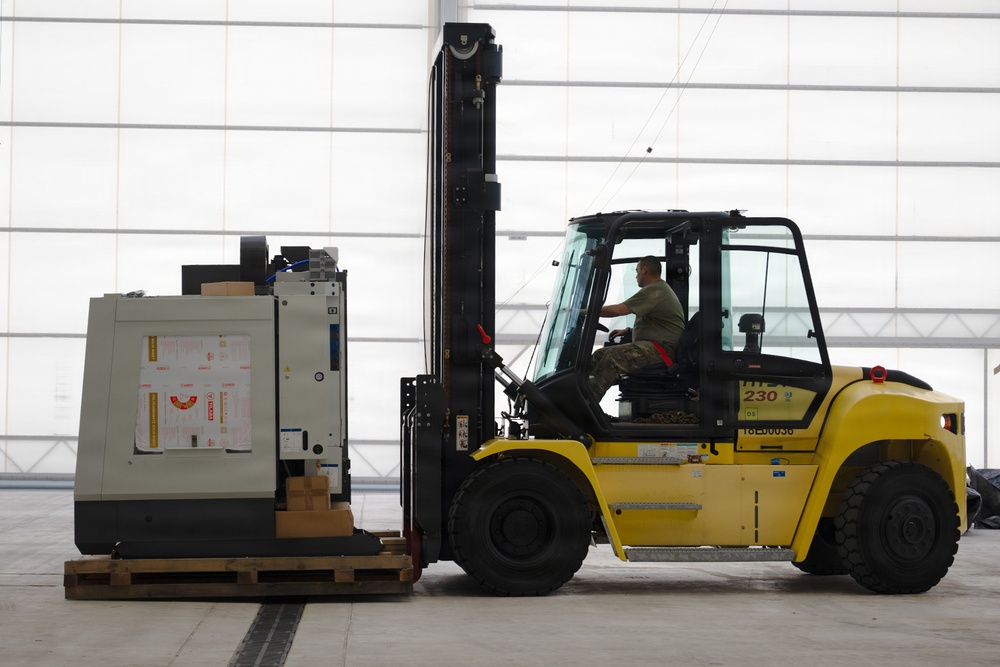
Photo By Staff Sgt. Taylor Queen | Tech. Sgt. Bryan Kopp, an aircraft metals technology specialist with the 64th Air Refueling Squadron, repositions a CNC milling machine March 11, 2026 at Pease Air National Guard Base, New Hampshire. The new machine will allow both the 64th and the 157th Air Refueling Wing to produce non-procurable parts.( U.S. Air National Guard photo by Staff Sgt. Taylor Queen) see less
| View Image Page
PEASE AIR NATIONAL GUARD BASE, N.H. - The 157th Air Refueling Wing aircraft metals
technology shop accepted a delivery of two Haas VF4 CNC milling machines.
For decades, metals technology specialists assigned to the wing and 64th Air Refueling
squadron manually milled parts on a single Bridgeport machine that was built in 1989. The
machine had long been the backbone for turning aluminum and steel stock into aircraft parts at
the base.
“This is really the industry standard for milling parts,” said Tech. Sgt. Colby Jerran, a metals
technology specialist with the 157th Maintenance Group. “It has repeatability. It can make the
same part again and again within the tolerances.”
The new machines feature high-speed spindles, automatic tool changer, three axises and
accuracy up to .001 inch. Unlike the older manual mill, which required multiple setups, the new
machine can manufacture more complex parts, quicker.
“If you’re going to make the same part more than once, it’s a lot faster,” said Jerran. “Let’s say I
could make a part in four hours the manual way. Now it’ll take roughly four hours to program it,
but each additional part will only take 15 minutes.”
With the addition of the two new CNC machines, the shop now expects to be able to increase
and expedite production capabilities.
“We’re such a small shop, it will help cut down on man hours too,” said Tech. Sgt. Bryan Kopp of
the 64th Air Refueling Squadron. “We’ll be able to load the part, touch off, get it going, and do
other things while me monitor.”
But the new mills may prove to be more than just a faster production effort. As with any new
platform, the Boeing KC-46 will need parts that would otherwise be unprocurable for various
reasons.
“It’s based off the 767 frame, but obviously we have very specific parts,” said Kopp. “There’s a
lot of things on the aircraft that are military specific.”
Once fully installed, the Airmen will receive refresher training on the machine and start
producing mission essential parts that will keep the total force mission moving forward.

 Subscribe






