
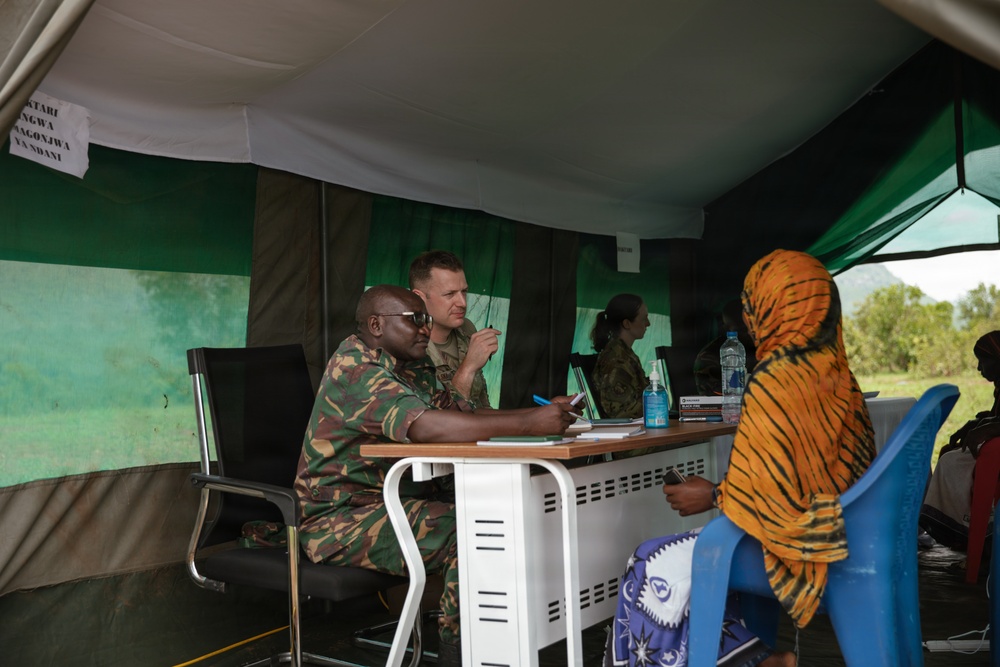
Photo By Capt. Tucker Chase | U.S. Air Force Maj. Daniel Cybulski, an infectious disease physician with the Center...... read more read more
 Subscribe
DAR ES SALAAM, Tanzania –- U.S. Army military medical professionals tested the Medical Currency Application for Readiness Tracking 2.0, a digital, field-medicine tracker, for the first time in Africa during Justified Accord 2026 at Lugalo General Military Hospital and Msata Military Training Base, March 2-12.
Justified Accord is U.S. Africa Command's largest exercise in East Africa. This year's event connected U.S. military medical professionals, Tanzanian healthcare providers and Nebraska Air National Guard personnel through the Nebraska-Tanzania State Partnership Program.
Historically, military leaders have struggled to measure the readiness value of medical care. Providers would gain critical clinical experience during exercises, but the data only existed in spreadsheets, paper logs or individual memory. The inaugural medical readiness exercise represented an opportunity to use MCART 2.0 to quantify operational readiness.
“MCART began as an effort to create a self-reporting tool that would allow military medical personnel to document readiness-relevant clinical activity, particularly care delivered outside military treatment facilities,” said U.S. Air Force Col. Justin Fox, professor of surgery at the Uniformed Services University of the Health Sciences.
The concept emerged approximately five years ago and was initially developed as a proof-of-concept application within the U.S. Air Force to address a persistent gap in capturing operational clinical experience.
Now, MCART 2.0 is a cloud-enabled, modular system. Providers log encounters, procedures, diagnoses and clinical hours through a mobile interface. The platform aggregates clinical data and adds calculated measures like work-relative value units, joint knowledge, skills and abilities metrics, then populates that data to a dashboard for senior leaders.
The system captures service-specific readiness requirements, such as U.S. Army individual critical task lists, and U.S. Air Force comprehensive medical readiness program activities, which creates a single joint operational picture.
In October 2025, the development team began coordinating with U.S. Army Southern European Task Force, Africa (SETAF-AF) to determine how to introduce and integrate the tool into military exercises in Africa.
Planners collaborated to incorporate specific situational reporting requirements and medical specialties into the system. This preparation resulted in a tailored tool that matched SETAF-AF’s reporting workflows and JA26 MEDREX requirements.
“MCART 2.0 was integrated into the Justified Accord MEDREX as the standardized mechanism to capture clinical activity and readiness-relevant events,” Fox said. “Entries are aggregated into near real-time dashboards to provide visibility to mission and command leadership.”
Within the first days of the MEDREX, the dashboard began displaying patient encounter totals and procedure counts. For the first time, the database captured clinical data related to dermatology and bioenvironmental engineering.
“The system allows us to capture the work that our medical teams are doing in a way that translates directly into readiness,” said U.S. Air Force Lt. Col. Benjamin Pass, an international health specialist with Air Combat Command's Office of the Command Surgeon. “It provides leaders with visibility into the clinical activity taking place across the mission and helps demonstrate the value of these engagements.”
The platform, developed in collaboration with USU, has supported more than 20 missions across U.S. Southern Command and U.S. Indo-Pacific Command, and its use has extended to U.S. Africa Command through JA26.
MCART 2.0 training has evolved from informal orientation to a structured onboarding approach. Training emphasizes short, practical sessions that guide users through account setup, logging encounters and understanding how their entries translate into mission and readiness metrics.
“The most significant improvements came from the hundreds of end users across the Army, Navy and Air Force who tested the application during operational missions and exercises,” Fox said. “Their feedback was critical in improving usability and ensuring the platform met the practical needs of clinicians operating in real-world environments.”
U.S. Air Forces Southern Command led early adoption, and the Navy first used the platform during Pacific Partnership in 2025. SETAF-AF’s adoption during JA26 advances the Army’s transformation initiative, applying an innovative medical readiness tool in Africa.
Ongoing efforts are underway to migrate MCART 2.0 into the Defense Health Agency’s IT infrastructure to support long-term sustainment and enable it to function as an enterprise capability. As part of this effort, data will transition into the Military Health System Information Platform, allowing secure access for DHA and military department analytic teams to support program evaluation and provider readiness assessments.
For SETAF-AF, Africa serves as a battle lab where joint medical teams can validate tools defining readiness across the total force. By integrating digital tracking during the MEDREX, U.S. forces proved innovative training enables partner-led security.
| Date Taken: | 03.13.2026 |
| Date Posted: | 03.26.2026 15:26 |
| Story ID: | 560579 |
| Location: | DAR ES SALAAM, TZ |
| Web Views: | 144 |
| Downloads: | 1 |

This work, US Army tests medical readiness tracker for the first time in Africa during Justified Accord 2026, by CPT Tucker Chase, identified by DVIDS, must comply with the restrictions shown on https://www.dvidshub.net/about/copyright.


No keywords found.




