
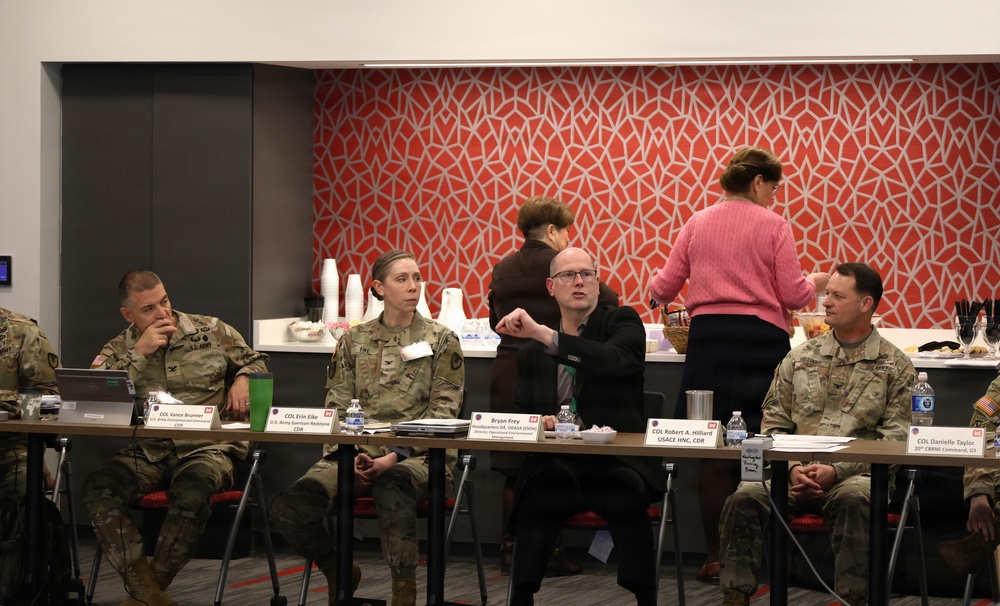
Photo By Lillian Putnam | Army leaders and environmental experts met at Redstone Arsenal for the Feb. 25...... read more read more
REDSTONE ARSENAL, Ala. — Army leaders and environmental experts met at Redstone Arsenal for the Feb. 25 inaugural meeting of a working group focused on strengthening coordination and advancing environmental restoration across the installation.
The meeting brought together representatives from U.S. Army Environmental Command, U.S. Army Corps of Engineers Engineering and Support Center Huntsville, U.S. Army Combat Capabilities Development Command Chemical Biological Center, Redstone Chemical Activity and other Army organizations to discuss ongoing operations and identify ways to improve coordination and efficiency across the mission.
“The primary purpose of the Environmental Restoration Leaders Working Group is to bring together key leaders from across the Redstone Arsenal enterprise and its partner organizations,” Ashley Roeske, Huntsville Center Ordnance and Explosives Supervisory Program Manager, said. “The goal is to create a dedicated forum for open dialogue and collaborative problem-solving to address the complex, long-term environmental restoration challenges at the installation.”
The installation has been a focal point for Army cleanup operations for more than a decade. Environmental restoration efforts at the installation involve addressing a wide range of legacy contaminants while also managing the recovery and safe destruction of chemical munitions discovered during remediation work.
Roeske emphasized the broader impact of the mission and the importance of the ongoing restoration efforts.
“These efforts are fundamentally about enabling Redstone Arsenal's future. The primary importance is to clean up and restore land that is critical for the installation's growth and its ability to support future Army missions,” Roeske said.
The Director of Operational Environmental Management from the Office of the Assistant Secretary of the Army for Installations, Energy, and Environment, Bryan Frey, emphasized that close collaboration between organizations will be essential to maintaining momentum and ensuring operations move forward smoothly.
“We need solution-oriented folks supporting this effort, people who are concerned with solving the Army’s problems, not just their individual organization’s problems,” he stated.
Roeske said innovation and flexibility will also play an important role in the group’s efforts moving forward.
“Innovation and flexibility are identified as absolutely critical for success. The leadership team acknowledges that the challenges they face are unique,” she said. “They emphasize the need to be open to new ideas, adapt to unforeseen challenges and empower their teams to think creatively.”
Participants concluded the meeting by outlining next steps to strengthen coordination among the variety of organizations involved with the mission. The working group plans to map out cleanup efforts, helping organizations better understand the steps involved and improve coordination across the process.
“The intended lasting effect of this working group is to establish a new, collaborative culture and a repeatable framework for tackling complex challenges at Redstone Arsenal,” she explained. “By fostering relationships and creating shared understanding across different organizations, the group aims to create a more unified and effective approach to environmental restoration that will outlive the group itself.”
| Date Taken: | 03.13.2026 |
| Date Posted: | 03.13.2026 16:09 |
| Story ID: | 560536 |
| Location: | ALABAMA, US |
| Web Views: | 137 |
| Downloads: | 0 |

This work, Redstone Arsenal leadership convenes for inaugural restoration working group, by Lillian Putnam, identified by DVIDS, must comply with the restrictions shown on https://www.dvidshub.net/about/copyright.

No keywords found.





