
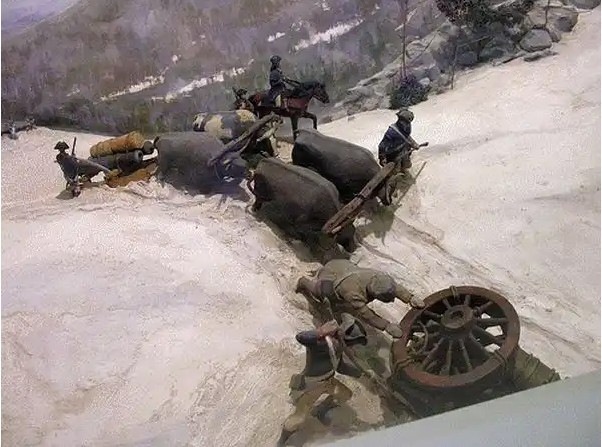
Courtesy Photo | Depicting the troubles and tribulations of the movement of the Ordnance.... read more read more
As the United States approaches its 250th birthday, we are reminded by the American Revolution that the nation's independence was won not only by battlefield bravery but also by extraordinary feats of logistical ingenuity. The British evacuation of Boston on 17 March 1776, a date still celebrated as Evacuation Day in Massachusetts, stands as one of the Continental Army's first major strategic victories. This pivotal success, however, would have been impossible without a preceding logistical miracle. This impressive feat would come to be known as the "Noble Train of Artillery," a testament to the Continental Army's ability to project power through sheer will and meticulous planning.
Following the Battles of Lexington and Concord, a force of colonial militia laid siege to Boston, trapping the British army within the city. Yet, it was a stalemate. The British, commanded by General William Howe, controlled the harbor and were easily resupplied by the Royal Navy. The Continental Army, under the new command of General George Washington, lacked the heavy artillery required to threaten the British fleet or their fortifications. To break the siege, Washington needed firepower. That firepower sat captured and idle, 300 miles away at Fort Ticonderoga and Crown Point in upstate New York.
The task of retrieving these armaments fell to Colonel Henry Knox, a 25-year-old former Boston bookseller.A self-taught military engineer and avid reader of military history, Knox possessed a deep knowledge of artillery and confidence that impressed Washington.Washington gave Knox his orders on 16 November 1775 to journey to Ticonderoga and bring the cannons to Boston, sparing "no trouble or expense."Knox reached Fort Ticonderoga on 5 December and began the monumental task of inventory and selection.He chose 59 pieces of ordnance: iron and brass cannons ranging from 4 pounders to massive 24 pounders, and several mortars. The total weight was estimated at nearly 60 tons.
The expedition began with a waterborne leg.The heavy guns were moved from the fort down to the shore of Lake George in upstate New York, then loaded onto a small flotilla. Disaster struck almost immediately.The overloaded barge carrying the heaviest artillery floundered in the shallows and later was swamped by high winds causing it to sink.The crew, in a remarkable display of field recovery, managed to bail and refloat the vessel, saving the precious cargo.
Upon reaching the southern end of Lake George, the true logistical test began. Knox had to move the train overland. His plan depended on snow and ice.He arranged for the construction of 42 "exceeding strong sleds" and, with crucial assistance from Major General Philip Schuyler, the commander of the Northern Department, began procuring the necessary draft animals and teamsters.Schuyler's local expertise proved invaluable; he intervened to prevent Knox from being overcharged by a contractor for building new sleds. While popular imagery, like Tom Lovell's famous painting used in this article, depicts oxen as the main transportation power. Knox's diary and records show that from Fort George to Springfield, Massachusetts, the train was pulled primarily by teams of horses, numbering around 124 pairs.
Crossing the semi-frozen Hudson and Mohawk rivers presented another series of crises.Cannons repeatedly crashed through the ice, and in each instance, they were painstakingly recovered.Knox employed innovative tactics, ordering his men to pour water onto the ice to thicken it overnight, a simple but effective bit of field engineering to support the immense weight.
The journey across the Berkshire Mountains of western Massachusetts was the most grueling phase. The roads were little more than rough tracks, and the steep grades were a nightmare for the heavily laden sleds.Knox himself wrote in his diary that it seemed "almost a miracle that people with heavy loads should be able to get up & down such hills as are here."The support of local communities along the route was critical. Farmers and laborers stepped up to lend fresh animals, repair sleds, and literally put their shoulders into hauling the guns up the steepest slopes.
After a brutal 56-day, 300-mile journey, far longer than the two weeks he had optimistically planned Knox's "noble train of artillery" arrived outside Boston on January 25, 1776. Washington wasted no time. On 4 March, his troops stealthily fortified Dorchester Heights just to the south of Boston with the newly arrived cannons, placing the British fleet and city in their sights. Upon seeing the Continental advantage, General Howe had no choice but to negotiate a withdrawal. On 17 March 1776 the British evacuated and the fleet sailed for Nova Scotia.
Hailed as "one of the most stupendous feats of logistics" of the entire war, the Knox Expedition was a profound victory.It demonstrated the resourcefulness and resilience of the Continental Army and solidified George Washington's leadership. The expedition remains a masterclass in operational planning, resource management, improvisation. As America celebrates its 250th anniversary, the story of Henry Knox and his Noble Train serve as a powerful founding story for the U.S. Army's long and proud history completing the mission.
Knox, Henry. "Diary of Henry Knox." In The New England Historical and Genealogical Register, Vol. XXX. Boston: New England Historic Genealogical Society, 1876. The Papers of George Washington, Revolutionary War Series, vol. 2, 16 September 1775-31 December 1775. Edited by Philander D. Chase. Charlottesville: University Press of Virginia, 1987. Brooks, Victor. The Boston Campaign: April 1775-March 1776. Conshohocken, PA: Combined Publishing, 1999. Callahan, North. Henry Knox: General Washington's General. New York: Rinehart & Company, 1958. McCullough, David. 1776. New York: Simon & Schuster, 2005. Philbrick, Nathaniel. Bunker Hill: A City, a Siege, a Revolution. New York: Viking, 2013.
| Date Taken: | 03.13.2026 |
| Date Posted: | 03.13.2026 15:31 |
| Story ID: | 560530 |
| Location: | US |
| Web Views: | 146 |
| Downloads: | 0 |

This work, A Logistical Masterpiece- Evacuation Day and the Noble Train of Artillery, by Kaleb Bemis, identified by DVIDS, must comply with the restrictions shown on https://www.dvidshub.net/about/copyright.


No keywords found.





