
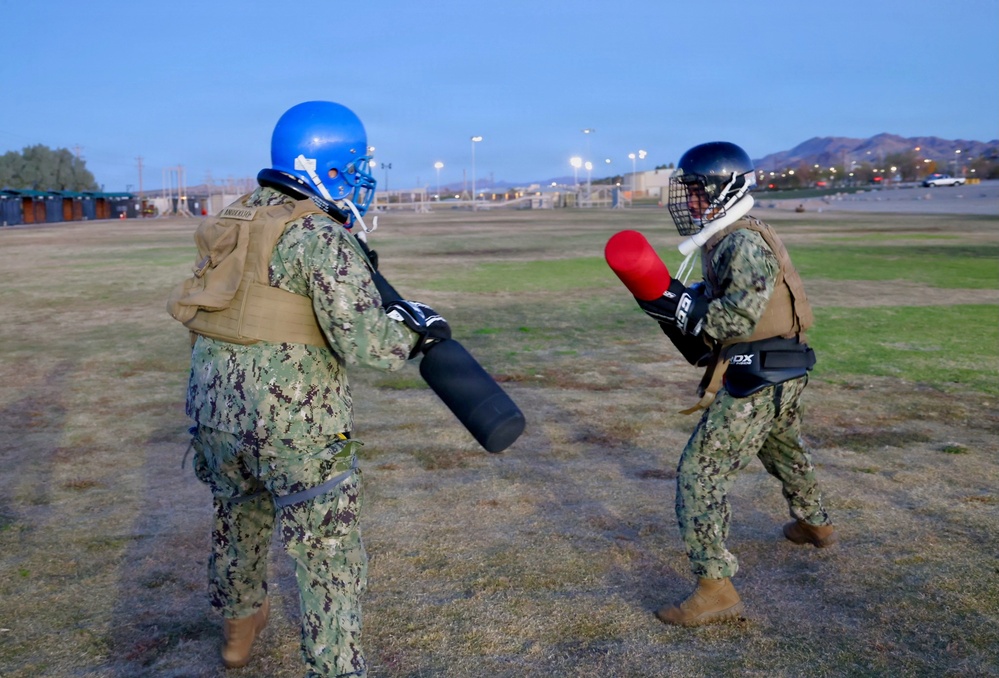
Photo By Christopher Jones | Hospital Corpsman 2nd Class Arturo Fregoso (left), assigned to Navy Medicine Readiness...... read more read more
TWENTYNINE PALMS, Calif. — Sailors assigned to Navy Medicine Readiness and Training Command (NMRTC) Twentynine Palms completed the Marine Corps Martial Arts Program (MCMAP) Tan Belt course in December 2025, participating in the physically demanding training under the instruction of a Marine instructor at Marine Corps Air Ground Combat Center Twentynine Palms.
Led by Marine instructor Staff Sgt. Joshua Hutchinson, the course introduced Sailors to the fundamentals of close-combat techniques, including strikes, grappling, weapon retention and warrior studies. The training pushed participants beyond their comfort zones while reinforcing the physical and mental attributes necessary to operate effectively in high-stress operational environments.
“MCMAP develops well-rounded warfighters mentally, physically, and ethically,” Hutchinson said. “It builds discipline, resilience, and the ability to make sound decisions under stress. That foundation benefits any service member, including Sailors, because confidence and composure matter in every operational environment.”
While the program is a cornerstone of Marine Corps training, its principles translate directly to Sailors serving alongside Marines in expeditionary environments. For corpsmen and other Navy personnel stationed at the combat center, the training offers both practical defensive skills and a deeper understanding of the warrior culture shared across the naval force.
When the Sailors from NMRTC Twentynine Palms first began the course, Hutchinson noted that many were stepping into unfamiliar territory.
“The Sailors came in motivated and professional, though many were outside their comfort zone,” Hutchinson said. “There was some early hesitation with the physical intensity, but they adapted quickly and stayed committed.”
As the training progressed, the Sailors’ approach to learning stood out.
“They brought an analytical mindset,” Hutchinson said. “As many were medical professionals, they focused on understanding the mechanics behind each technique. That attention to detail led to controlled, technically sound execution as their confidence grew.”
That combination of technical focus and teamwork became evident as the course advanced. “A memorable moment was seeing the peer-to-peer learning take shape,” Hutchinson said. “As their confidence grew, the Sailors began coaching and correcting each other, which accelerated improvement and strengthened team cohesion. It showed that MCMAP is built on shared growth as much as instruction.”
The Tan Belt course also introduced Sailors to the program’s practical combat applications, including pugil stick training. Pugil sticks—padded training tools that simulate rifle-and-bayonet combat—allow participants to engage in controlled force-on-force scenarios designed to build timing, aggression control and the ability to perform under stress.
For Sailors like Religious Program Specialist 2nd Class Diego Escalante, the course provided an opportunity to sharpen combat readiness during a shore assignment.
“A personal motivation for me to take on that challenge was to sharpen and refresh my combative skills during shore duty,” Escalante said.
As a religious program specialist who could often serve alongside Marines in operational environments, Escalante said the hands-on training reinforced confidence in his ability to respond if confronted with a hostile situation.
“As an RP, it was refreshing to feel physical contact because it gives you confidence on being more capable of handling future potential hostile environments,” he said.
Hospitalman Jessica Sanderson, who previously supported MCMAP training as a safety corpsman, decided to participate in the course herself after observing the program firsthand.
“I was curious to try something new,” Sanderson said. “I had been to MCMAP coverages as a safety corpsman. It looked like everyone was having fun practicing techniques, so I decided to give it a shot.”
Training under a Marine instructor also provided a unique learning experience.
“Staff Sgt. Hutchinson was great as an instructor in all aspects—thorough when it was time to learn and disciplined when it was time for challenges,” Sanderson said. “He was clear and direct with what was expected from us learning and was able to break down the how-to’s and knowledge he has learned throughout his career in the Marine Corps to prevent injury or improve techniques.”
By the end of the course, Sanderson said the experience had reshaped her approach to physical readiness and daily routine.
“The biggest difference I saw in myself was the adaptation to structure,” she said. “Maintaining a busier PT schedule in the early morning can be challenging at first, but after accepting and getting used to it, starting the day with fighting is nice in ways.”
Beyond the physical challenge, Sanderson said learning the fundamentals of the martial arts program helped reinforce personal safety awareness.
“Learning the basics and fundamentals of MCMAP has been insightful on what I can work on for my own personal safety,” she said.
Master-at-Arms 3rd Class Thuan Nguyen also viewed the course as an opportunity to challenge himself while building skills directly tied to his security mission.
“My main motivation for participating in the Marine Corps Martial Arts Program was to earn my Tan Belt certification and challenge myself physically and mentally while learning new skills,” Nguyen said.
As a law enforcement specialist responsible for maintaining order and security, Nguyen said the close-combat training strengthened his confidence.
“As a master-at-arms, learning these close-combat skills has made me more confident in my ability to protect myself and others,” Nguyen said. “The training has helped me feel better prepared to respond effectively in potentially hostile situations while performing my duties.”
Among the techniques taught during the course, Nguyen said one lesson stood out.
“One technique that stood out to me was learning the armbar,” Nguyen said. “It was valuable because it showed how proper technique and leverage can be used to control an opponent effectively, even without relying on strength alone.”
While the physical techniques form the foundation of MCMAP training, Hutchinson emphasized that the program’s broader purpose extends beyond combat skills.
“A Tan Belt gains basic strikes, grappling, weapon retention, and an introduction to warrior studies,” Hutchinson said. “More importantly, they build confidence and composure—skills that carry over into daily duties and high-stress situations.”
Training together also strengthens the relationship between Sailors and Marines at the combat center.
“When Sailors and Marines train together at Marine Corps Air Ground Combat Center Twentynine Palms, it builds mutual respect and strengthens interoperability,” Hutchinson said. “It reinforces that we operate as one naval force.”
For Navy Medicine personnel supporting Marines in both training and operational environments, that shared understanding can have direct impacts on mission readiness. Corpsmen who train alongside Marines gain greater familiarity with the physical demands placed on their patients and teammates, helping them better anticipate injuries, treat them effectively and return warfighters to duty.
Sanderson said participating in the training also provided insight that helps her better connect with Marines she may treat as patients.
“Knowing how this program works and what training is involved helps me treat Marines and Sailors as patients with common injuries from this training,” Sanderson said. “It helps share knowledge and connect with patients that want to get back to training.”
For Nguyen, the experience reinforced the value of stepping outside one’s comfort zone. “I would encourage others not to hesitate to try it,” Nguyen said. “The training is fun, challenging, and a great way to start the morning while building confidence and learning practical skills.”
Hutchinson said the true value of earning a Tan Belt lies not only in mastering techniques, but in carrying forward the mindset the program instills.
“Carry the mindset forward,” Hutchinson said. “The Tan Belt represents discipline and resilience. Apply that confidence and composure to your mission in Navy Medicine, especially under pressure. Above all, commit to being a lifelong student—continuously seek growth, refine your skills and never become complacent in your professional or personal development.”
Through programs like MCMAP, Sailors assigned to NMRTC Twentynine Palms reinforce the warrior ethos at the heart of Navy Medicine—developing confidence, resilience and lethality while preparing corpsmen to provide war-ready medical care wherever the mission demands.
| Date Taken: | 03.12.2026 |
| Date Posted: | 03.12.2026 15:59 |
| Story ID: | 560429 |
| Location: | TWENTYNINE PALMS, CALIFORNIA, US |
| Hometown: | BRADENTON, FLORIDA, US |
| Hometown: | SAN DIEGO, CALIFORNIA, US |
| Hometown: | SAN TAN VALLEY, ARIZONA, US |
| Web Views: | 232 |
| Downloads: | 0 |

This work, Twentynine Palms Sailors strengthen warrior ethos, increase lethality through Marine Corps Martial Arts Program, by Christopher Jones, identified by DVIDS, must comply with the restrictions shown on https://www.dvidshub.net/about/copyright.


No keywords found.





