
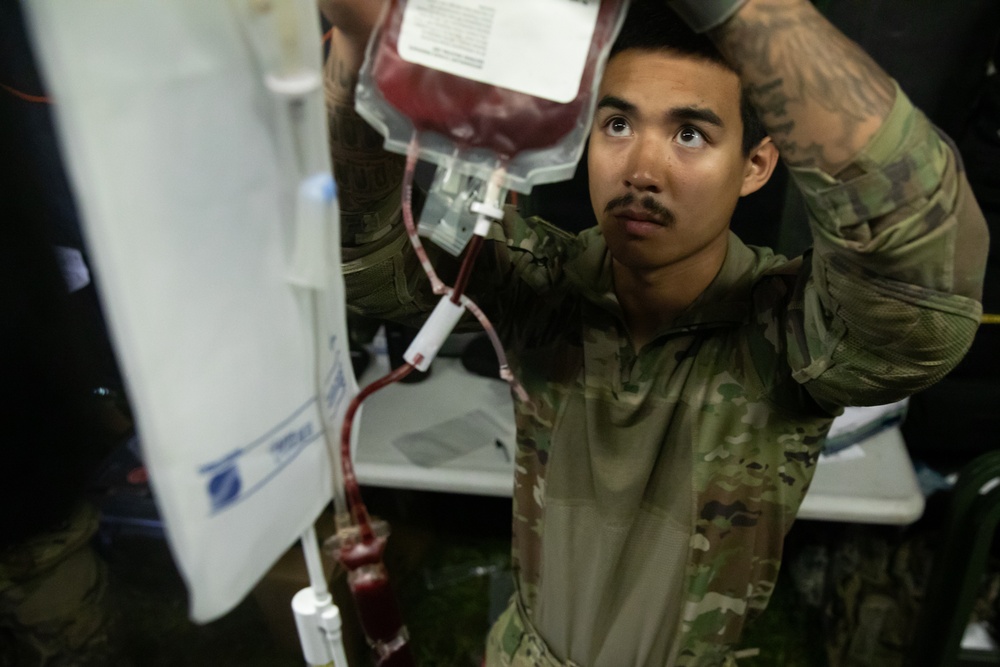
Photo By Staff Sgt. Sean Ferry | Spc. Mark Walker, a combat medic assigned to Headquarters and Headquarters company,...... read more read more
 Subscribe
The Defense Health Agency’s Armed Services Blood Program division added Germany and New Zealand to a Department of War list that allows military medical teams to use certain partner-nation blood products with no recipient follow-up infectious disease testing when U.S. blood is not available overseas.
According to the memorandum, “Foreign Nations with Blood System Regulations and Standards Deemed Comparable to the United States,” the expansion includes “receipt of blood products manufactured in foreign countries deemed comparable” by the Assistant Secretary of War for Health Affairs Keith Bass, ensuring the military hospitals and clinics can maintain lifesaving transfusion capabilities.
Bass noted in the memo, “The ASBP conducted a thorough evaluation of New Zealand and Germany’s blood systems. The results of this evaluation confirmed that blood donor screening, blood collection, and the manufacture of blood products in Germany and New Zealand are comparable to U.S. standards.”
“The use of fully tested non-U.S. blood products is sometimes necessary to save lives and may be the only alternative during combat operations or mass-casualty events,” Bass wrote.
ASBP ensures blood products for mission-readiness
The Armed Services Blood Program serves as the military’s official blood program and operates under Food and Drug Administration standards, according to Dr. Mary Ann Spott, ASBP deputy director. ASBP collects, tests, manufactures, and distributes blood products forward to support combat and emergency missions.
With the expansion of partner nations, Spott said the comparable blood enhances readiness by providing options when U.S. supply lines are challenged. “This supports the overall mission readiness for our warfighters as we have an assurance that if our blood supply is disrupted for any reason, we can rely on our partner nation’s blood supplies and continue our mission.”
Under DOD Instruction 6480.04, ASBP evaluates foreign nations’ blood programs and supports the Office of the Assistant Secretary of War for Health Affairs’ decision on whether a country’s system matches U.S. safeguards. If a nation’s blood supply is deemed comparable, recipients of that nation’s tested blood products can be exempt from follow-up and tracking rules tied to other non-U.S. blood products. This reduces the administrative burden on medical units while maintaining high safety standards.
Any future changes in a nation’s testing practices that could degrade safety will trigger an immediate re-evaluation of its status, according to Lt. Cmdr. Beth Auckland, ASBP operations branch chief who led the evaluation efforts for the expansion.
Auckland noted U.S. blood supplies are not always available in emergency situations, and in those cases, a service member would be given blood that is available. She said this is a situation when “comparability comes into play after the fact” to determine whether the recipient needs follow-up testing for transfusion-transmitted diseases. In an emergency, any nation’s blood supply can be used for patient care, but recipient infectious disease follow-up testing is required if the nation has not been deemed comparable to U.S. standards.
Strict criteria for comparable blood consideration
Nations do not join the list automatically and they require a thorough review using a needs-driven process focused on locations where U.S. forces are likely to serve, according to Auckland. A country is typically considered if there is a clear operational need, a high volume of potential transfusion, or an existing partnership in combined operations.
To judge a nation’s quality controls before inclusion, Auckland said the program uses criteria to standardize assessments and reviews donor screening, infectious disease testing, collection controls, and manufacturing practices. Criteria includes general principles; quality and proficiency programs; blood collections; component production; blood donation testing; transfusion practices; data on military blood centers; data on civilian blood centers; transportation; blood product development; and the organization of blood transfusion services.
An additional, important part of the process is how partner nations assess donors, said Auckland, with the evaluation including several critical steps:
Auckland said ASBP evaluates each country, works with regional liaison officers, searches open-source data to compile an assessment, and consults subject matter experts for review. If experts support the findings, the program routes a package through channels to OASW-HA for final approval.
With the newest additions, the list of comparable nations includes Australia, Canada, France, Japan, the Republic of Korea, Taiwan, the Netherlands, the United Kingdom, Germany and New Zealand. The priority for nation review is determined by the Joint Staff Surgeon and Combatant Command Surgeons.
| Date Taken: | 03.12.2026 |
| Date Posted: | 03.12.2026 12:26 |
| Story ID: | 560390 |
| Location: | US |
| Web Views: | 136 |
| Downloads: | 0 |

This work, Partnerships with foreign blood programs increase warfighter readiness, combat support, by Robert Hammer, identified by DVIDS, must comply with the restrictions shown on https://www.dvidshub.net/about/copyright.


No keywords found.




