
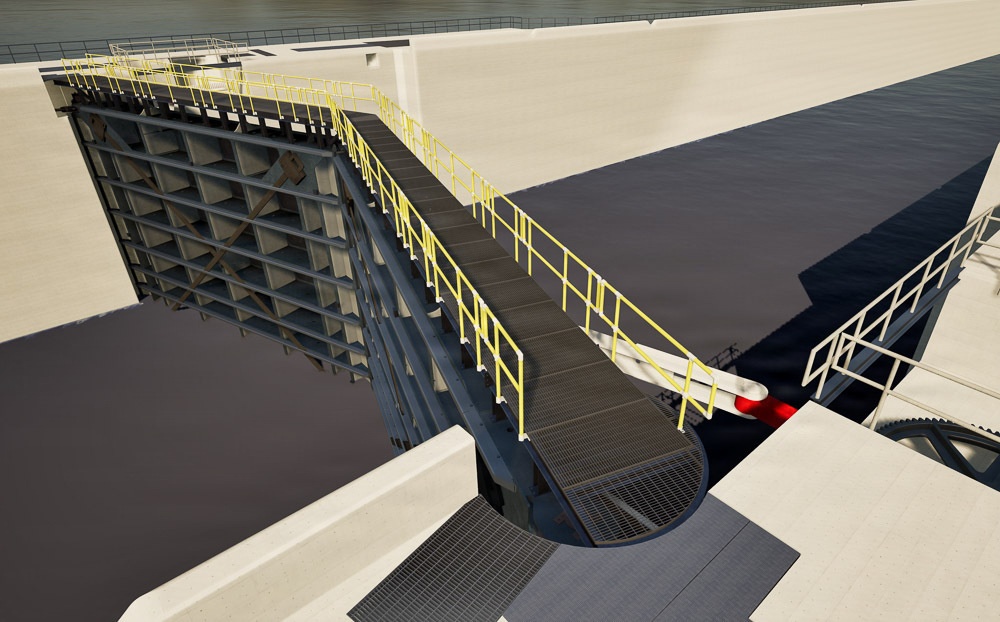
Photo By Elijah Wittum | A 3D rendering of miter gates at McClellan-Kerr Arkansas River Navigation System is...... read more read more
When a barge passes through a navigation lock along the McClellan-Kerr Arkansas River Navigation System, few people think about the massive steel gates that quietly make the process possible. Behind those gates is a team of engineers and technical specialists from across the U.S. Army Corps of Engineers, including experts from the Walla Walla District, using advanced digital modeling tools to design the next generation of infrastructure that keeps commerce moving along the nation’s inland waterways.
Recently, the team’s work was recognized in the agency’s 2025 national awards program. Engineers and technicians supporting the project received the Computer-Aided Design/ Building Information Modeling Team Award of Excellence for their innovative design work supporting the navigation system. Personnel from the Walla Walla, Philadelphia, Mobile, Louisville, Little Rock, Tulsa and Rock Island districts collaborated to design replacement miter gates for 18 locks and dams on the navigation system. The McClellan-Kerr Arkansas River Navigation System spans 445 miles across Arkansas and Oklahoma, connecting inland ports to the Mississippi River and supporting billions of dollars in commerce each year.
Computer-Aided Design, or CAD, and Building Information Modeling, known as BIM, are digital tools engineers use to design construction projects. CAD produces detailed 2D and 3D drawings. BIM goes a step further by creating intelligent 3D models that contain data engineers can use for analysis, coordination and long-term maintenance planning.
Several miter gates, large steel gates which allow vessels to move through locks, are scheduled for replacement, marking the first time miter gates on this system are replaced, making the design effort especially significant. The team first created a detailed model of the gates using specialized software, then replicated the original model and adjusted key dimensions, saving hundreds of design hours and improving consistency across all 18 sites.
“The first gate served as a base model, which was then replicated and adapted for two other locations – cutting design hours significantly while increasing consistency and quality,” said Jeffrey Lyon, Supervisor General Engineer, Walla Walla District.
It also set the standard for future miter gate replacements throughout the system, allowing the team to reuse proven assemblies and details in future designs while reducing the chance of errors, speeding up production and simplifying maintenance. The models also provide additional benefits, including advanced analysis that allows engineers to quickly adjust designs, the ability to review designs in virtual and augmented reality environments before construction begins, and early identification of potential issues that can reduce construction changes, contractor questions and overall costs.
“We started this project without knowing how much we would learn in the process - particularly on the technical side of things,” said Guido Iglesias, Engineering Technician, Walla Walla District. “Our leaders were always on our side, ensuring that we had everything we needed to succeed.”
While most people may never see the digital models behind the scenes, the impact of that work will be visible for generations — in safer infrastructure, more reliable navigation and stronger communities supported by modern engineering.
| Date Taken: | 03.11.2026 |
| Date Posted: | 03.12.2026 11:24 |
| Story ID: | 560378 |
| Location: | WALLA WALLA, WASHINGTON, US |
| Hometown: | WALLA WALLA, WASHINGTON, US |
| Web Views: | 98 |
| Downloads: | 0 |

This work, Walla Walla District Engineers among those recognized for innovative digital design of major navigation system, by Elijah Wittum, identified by DVIDS, must comply with the restrictions shown on https://www.dvidshub.net/about/copyright.


No keywords found.





