
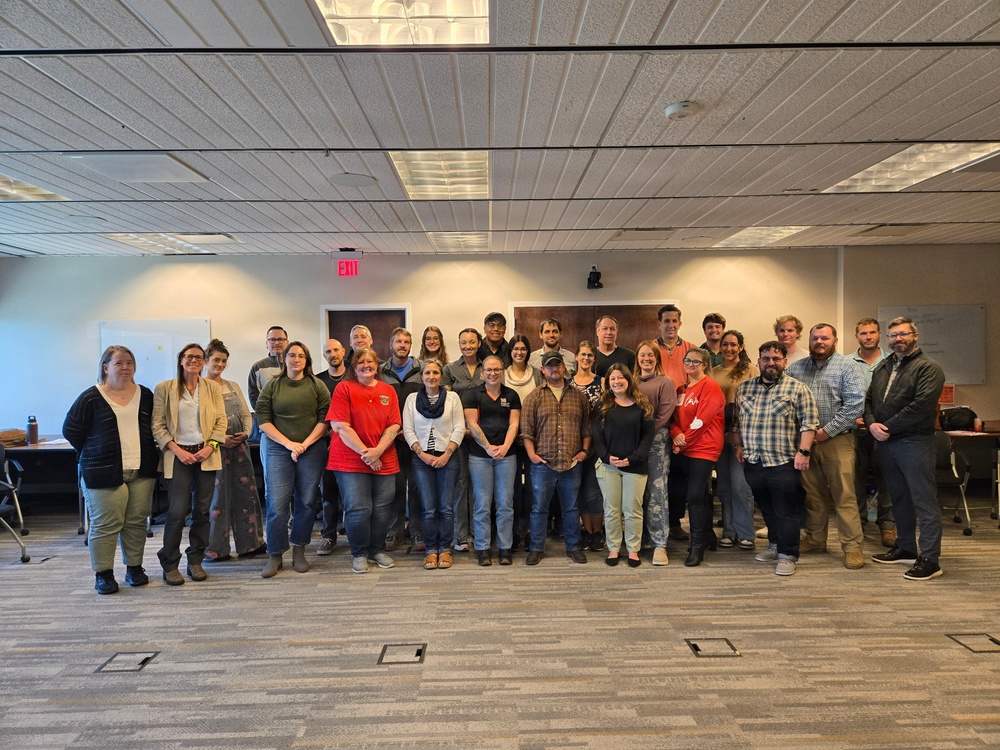
Photo By Peggy Bebb | Core Skills for Regulators students and instructors pose for a group photo on the...... read more read more
JACKSONVILLE, Fla. – Imagine the regulator at a desk, a permit application on one side of the screen and the regulation staring back from the other. The decision looks straightforward: criteria met or not met, a signature that either allows a long‑awaited dock to be built or stops the project cold. Yet every page carries a tension - policy on one side, the human aspect on the other. The regulator knows the applicant has spent months, even years, reaching this moment, has heard the hopes pinned to an approval and the dread of what a denial would mean. Still, the duty is to the broader public—the people who will never see the file but will live with the project’s ripple effects. Their work lives in that narrow space between statute and empathy, policy and humanity, where they must uphold the standard without reducing the applicant to a name on a page. The final decision may be written in the formal language of findings and conditions, but it is ultimately an act of human judgment, with effective oversight resting as much on people-skills as on policy.
Identified as a longstanding need by U.S. Army Corps of Engineers (USACE) Headquarters Regulatory team, the Core Skills for Regulators was born from a 2023 Strong Leaders Program project. At that time, 95% of enterprise-wide Regulatory Division Chiefs said there was a need for a course that developed non-technical skills for their teams. Core Skills like workload management, foundational excellence, public service, outreach, building trust, adaptability, resiliency and briefing techniques were identified as essential for the standard USACE regulator. Now in its fourth iteration, the class had found its way to the Jacksonville District for a week of listening, leaning in, learning and collaboration.
“Equipping regulatory professionals of all experience levels with the essential competencies required to excel in their roles is the main purpose of the course,” said Kara Hellige, Chief, Southern Colorado Branch, Albuquerque District and course instructor. “This training will help them manage high levels of project workloads, be resilient after setbacks, build critical relationships, and master difficult conversations and controversial situations.”
Throughout the week, the interactive, collaborative exercise-driven course covered key topics of communication, conflict resolution, internal growth, and foundational excellence. Led by a group of instructors from across USACE with decades of regulatory experience, the course asked students to come in open-minded, prepared to engage, and willing to collaborate. Pledging a commitment to growth – and being introspective, confident and empathetic - allowed students to get the most out of what the course offered.
Some participants arrived skeptical, uncertain how the course would be presented or whether it would resonate to their day-to-day work. “Although I was looking forward to attending but was apprehensive about whether the training was going to be helpful at the individual project manager level. I was happy to discover that the class functioned with tools and scenario-based instruction instead of providing theory via heavy PowerPoint briefs,” said Marena D’Orio, Regulatory project manager, Fort Myers Section.
Jeffrey Meyer, Regulatory Project Manager, Palm Beach Gardens Section wasn’t completely sold on the course either, thinking it might be too basic and entry-level; however, it wasn’t long before he was pleasantly surprised at the content being presented and how he could implement it in his day-to-day job. “Although I was confident in my understanding of public service, written communication, and building trust and relationships with the regulated community, I wasn’t necessarily unsure about any of the course topics but knew I could use some help with workload management and conflict management.”
Similarly, Rachel Somerville, Biologist/Project Manager, Tampa Permits Section, expected the training to be lecture-style, impersonal, and information overload with few opportunities to interact with other regulators and she wasn’t looking forward to possibly falling behind on her projects. However, Somerville noted “soft skills are incredibly important in this role, so I was interested in the potential content.”
Day one set the tone, underscoring that public service is a public trust and USACE regulators must earn and keep that trust by conducting themselves in a manner that is professional, respectful, fair and reasonable, honest, timely, knowledgeable and accountable. The day also emphasized mindset as the foundation of excellence-anchored in ideas like starting your day with a task completed, recognizing you can’t go it alone, being your best in your darkest moments and never “ringing the bell.” “There’s a reason they taught foundational excellence and public service on day one. Without a strong sense of purpose in this job, everything else is irrelevant,” said Meyer. With a renewed commitment to public service and newly acquired foundational skills, the team moved into day two working on briefing techniques that prepared them to present in front of district leadership later in the afternoon. Learning briefing techniques such as the 1-3-1 approach – one challenge, three-courses of action, one recommendation, set the expectation for the afternoon’s presentations.
Previous students often reported that the most impactful activity was the simulated briefing exercise, and this class was no different. The class was split into groups and each group collaborated on a controversial project that needed a decision, then created a slide to brief leadership on the project, key issues, status and recommendation. “In this exercise, teams developed and delivered a formal briefing to the district deputy commander and division chief, followed by peer feedback and class discussion, providing a comprehensive, practical application of the techniques learned,” said Hellige.
“I was challenged by the briefing techniques exercise to brief the Deputy Commander and Regulatory Chief,” said D’Orio. “I get nervous no matter how many times I stand up to talk in front of people.”
Meyer put immense pressure on himself when it came time to brief the deputy commander and chief on his group’s project. “Trying to maintain a professional image and slipping up in front of the big man would haunt me forever. For that reason, successfully completing the exercise was both intense and exhilarating and gave me a huge boost of confidence.”
Another stand-out session for the group was the life-raft exercise, which reinforced the idea to “not judge a book by its cover” and to remember you don’t always know what someone else is going through. The activity highlighted how empathy and open-mindedness are real-life skills and how first impressions can be misleading. The room was broken into small groups and to imagine being in a life raft in the open water. Every person was given a role- a doctor, Army commander, a wheelchair bound college student, trust fund kid, and a biker gang president, among others -but no background. With the raft sinking, the group had to choose one person to offload, deciding solely on the role title. The discussion that followed made clear how pre-judging someone without knowing their story can lead to very different choices than if the full picture were known.
“I was assigned the role of the doctor, described as a white male with 30 years of medical experience,” said Somerville. Her group worked through two rounds of decisions on who to put off the raft, unanimously choosing the wheelchair-bound college student and trust fund kid, while the Army commander and the doctor were never considered. At the end of round two, it was revealed that the trust fund kid was a philanthropist, the biker gang president protected child abuse victims, the two controversial roles were the doctor, who was a supporter of a terrorist group, and the Army commander, who was dishonorably discharged. “It was a challenge determining who should be kicked off the raft and who should stay aboard – the conversations were engaging and at times we disagreed with the group,” explained Somerville. “The ultimate lesson learned was ‘don’t judge a book by its cover’ but also the way others perceive you is important as well.”
By the end of the week-long training, the class had built not just a toolkit of core skills but also a stronger sense of shared purpose. While the evolution brought excitement, engagement and enough skills to fill their proverbial toolbox, the regulators were eager to get back to their projects and put those lessons to work. After returning to their day jobs, D’Orio found herself relying on the skills learned during the Foundational Excellence module, such as focusing on one task at a time and reducing distractions. Somerville was certain the conflict management skills would come in handy. “This job requires constant communication with agents, applicants, government entities, congressional representatives, special interest groups, etc. and a lot of these communications are contentious. Having the skill set to de-escalate negative interactions is invaluable in this role.” “Overall, I am feeling motivated to put the lessons into practice,” said Meyer. “I am most excited about managing my workload more efficiently and improving, my communications to provide a higher level of service to my community.”
In the end, the course did more than fill a training requirement; it closed the distance between that quiet moment at the desk and the people affected by what happens there. By strengthening the human skills behind each decision- how our regulators listen, brief, question, and respond – Core Skills for Regulators is helping ensure that when policy and people meet, they do so in a way that is firm, fair, and deeply grounded in public service. In that sense, it lives up to its name: investing in the people side of oversight so regulators have the core skills they need to deliver effective, trusted regulations in an ever-changing world.
| Date Taken: | 03.06.2026 |
| Date Posted: | 03.11.2026 14:35 |
| Story ID: | 560307 |
| Location: | JACKSONVILLE, FLORIDA, US |
| Hometown: | JACKSONVILLE, FLORIDA, US |
| Web Views: | 59 |
| Downloads: | 0 |

This work, The People Side of Oversight: Building the Skills for Effective Regulation, by Peggy Bebb, identified by DVIDS, must comply with the restrictions shown on https://www.dvidshub.net/about/copyright.


No keywords found.





