
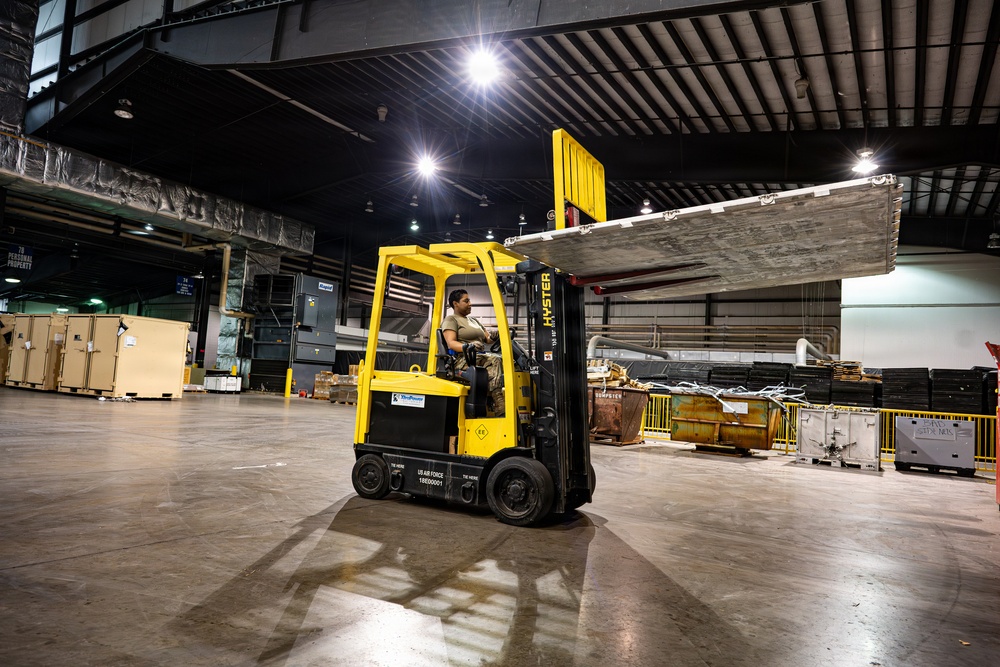
Photo By Airman 1st Class Macy Dismore-Mann | U.S. Air Force Airman 1st Class Natalya Garza, 436th Aerial Port Squadron cargo...... read more read more
 Subscribe
DOVER AIR FORCE BASE, Del. –
Operating at the critical intersection of speed and scale, the 436th Aerial Port Squadron at Dover Air Force Base stands as the Department of Defense’s largest and busiest aerial gateway. Affectionately known as the Super Port, the powerhouse unit serves as the operational backbone for global reach, sustaining missions ranging from humanitarian relief to frontline warfighting. Behind every departure is a coordinated team ensuring missions launch on time and reach their destinations safely. The 436th APS plays a critical role in global mobility by moving people and cargo worldwide. Each month, the squadron processes several hundred aircraft, supporting missions across U.S. European Command and U.S. Central Command. “The world turns because the Super Port pushes it,” said U.S. Air Force Capt. Rollin Read, 436th APS operations officer. “By sheer volume, we create mass effect in the transportation enterprise and support operational and tactical outcomes across multiple theaters.” Before any cargo leaves the ground, it is carefully inspected to ensure it meets strict safety and airworthiness standards. For the Airmen responsible for managing and coordinating military shipments, attention to detail is critical to protecting aircraft, crews, and mission success. “We have to be ‘spot on’ every time. And if there are issues, we identify those issues, and then work with either the shipper, the user, or whoever packaged the material to correct it before it gets on the airplane,” said Bradley Schmidt, 436th APS logistics management specialist and coordinator for military sales and security assistance. “It has to be 100 percent airworthy each and every time.” Supporting foreign military sales requires deliberate coordination across a complex network of agencies, transportation modes, and operational functions. Each shipment moves through multiple phases, originating at munitions depots or supply points, transitioning through surface transportation, and ultimately integrating into airlift operations before being delivered to an aircraft. Success depends on precise timing, shared accountability, and seamless collaboration among all partners involved. “When we are supporting foreign military sales, we work with upwards of 10 different agencies. Everyone from munitions depots and surface carriers to airfield management and ramp services plays a role,” said Schmidt. “If one piece is missing, the mission does not move.” Balancing foreign military sales with higher-priority airlift requirements demands constant coordination and real-time decision-making. Tasks from the U.S. Transportation Command and the Department of War shape daily operations, requiring Airmen to continually assess mission urgency, available capacity, and partner expectations while keeping overall port operations moving. Long before aircraft arrive on the ramp, missions are shaped through months of behind-the-scenes planning and coordination. “We are planning sometimes upwards of 120 days in advance of a mission, and in that 120 days, there are a lot of moving parts. We are looking to verify documentation, and we're looking at what type of airplane we need to execute the mission. There's a lot of pre-planning and pre-coordination that no one sees in these back offices here,” said Schmidt. “Whether it's the Army, State Department entities or foreign military sales programs, a lot of what we are able to accomplish through flexibility is built intrinsically on our relationships, both on and off the installation,” said Read. At the 436th APS, mission success depends on the expertise, judgment, and initiative of the Airmen on the ground. Leaders focus on developing personnel to navigate complex situations. This trust and investment in people allow the squadron to operate efficiently and effectively, even in high-stakes, fast-moving operations. “It's a combination of how we are developing our people to overcome those gray areas and how we are empowering them to make decisions at their level,” said Read. “We put a lot of trust in our Airmen to make large and impactful decisions to navigate that.” From processing hundreds of aircraft each month to coordinating complex missions across multiple commands and partners, the 436th APS relies on careful planning, precise execution, and strong relationships. Airmen are empowered to make high-impact decisions, navigate challenges, and adapt when priorities shift. As Read and Schmidt note, it is this combination of expertise, trust, and teamwork that allows the Super Port to move the world, one mission at a time.
| Date Taken: | 01.26.2026 |
| Date Posted: | 03.10.2026 14:26 |
| Story ID: | 560219 |
| Location: | DOVER AIR FORCE BASE, DELAWARE, US |
| Web Views: | 116 |
| Downloads: | 0 |

This work, At the Center of Global Mobility: The 436th Aerial Port Squadron, by A1C Macy Dismore-Mann, identified by DVIDS, must comply with the restrictions shown on https://www.dvidshub.net/about/copyright.


No keywords found.




