
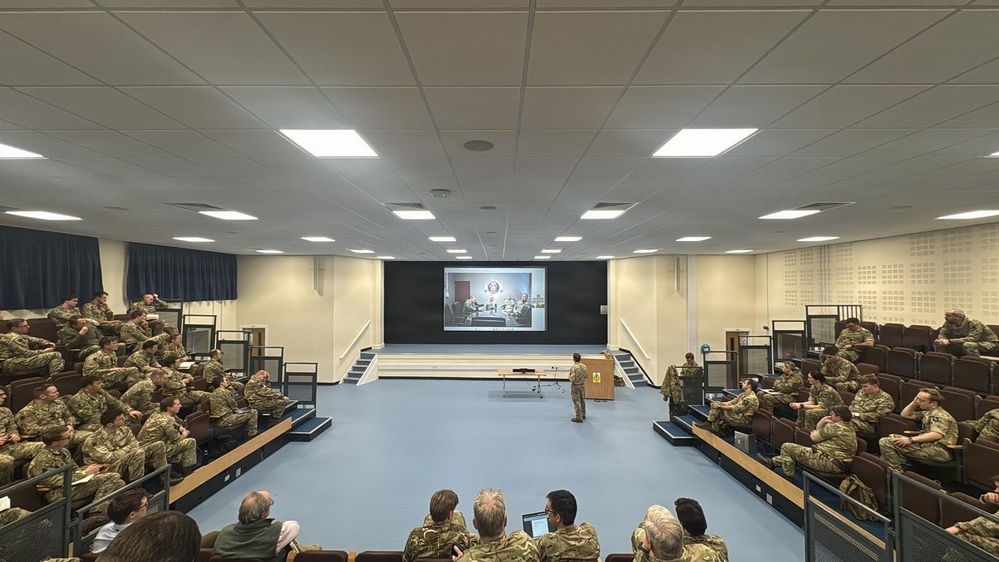
Photo By Sarah Hauck | U.S. Army Command and General Staff College Commandant Col. Ethan Diven provides the...... read more read more
FORT LEAVENWORTH, Kansas – U.S. Army and allied leaders are wrestling with how to win on battlefields of new technologies that are challenging armored maneuver.
The U.S. Army Command and General Staff College U.S. students and allied partners learn to execute multi-domain operations as part of joint or multi-national teams.
Through curriculum and exercises like Eagle Owl, students earn valuable knowledge and skills to conduct division-level combat operations in modern warfare.
U.S. Army Command and General Staff College Commandant Col. Ethan Diven provided the keynote address for the British Covering Force Symposium 2026 with focus on changing character of war, and how armored forces are adapting to new realities.
The conversation is a direct continuation of CGSC’s global focus and the larger Army’s commitment to sharing lessons learned with allies and partners to solve common problems.
“This is the way that we are going to fight [jointly with British military],” Diven said. “If we don't agree that we are not good enough yet; the tech that we're experimenting with is getting to some people, but not all the right people and not in the right time; and making sure our leaders are using clear language, we're going to continue to struggle. I share your sense of urgency. I share your lack of satisfaction with how fast we are going.”
The audience of officers and senior non-commissioned officers of the U.K.’s three armored and recce brigades, had vested interest in how to move their forces’ calvary capabilities by examining challenges emerging from the Russia-Ukraine War.
Near omnipresent enemy and defensive drones (among other emerging technologies) has changed how armored, combined arms teams plan for tactical success, Diven explained.
Making initial non-human contact with enemy forces has become increasingly important, encouraging experimentation with how the Army sequences and integrates drones and other recon-strike platforms ahead of crewed fighting vehicles.
Old armored team tactics and techniques in today’s rapidly changing battlefield creates high-value risk, Diven explained.
“Reconnaissance professionals, and reconnaissance organizations, do not just exist, but will continue to demonstrate their relevance by helping inform a commander's decision to be violent. To commit, not just robots, but ultimately humans to fight and win,” he said.
New technologies like artificial intelligence, digital collaborative command and control platforms and data-driven decisions, are influencing how commanders see, describe, and direct forces.
These advancements, while allowing more refined, high-speed tactical actions, are generating secondary effects easily detected by increasing overhead surveillance: signatures.
Contemporary command posts and those of a decade ago share only two commonalities: being housed under a “giant circus tent” and being a buzz of activity.
Today’s CP activity generates more enemy-detectable information than ever before, Diven explained, challenging maneuver across the board.
This detriment to movement was a common observation in his role as the commander of an Armored Brigade Team and commander of operations for the National Training Center.
"I was much more comfortable to be where the action was, to confirm what is being told to me over the radio or the digital common operating picture with my own eyes, talking to that sergeant that is seeing and fighting, to build my understanding. That comes with risk... and that is likely not the best decision or the best use of assets anymore."
How can armored forces fight effectively without commander’s orchestrating shoulder to shoulder with their teams?
Clear communication.
Not just verbally but through a set of concise, orders products, and leader interactions.
“Have you provided a simple, clear, understandable series of products that can stand the test of not just time, but continuous contact?” Diven said. “The 200-page word document that is complemented by the 50 PowerPoint slide deck, with a series of annexes that are only enabled by unlocked series of passwords that require an incredible amount of bandwidth. aren't super helpful for the platoon or the koi [company] that can only communicate over TACSAT.”
Commanders who communicate clearly, and staff who challenge them to do so, enable subordinates to execute at speed, in fiercely contested environments.
Gone are the days of planners and command teams gathering around acetate maps, Diven explained.
Officers and NCO’s now use digital collaborative and synchronization programs and training to operate differently and at greater tempo.
Students at CGSC are learning the intricacies of these planning and execution tools to be capable and ready leaders upon arrive to assigned commands.
“We have to deliberately disaggregate ourselves and figure out how to conduct decentralized planning, decentralized coordination, and look like other small elements at the platoon at most size and move our command posts at the battalion squadron at tactical level,” Diven said.
As armor forces adapt to fight new enemy capabilities and warfare as a whole, Diven encouraged a transformation in command culture, to enable units to operate more effectively.
Culture shifts include in traditional sequential training schedules and embracing the “uncomfortable” associated with stepping off the normal path of training and technology adoption.
“Our Secretary of War, that entire department, down to platoon level, is embracing a culture of experimentation,” Diven said. “It is not waiting for the Army to give us the tool to try to train with.”
The U.S. and British Army have more than a century of experience fighting together, driving the importance of continued training and lessons sharing.
The Covering Force Symposium, which included most officers and NCOs of the British armored force, was an opportunity for American and British warfighters to discuss shared challenges and potential solutions.
“I'm excited to not just fight together in the future, but to collaborate on how we’ve got to get better,” Diven said.
| Date Taken: | 03.04.2026 |
| Date Posted: | 03.09.2026 11:05 |
| Story ID: | 559748 |
| Location: | FORT LEAVENWORTH, KANSAS, US |
| Web Views: | 137 |
| Downloads: | 0 |

This work, U.S. and U.K Army leaders discuss armored warfare: CGSC Commandant provides keynote address to British Armoured Cavalry’s Covering Force Symposium 2026 to discuss shared challenges for recon, armored tactics, by Sarah Hauck, identified by DVIDS, must comply with the restrictions shown on https://www.dvidshub.net/about/copyright.


No keywords found.





