
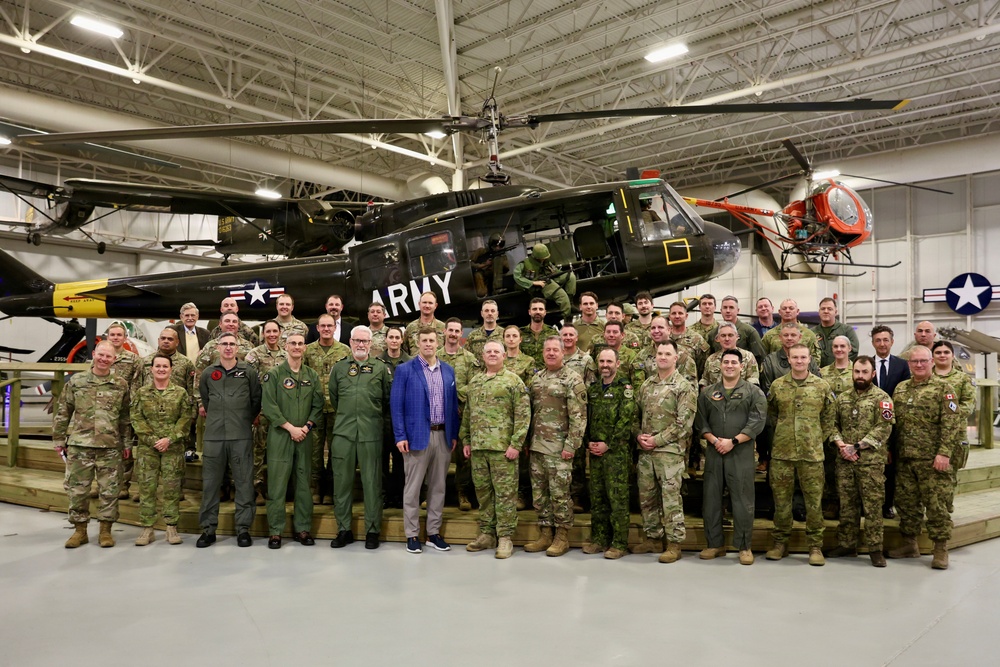
Photo By Leslie Herlick | The Aviation Center of Excellence hosts the International Combat Aviation Safety...... read more read more
FORT RUCKER, Ala.--The Aviation Center of Excellence hosted the International Combat Aviation Safety Summit (ICASS) at Fort Rucker, Ala., March 3-5.
The annual summit provides the “Five Eyes” partner nations of Australia, the United Kingdom, Canada, New Zealand and the United States, an opportunity to collaborate to bolster safety measures regarding rotary-wing and tiltrotor combat aviation operations.
Under the banner theme of “Battlefield Coordination in Congested Airspace,” the event included two days of scheduled speakers and panels sessions focused on partner nation updates, the nature of increasingly congested airspace and the need to adapt airspace management practices, contemporary lessons learned and an ICASS leadership panel, followed by a final day with an optional scheduled tour of Fort Rucker. Tour stops included the flight training simulations devices at Victory Hall, as well as the U.S. Army Aeronautical Research Laboratory and the U.S. Army Combat Readiness Center.
Event host Maj. Gen. Clair A. Gill, AVCOE and Fort Rucker commanding general, welcomed attendees to the “home of U.S. Army Aviation.”
He explained Army aviation “fights the ground fight” and “just happens to break friction with that ground.” “We see, sense, strike and move, and extend the battlefield,” Gill said.
Gill said the summit was an opportunity to discuss how to ensure aviation crew members are as competent, safe and lethal as possible, noting the changing character of war.
“Today it’s just such a dynamic battlefield,” Gill said. “The fight that used to be somewhat conventional, now we’re seeing more and more unmanned (systems). We have to figure out how we’re going to fight the manned and the unmanned fight in a way that makes the most sense.”
While for some tasks unmanned systems may be the way of the future, manned aviation is not going away, Gill noted.
“I’m proud to say the assault into Venezuela proofed out the criticality of having manned aviation certainly in the vertical lift paradigm,” Gill said, of the mission to capture Venezuelan dictator Nicolas Maduro back in January.
Gill explained that as the Army transforms, Army aviation is feeling its effects, including getting rid of cavalry squadrons and legacy aircraft, divesting U.S. Army Reserve rotary-wing fleets, making big investments in unmanned systems and formations, among other initiatives. The branch is pursuing technologies to help in degraded visual environments.
The Aviation Center is also working toward a commercially owned and operated model for initial rotary-wing training at Fort Rucker.
Gill explained the new 15X Tactical Unmanned Aircraft Systems specialists are intended to serve in brigade formations, and their role includes training, maintaining, operating, and advising commanders on how to deploy the capability.
The branch is on glide path to achieving the game-changing MV-75 vertical lift aircraft, with the first prototype currently being built, Gill added. He expects the first aircraft will be produced by the end of the calendar year.
Maj. Gen. David C. Hafner, who commands Australian Army Aviation Command, welcomed attendees and thanked Gill for providing the venue.
“It’s great to come to Fort Rucker once again, and I really appreciate you hosting this event. Thanks everyone for taking the time out of your busy schedules to come together. It’s what makes this a success,” Hafner said.
Hafner emphasized the importance of telling the Army aviation story—educating and informing “to make sure we have others who are advocates as well,” when it comes to capability needs.
Among his priorities is building trust. “Every nation that’s here has got a great history on how you supported and executed your nation’s mission, but I think we can all appreciate as well you can’t always just rest on your laurels,” he said.
He explained trust is something all must continue to work on, within their own forces, with their nations and with partner nations, and it’s especially important in environments with degraded capability. It’s all about turning up and delivering as a reliable partner. “It’s not about saying yes, it’s about doing what you say,” he said.
Echoing Gill’s sentiment about the relevance of Army aviation on the battlefield, Hafner said, “I can’t think of a time in my career in any operational theater where someone has come up to me and said ‘I have too much aviation’.”
Lt. Col. Luke P. Hodda, Australian Army Aviation Command G-3 and ICASS Secretariat lead, explained the ICASS concept was formed in late 2023 after two aviation mishaps that resulted in the loss of life of four members of Australian Army Aviation and three U.S. Marines from Marine Rotational Force-Darwin. A presentation slide included photos of the personnel tragically lost in those incidents.
“It’s important to understand that each of the faces on the screen there has family and friends behind them, but also a significant investment from government, resulting in a significant loss of capability and experience,” Hodda said. “That is why we are here today, to avoid this loss where we can in the future.”
He highlighted that although partner nations were identifying similar challenges and risks, up until ICASS there was no forum to share collective learning and observations. The inaugural summit was held in Australia in 2024, and in 2025 leaders from the five nations met in San Diego; also last year the ICASS Charter was jointly signed, wherein all member nations committed to invest in its framework.
He explained ICASS is command led, outcomes driven, platform and branch agnostic, inclusive at echelon and founded on trust through strengthening relationships. Previous summits focused on the human element and spatial disorientation.
Presenters from around AVCOE and Fort Rucker also included representatives from the Directorate of Evaluation and Standardization, AVCOE G-3, Aviation Survivability Development and Tactics team, the U.S, Army Aeronautical Research Laboratory, the U.S. Army Combat Readiness Center, 164th Theater Airfield Operations Group and others.
| Date Taken: | 03.06.2026 |
| Date Posted: | 03.09.2026 11:47 |
| Story ID: | 559538 |
| Location: | ALABAMA, US |
| Web Views: | 45 |
| Downloads: | 0 |

This work, Fort Rucker Hosts Aviation Safety Forum, by Kelly Morris, identified by DVIDS, must comply with the restrictions shown on https://www.dvidshub.net/about/copyright.


No keywords found.





