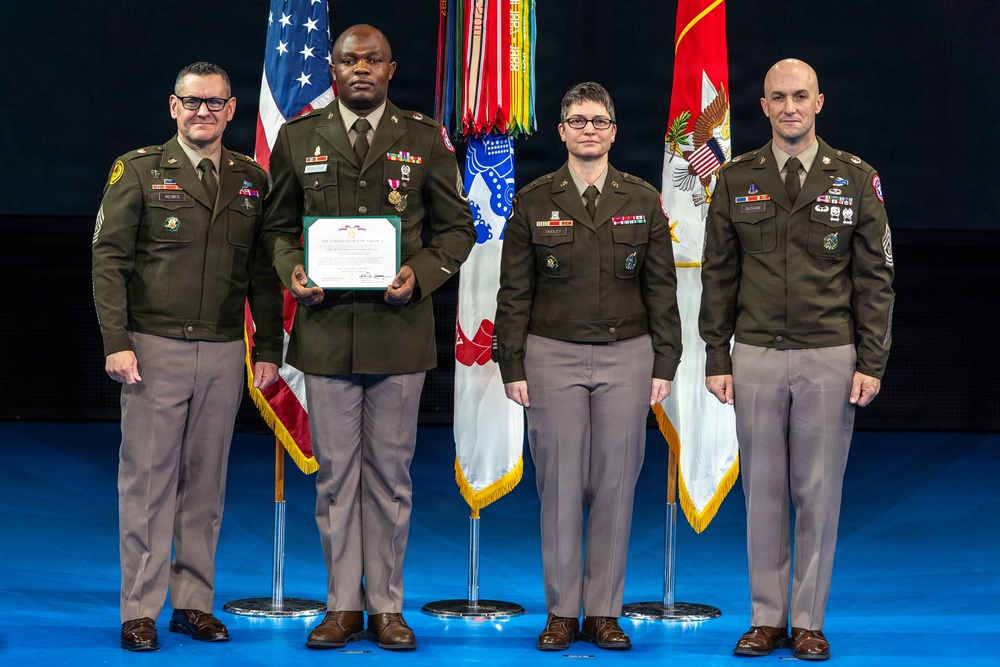
Photo By Staff Sgt. Gerald Holman | U.S. Army Staff Sgt. Gyres Fouelefack, a recruiter assigned to the 6th Recruiting Brigade, Central California Recruiting Battalion, stands for a photo after being recognized as one of the top 30 recruiters for fiscal year 2025 during a ceremony at Conmy Hall, Joint Base Myer-Henderson Hall, Va., Jan. 22, 2026.
Sergeant Major of the Army Michael R. Weimer, Brig. Gen. Sara Dudley, the commanding general of the U.S. Army Recruiting Division, and Command Sgt. Maj. Danny Basham, the USARD command sergeant major, presented awards to the recruiters for their exceptional performance and impact on the Army’s mission. see less
| View Image Page
Standout Central California Army Recruiter shares his recruiting story
SAN JOSE, Calif. — The U.S. Army recognized some of the Army’s best Recruiters during a ceremony in Washington earlier this year. One of the Soldiers is assigned to the Central California Army Recruiting Battalion at the San Jose East Army recruiting Station.
Staff Sgt. Gyles Fouelefack was personally responsible for bringing 46 Soldiers into the Army in 2025. An achievement, as Recruiters are only tasked with bringing in one Soldier a month.
Our public Affairs team got a chance to speak with him recently so he could share his truly American success story.
INTERVIEWER: It’s nice to finally meet you. So, getting down to business, where are you from originally?
SSG FOUELEFACK: So I was born in Cameroon, Central Africa.
I graduated high school there in 2016, and I went to college for two years gaining a finance related associate degree. After that I had an opportunity to move to America, so I moved to the United States in 2019. My wife stayed in Cameroon.
My first language is French and my English my was not that good. I wanted to work in Finance, but having English as a 2nd language, it was kind of hard for me to work in finance, so I started working as a baker, making bread in Maryland. I worked there for like six months, but I still wanted to work in financial, because my goal was always to be banker.
Every time when I go to my bank, I wanted to talk to the banker asking, like, how can I get this position? He was like, so do you think someone will trust you to manage their money if you can’t explain it to them in a way they understand in English?
That was my real weakness. And he was like, I think like you should focus on learning [English] and then pursue your goal.
INTERVIEWER: Good advice?
SSG FOUELEFACK: Yes, definitely. So when he told me that I enrolled in a local community college to learn more English. I started learning, but the thing is I had to pay my bills because I was the only person in America, I didn't have any family here to help me. I was by myself renting a house. So I had to pay my bills. So I’m going to college every night after work. I was kind of tired when I get there, so I had a tough time learning and improving.
INTERVIEWER: I know how you feel. I did sort of the same thing. I worked full time while I was in college too. It was tough, but I didn't have to deal with English is a 2nd language.
SSG FOUELEFACK: Yeah, exactly. I was like, I think I could not really learn much because imagine being tired and someone explained something in English that you don't really understand. That's when I made another friend. He was in the military before, and he told me, hey, do you know the Army has this English program where you can go to school and learn English before you go to basic training?
NOTE: This is called the Foreign Language Recruiting Initiative. FLRI allows applicants whose first language is not English to enlist and receive up to 30 weeks of paid English language training before starting Basic Training.
SSG FOUELEFACK: So I went to see the recruiter and told him “I know my English is not that good, but I really focus, I want to focus on how to get to the English program because that's my priority.” So that's when I go into the program.
I signed my contract and I got to ship out to English school in, um, that was March 2020.
I shipped to Texas, Lackland Air Force Base [The Defense Language Institute English Language Center at Joint Base San Antonio-Lackland]. I was there for about three and a half months. All we were doing there is learning English, and getting paid for it.
INTERVIEWER: That sounds like a good deal.
SSG FOUELEFACK: Right? I was getting paid and learning English. In that time I was able to improve my English enough to pass all the tests that they require including the ASVAB [Armed Services Vocational Aptitude Battery].
INTERVIEWER: So you were not a U.S. citizen correct?
SSG FOUELEFACK: Thank you for bringing that up. I wasn't a citizen yet.
So after I signed my contract my recruiter gave me the paperwork for citizenship, so I filled it out [while] in basic training and submitted it.
NTERVIEWER: So how was basic training?
SSG FOUELEFACK: It was not a problem, because physically I was fit, it’s just the mental stuff, that’s really that's the hardest part when you go through basic. I went through One Stop Unit Training at Fort Benning, GA to be a 19D Cavalry Scout. So that was my original MOS [Military Occupational Specialty] because I told my recruiter, I don't care about the job that you give me.
INTERVIEWER: So, Sand Hill like the infantry? [Interviewer was an 11C, (Indirect Fire Infantryman) and went to Benning for OSUT].
SSG FOUELEFACK: Harmony Church, not far away. Since I already learned my English, it was kind of easy for me. I received my first certificate of achievement and first coin in basic training too.
NTERVIEWER: Where was your first duty station?
SSG FOUELEFACK: My 1st assignment was to Fort Irwin. 211th Armored Cavalry Regiment. A lot of people don’t like Fort Irwin, but I'm not gonna lie. I loved it. So we have the training schedule for two years in advance. So, you know when you have time to take leave, you know where your training is. So, the good side of that is it kind of helped those of us that wanted to go to college to be able to have that schedule with the college.
INTERVIEWER: So you were able to take college classes while you were there.
SSG FOUELEFACK: Exactly. So as soon as I got there, in my first two months, I was working just to learn my schedule and then I went to the education center and enrolled in college. That's when I started my bachelor's in the financial field. I did it online because I wanted to make sure that I don't miss any work or anything because no matter how good I wanted to do in school, I also want to do good on my job.
I did 2 years back in Cameroon in college, they were able to consider those credits as well.
INTERVIEWER: So how long did it take from the time you turned in the paperwork to time you got your citizenship?
SSG FOUELEFACK: It took about three months. Oh, and let me correct something. I tried to submit my citizenship paperwork in Basic Training, but you also got to understand that it's not just their focus. They focus on the training. So, when I got there, you were kind of more focused on the training, so I didn't get to submit it until after I completed basic training. But it only took about three months after that. I got my citizenship at Irwin.
INTERVIEWER: So you were a Cavalry Scout at Fort Irwin working on a Bachelors in the financial field. Were you planning to switch over to a finance related MOS?
SSG FOUELEFACK: So, at Irwin I got my bachelor’s degree and in two-and-a-half-years years I also pinned Sergeant E-5. I told my leadership that I always wanted to work in the finance field
So I spoke to our career counselor about changing MOS. As my ASVAB score wasn’t high enough I started working on upping my score. And then, Army recruiting found me. I got a message saying I had been selected as selected (Department of the Army Selected) to be a Recruiter.
Oh, and I forgot to mention, as soon I got my citizenship, I applied for my wife to bring my wife to the U.S. I told my wife, okay, I know I already got all the requirements for finance, but here's another opportunity.
“What can we do? She said. It’s three years. You can try and see if you like it.
If you don't, you continue with changing your job.”
So I went to recruiting, I passed the six-week recruiting school (Army Recruiting Course), and shortly after I got promoted to E-6. It took me just four years to become a Staff Sergeant. I started as a recruiter at the San Jose East Army Recruiting Station on June 10, 2024.
INTERVIEWER: Obviously you’ve been doing quite well as a recruiter. Were you successful from the start?
SSG FOUELEFACK: No. It took three months before I got my first contract. I listened to my fellow recruiters on how to be successful. I met people in person, talked to them, but I was not initially able to get people that interested in joining. I was going to every place here in San Jose trying to get people to join. But I only got one person in those three months, and I feel like it was kind of tough, so I started thinking, how can I do it? What is the best way? I made phone calls every single day, trying to get people. That didn't work well. Then I started using social media. I share my story, just like I'm telling you my story.
Every time when I get that first message or call from someone saying I want to join, I make sure they understand my full story before we begin. And then once you hit that one, it was after I got my first contract, boom, the next month I put in another. That was the beginning of the
new FY (fiscal year) 2025. That's when I start putting people in fast and I closed 2025 with 46 contracts in one single year.
INTERVIEWER: So, social media has been key for you?
SSG FOUELEFACK: As I said, I still go out to the schools and physically recruit as much as I can, but social media is where people are and so I find myself going there more than anything.
INTERVIEWER: So besides telling prospects your story what else do you do?
SSG FOUELEFACK: I Just ask them the reason why they can't join. Because everyone, everything that you do in your life, you want to have the reason. A lot of times the reasons are not really reasons. Once we overcome the reasons why they feel they can’t join, then I tell them all the things they can do in the Army, the benefits they’ll get to help them reach their goals. I tell them what I did to get in, how the process went, the good and the bad. You're just going to have to accept that risk. that everything that has a benefit also has consequences.
INTERVIEWER: So what is your advice to other recruiters?
SSG FOUELEFACK: Learn how to really use social media. Visit military related sites and platforms and start conversations with people there. A lot of non-military people visit these sites because they are interested in a military lifestyle, think it’s cool or whatever. I never get pushy, I just start a conversation and tell them my story and then it goes from there. Also, the most important thing for me is that first contact, because first of all, they're not next to me. Make it personal every time so you don’t lose them.
INTERVIEWER: If you could give one piece of advice to a new recruiter on how to be successful?
SSG FOUELEFACK: Identify what works for you. What works for me might not work for you, but you never know until you try. So try every way the Army teaches and then whatever works for you stick to it and try every day trying to learn a new method to improve it. Every day is never going to be the same. Some days are really good. You have good things and some days it's kind of bad. Focus on the good side of things.
INTERVIEWER: So what’s next for you?
SSG FOUELEFACK: I want to become a full time recruiter. I’m DA select but want to switch over to 42T (Talent Acquisition Specialist). I’ve submitted the paperwork to my battalion so I can do that.
INTERVIEWER: Is it also safe to say that you're going to make the Army a career?
SSG FOUELEFACK: I want to make the Army a career, but in your life, we never know what is going to happen tomorrow. I love finance so I still want to go back to that eventually. My goal is to retire 20 years in the army in the financial field and then retire and get a government civilian position in finance especially if I can work for the Army.
INTERVIEWER: As we finish up, is there anything else you would like to add?
SSG FOUELEFACK: The Army has been great for me. It has helped me take care of my family. I’m married and I have two boys. They depend on me. I cannot fail. I have to give them 100%, even more, to be able to guarantee that they will have a better life than I had. The Army has helped me do that. If the Army can help me, it can help others. I am proud to be able to help others change their lives in the Army.