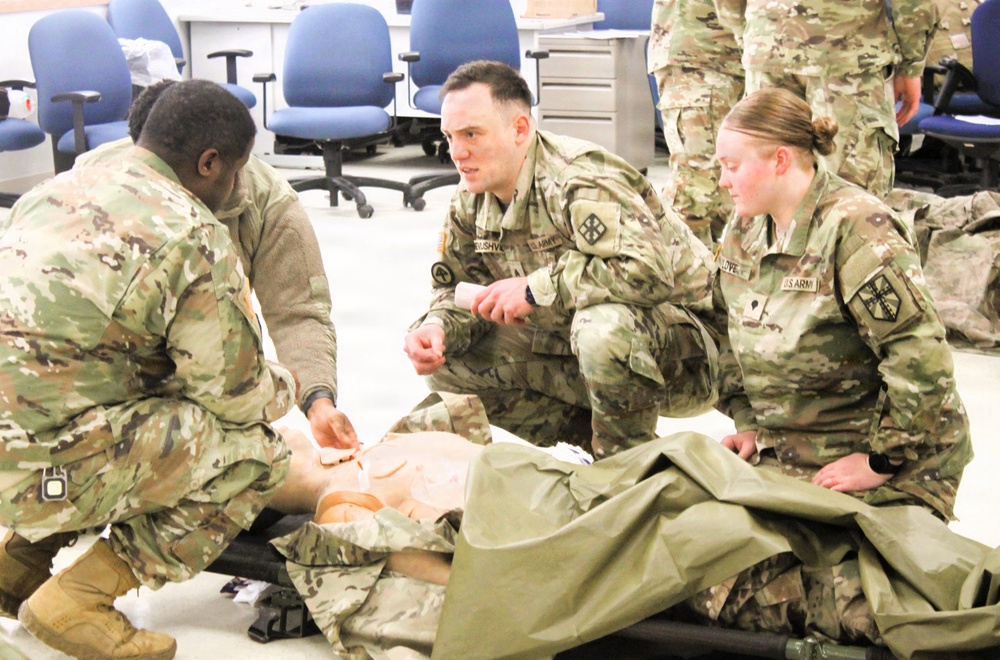
Between January and March 2026, more than 90 combat medics received condensed 68W Sustainment Training at Fort McCoy’s Medical Simulations Training Center to ensure these medics maintain their required career field skills.
Sgt. 1st Class Michael McCreary, a 68W combat medic himself, is serving as the noncommissioned officer in charge of supporting the training. McCreary is completing this training support while on temporary duty from 807th Theater Medical Command of Fort Douglas of Salt Lake City, Utah.
McCreary described the kind of training being done and why.
“Well, because of the government shutdown, we have a lot of combat medicswho have missed their window to go to school,” McCreary said. “So this is almost like an emergency mission in order to have them allsustain in their military occupational specialty (68W) with a March 31 deadline.”
The 68W Sustainment Training is normally a 10- to 12-day course at the Fort McCoy Medical Simulation Training Center (MSTC), McCreary said, but it’s been shortened to five days.
“We’ve condensed it into five days — four 12-hour days,and then one day of training and testing for the lanes,” McCreary said. “We’re getting that same amount of training,but it’s … fairly intense training for five days.”
McCreary said the training included lots of classroom time, hands-on practicing with equipment, and going through training trauma lanes multiple times, and more.
The sergeant first class also discussed how critical combat medics are for the Army Reserve and the Army.
“Well, in wartime, obviously combat medics are the most important part,” he said.“I mean, if someone goes down,it’s imperative that they get the life-saving treatment that they need towithin seconds, if not minutes,and that few minutes can make the difference between life and death.
“And the more training, the more hands-on we have for our combat medics,then they can build up those skills with their muscle memory,so they know exactly what to doversus spending time trying to figure out what they need to do now,” McCreary said.“So the more hands-on they can get, the better. In the Reserve we don’t typically get full-time access to mannequins and the other training aids,so these five to 10 days, depending on which course you're on,are instrumental in maintaining your 68 Whiskey MOSso that you can be the best Soldier you can.”
And to complete this training at Fort McCoy’s MSTC, McCreary said it fits the needs set forth for the training perfectly.
“I've been here for my own 68 Whiskey Sustainment Training,” McCreary said.“Phenomenal course.The amount of facilities that they have. I mean, the training simulator I think is $13 million.You’re not going to get that at a unit level.You’re not going to get mannequins at a unit level.
“I mean, this is really where people need to cometo get the most out of their trainingbecause if you’re just doing a unit level,you’re not really interacting as well as you could,” he said. “And Fort McCoy, besides the weather,has been the best training center that I’ve been toas far as the facilities and the training aids that they have available to them.”
Healthcare Instructor and Interim Director Benjamin Leonard with the Fort McCoy MSTC said the center is proud to support the training for Army Reserve Medical Command.
“For me, this is a wonderful experience,” Leonard said. “I love seeing NCOs getting up in front and leading the training. While we’re there to assist and see them do that training and be a part of it, allowing them to get their hands-on training with the simulators and training them to utilize this equipment, it’s like putting extra hands out there. Rather than just the six of us who are here, with these guys, we have another eight hands that get to (teach).”
The official designation of the 68W military occupational specialty is combat medical specialist by the U.S. Army. According to the Army job description for the MOS at https://www.goarmy.com/careers-and-jobs/science-medicine/intensive-care/68w-combat-medic-specialist, it describes a unique and specialized career field.
“As a combat medic specialist, you’ll deliver emergency medical care in high-pressure situations, from accidents and natural disasters to military training and operations,” the description states. “You’ll assess injuries, stabilize patients, and make critical medical decisions under extreme conditions. You’ll also train other Soldiers in first aid and provide ongoing medical support on base.”
Learn more about MSTC training by visiting the MSTC Sharepoint site at https://armyeitaas.sharepoint-mil.us/teams/FortMcCoyMSTC.
Fort McCoy’s motto is to be the “Total Force Training Center.” Located in the heart of the upper Midwest, Fort McCoy is the only U.S. Army installation in Wisconsin.
The installation has provided support and facilities for the field and classroom training of more than 100,000 military personnel from all services nearly every year since 1984.
Learn more about Fort McCoy online at https://home.army.mil/mccoy, on Facebook by searching “ftmccoy,” on Flickr at https://www.flickr.com/photos/fortmccoywi, and on X (formerly Twitter) by searching “usagmccoy.”
Also try downloading the My Army Post app to your smartphone and set “Fort McCoy” or another installation as your preferred base. Fort McCoy is also part of Army’s Installation Management Command where “We Are The Army’s Home.”
| Date Taken: |
03.05.2026 |
| Date Posted: |
03.05.2026 01:35 |
| Story ID: |
559407 |
| Location: |
FORT MCCOY, WISCONSIN, US |
| Web Views: |
123 |
| Downloads: |
0 |
PUBLIC DOMAIN

This work, Army Reserve combat medic describes 68W Sustainment Training at Fort McCoy, by Scott Sturkol, identified by DVIDS, must comply with the restrictions shown on https://www.dvidshub.net/about/copyright.

 Subscribe






