
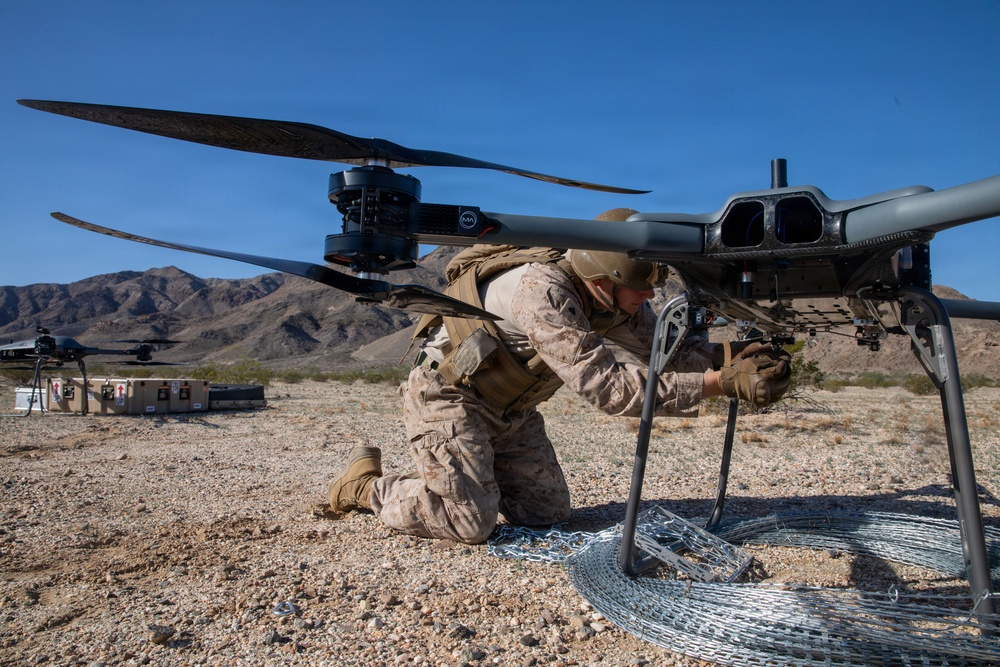
Photo By Lance Cpl. Zackery Dear | U.S. Marine Corps Cpl. Justin Duhon a motor vehicle operator with Combat Logistics...... read more read more
 Subscribe
FORT HUACHUCA, Ariz. – Along the U.S-Mexico border, Joint Task Force–Southern Border (JTF‑SB) and its subordinate units are turning one of the nation’s most challenging security environments into a proving ground for emerging military technology. From autonomous aerial resupply drones to long‑endurance unmanned surface vessels, the border has become what leaders describe as “the DoW’s newest laboratory” - a real‑world environment where innovation meets operational necessity.
Across the central and western portions of the Joint Operations Area (JOA), U.S. Marines assigned to JTF‑SB are implementing the Tactical Resupply Vehicle (TRV‑150C), a quadcopter‑style unmanned aircraft system. The TRV‑150C provides autonomous, small‑unit resupply without the need for traditional aviation support. It can also be an expeditionary capability with the entire system fitting into the bed of a Joint Light Tactical Vehicle (JLTV) or the Infantry Squad Vehicle (ISV) -- vehicles designed to be highly mobile platforms for U.S. servicemembers.
The TRV-150 itself is built for use by any trained servicemember, the system removes the requirement for a designated aviation specialty and is designed for flexibility in contested or austere environments. Its center‑of‑gravity configuration allows it to carry up to 150 pounds of cargo.
“The TRV is a game‑changer for the last tactical mile,” a Marine Gunnery Sgt. Abrahim Bosch, Operations Chief for Combat Logistics Company, JTF-SB “By putting autonomous resupply directly into the hands of our ground squads, we ensure they remain sustained and mission‑ready without waiting on traditional logistics chains.
Farther south along the Rio Grande, Soldiers and Border Patrol agents are integrating another emerging capability: Unmanned Surface Vessels (USV). These small, autonomous watercrafts are a part of an initiative which seeks to expand persistent riverine monitoring across the South Texas National Defense Area (NDA).
The vessels provide mobile, solar‑powered surveillance that can operate for up to six months without refueling or maintenance. Their sensors feed directly into shared interagency systems, enhancing the common operating picture and enabling faster reactions.
“This new tech initiative represents a critical leap in innovation for riverine operations,” Maj. Robert Robinson, senior operations officer, 130th Maneuver Enhancement Brigade (MEB), JTF-SB. “By deploying these autonomous systems, we are not just increasing our sensing capabilities; we are creating a persistent shield along the Rio Grande that protects territorial integrity while allowing our personnel to focus on other missions.”
The objective is to establish a hybrid manned‑unmanned presence in the Rio Grande’s National Defense Area, providing continuous detection and monitoring to counter illegal crossings and activities.
Together, these technologies reflect the next evolution in how JTF‑SB approaches border security: leveraging real‑world conditions to accelerate innovation, strengthen interagency coordination and protect our southern border.
| Date Taken: | 03.04.2026 |
| Date Posted: | 03.05.2026 16:37 |
| Story ID: | 559376 |
| Location: | ARIZONA, US |
| Hometown: | ALPINE, SAN DIEGO, CALIFORNIA, US |
| Hometown: | AVENEL/WASHINGTON, D.C., MARYLAND, US |
| Hometown: | CAMP WASHINGTON, OHIO, US |
| Hometown: | EL PASO, TEXAS, US |
| Hometown: | MCALLEN, TEXAS, US |
| Hometown: | NEW YORK, NEW YORK, US |
| Hometown: | PHOENIX, ARIZONA, US |
| Hometown: | SAN DIEGO, CALIFORNIA, US |
| Web Views: | 521 |
| Downloads: | 0 |

This work, Joint Task Force–Southern Border deploys cutting edge tech transforming border operations, by MSG Anthony Hewitt, identified by DVIDS, must comply with the restrictions shown on https://www.dvidshub.net/about/copyright.


No keywords found.




