
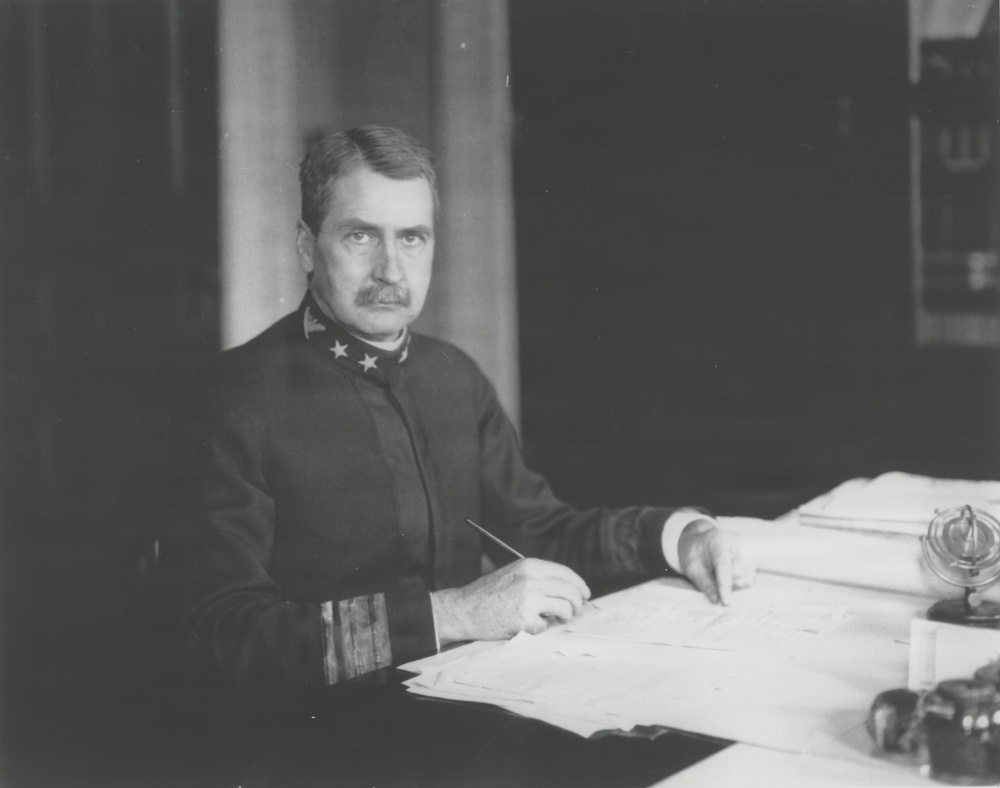
Courtesy Photo | Rear Adm. David W. Taylor, naval architect and engineer, served as chief of the Bureau...... read more read more
BETHESDA, Md. – On March 4, Naval Surface Warfare Center, Carderock Division recognizes the birthday of Rear Adm. David W. Taylor, the naval architect and engineer whose insistence on scientific rigor helped reshape how the U.S. navy designs ships. For those who work at Carderock, that date marks more than the anniversary of a historical figure; it marks the beginning of a legacy shaped the command’s engineering standards.
When Naval Sea Systems Command (NAVSEA) emphasizes delivering combat-ready ships and systems to the fleet, that expectation rests on disciplined engineering and validated performance. At Carderock, those principles are not new; they are foundational.
In 1898, Taylor designed and supervised construction of the Washington Navy Yard’s Experimental Model Basin and took charge of it the following year. He was not simply building a towing tank; he was institutionalizing a method. Ship design would no longer rely primarily on experience or approximation, but on controlled experimentation, measurable results and repeatable standards.
Through the development of what became known as the Taylor Standard Series, Taylor introduced a systematic set of hull forms with documented performance data. Naval architects could compare, analyze and estimate resistance and propulsion requirements using structured, validated information. His work reduced uncertainty in ship performance and accelerated confidence in design decisions by establishing a disciplined technical baseline.
More than a century later, that expectation remains intact across Carderock’s mission areas. Whether in hydrodynamics, structures, materials, manufacturing or survivability, scientists and engineers across the command continue to apply rigorous analysis and testing to ensure naval systems perform as intended. The tools have advanced, but the principle is unchanged: Validate before you deliver.
Taylor’s career reflected that same alignment between innovation and execution. He held 13 U.S. patents related to ship design and later served as chief of the Bureau of Construction and Repair during a period of significant fleet expansion. His work demonstrated that invention must be paired with technical rigor and operational relevance.
Carderock did not pivot toward disciplined engineering in response to modern strategy. It was founded on it.
The David Taylor Model Basin, dedicated in 1939 in his presence, stands as a physical reminder of that foundation. But the true legacy is not the facility itself; it is the standard it represents. Before there were “lines of effort,” there was a commitment to evidence, repeatability and accountability in design. That commitment continues to define how Carderock contributes to naval readiness and maritime superiority.
| Date Taken: | 03.04.2026 |
| Date Posted: | 03.04.2026 14:32 |
| Story ID: | 559371 |
| Location: | BETHESDA, MARYLAND, US |
| Web Views: | 83 |
| Downloads: | 0 |

This work, The Birth of a Standard: Recognizing the Legacy of Rear Adm. David W. Taylor, by Alisha Tyer, identified by DVIDS, must comply with the restrictions shown on https://www.dvidshub.net/about/copyright.


No keywords found.





