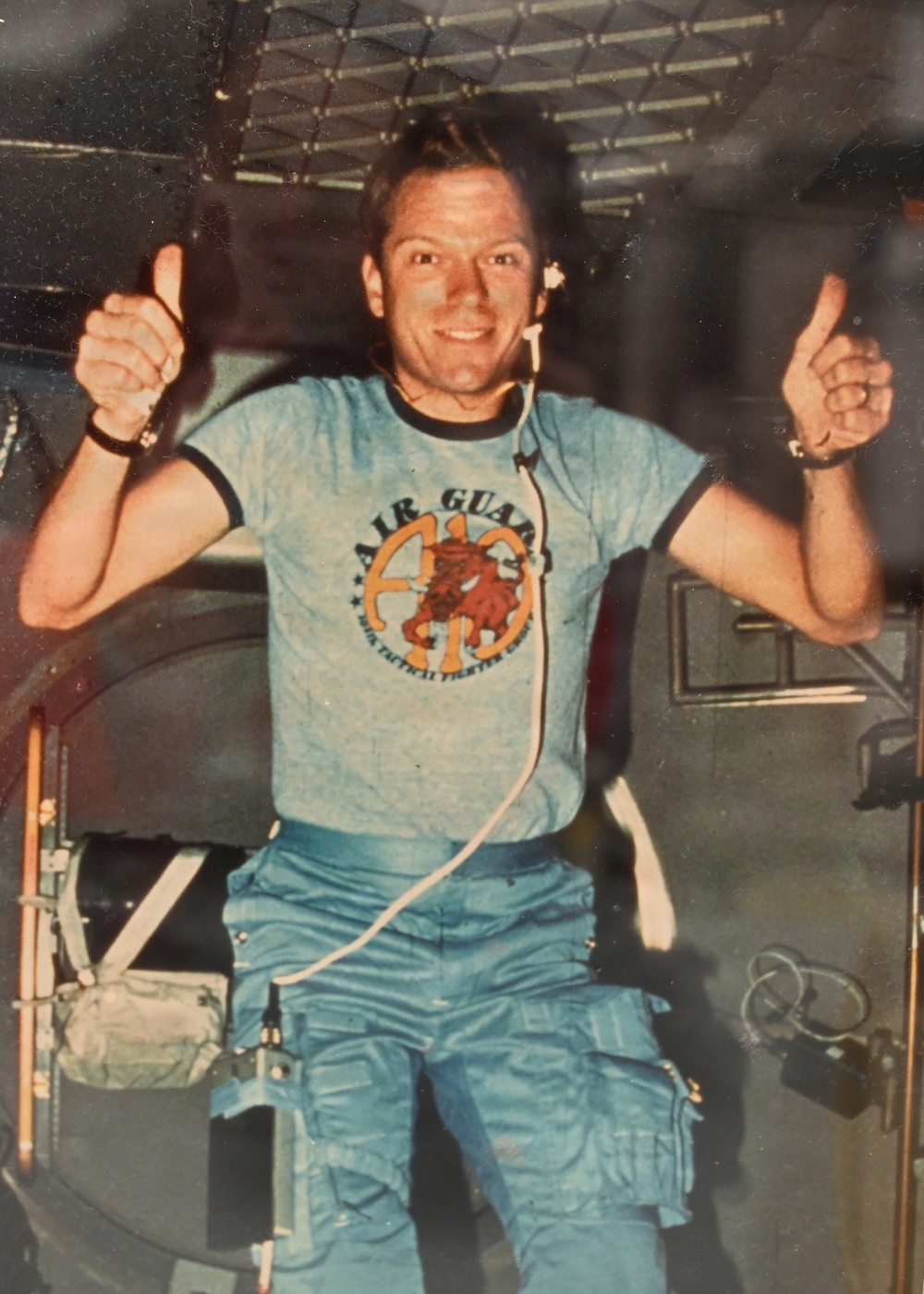
Photo By Melanie Casineau | U.S Air Force Lt. Col. Byron K. Lichtenberg, 104th Tactical Fighter Group pilot, is shown in a framed photo of him wearing a t-shirt in space from the 104th Tactical Fighter Group used for a fundraising opportunity for the base hockey team, brought in by Retired Chief MSgt. John DeVeche, 104th Fighte Wing, Barnes Air National Guard Base, Westfield, Ma, February 13, 2026. DeVeche started the origianl hockey team when they were part of the Pioneer Valley League Over 25 team and were called the Minutemen. (U.S. Air National Guard Photo by Melanie J. Casineau) see less
| View Image Page
Fighter jets to spacecraft, the 104th Fighter Wing’s legacy extends to space
BARNES AIR NATIONAL GUARD BASE, Westfield, MA-“Houston, we’ve had a problem.”
That’s not a phrase we hear at the 104th Fighter Wing, but it was spoken by one of our members.
The 104th Fighter Wing has a proud history of pilots who went on to become astronauts. The first was John “Jack” Swigert, who served with the Massachusetts Air National Guard’s 131st Fighter Interceptor Squadron from September 1957 to April 1960. During his time with the 131st, Swigert flew the F-86H Sabre jet as a fighter pilot. He later transferred to the Connecticut Air National Guard, serving from 1960 to 1965 and flying the F-100 Super Sabre.
Between both assignments, Captain Swigert logged more than 6,430 hours in jet aircraft. While serving in the Guard, he also worked as a test pilot for Pratt & Whitney and North American Aviation.
At the 131st Fighter Interceptor Squadron, Swigert was known as both a skilled fighter pilot and a bachelor who never married. However, he became best known as the Command Module Pilot for NASA’s Apollo 13 mission in 1970. Swigert was a last-minute replacement for Ken Mattingly, stepping in just 72 hours before launch after Mattingly was exposed to German measles.
During the mission, an oxygen tank exploded, crippling the spacecraft. Swigert calmly radioed Mission Control with the now-famous words, “Houston, we’ve had a problem.”
On April 17, 1970, Apollo 13 safely returned to Earth in what became one of NASA’s most remarkable rescue missions.
Swigert had been accepted into NASA in April 1966 and previously served as a support crew member for Apollo 7 before being assigned to Apollo 13’s backup crew. Though Apollo 13 was intended to be the third mission to land on the moon, it instead became a powerful testament to teamwork, ingenuity, and resilience.
Swigert did have a sense of humor. In addition to reporting the spacecraft malfunction, he made another memorable request from space, an extension on his income taxes.
“Things kind of happened real fast down there and I need an extension. I’m really serious,” he told Mission Control, prompting laughter. Flight Director Glynn Lunney reassured him that Americans out of the country received a 60-day filing extension, which, he noted, presumably applied in this case.
The 104th’s second astronaut reached space while still serving in the Guard.
Lt. Col. Byron K. Lichtenberg, a pilot with the 104th Tactical Fighter Group, became the first NASA payload specialist to be launched on a space mission.
“When the original astronauts went into space, I realized they were all military test pilots,” Lichtenberg said. “So I figured I would have to do that, too.”
Lichtenberg served 23 years as a fighter pilot in the 104th Tactical Fighter Group, Massachusetts Air National Guard, flying the F-4, F-100, and A-10 aircraft. During the Vietnam War, he flew 138 combat missions and was awarded two Distinguished Flying Crosses, ten Air Medals, and numerous other decorations.
After graduating from Brown University in 1969 and completing his Air Force service in Vietnam, Lichtenberg pursued advanced degrees at the Massachusetts Institute of Technology, earning master’s and doctoral degrees in mechanical and biomedical engineering.
“I realized if I was a fighter pilot with a doctorate, I would have a better chance of getting into space,” he explained.
His determination paid off.
While still serving in the Guard, Lichtenberg flew on the 10-day Spacelab-1 (STS-9) mission aboard Space Shuttle Columbia in 1983. The mission carried the first Spacelab laboratory module into orbit and conducted numerous experiments in life sciences, materials science, astronomy, atmospheric physics, and more.
He later flew on the ATLAS-1 (STS-45) Spacelab mission aboard Space Shuttle Atlantis in 1992, spending nine days conducting 13 experiments in atmospheric sciences and astronomy. Over his two missions, Lichtenberg completed 310 Earth orbits and logged 468 hours in space, all while serving with the 104th Tactical Fighter Group in Westfield.
Even while reaching for the stars, Lichtenberg remained deeply connected to the 104th community.
TSgt. John DeVeche (now retired Chief), who founded the 104th Tactical Fighter Group Barnestormers Hockey Team, asked Lichtenberg to bring the team’s fundraising T-shirt into space. A hockey fan himself, Lichtenberg proudly did so and even took a photograph with the shirt in orbit, a lasting tribute to the team and the base.
During his time as an astronaut, members of the Westfield community, including middle school students and civic leaders, traveled to Cape Canaveral to witness one of his launches. Lichtenberg worked to inspire the next generation of explorers who would follow in his footsteps.
From fighter jets to spacecraft, the 104th Fighter Wing’s legacy extends far beyond the runway, reaching all the way to space.

 Subscribe






