
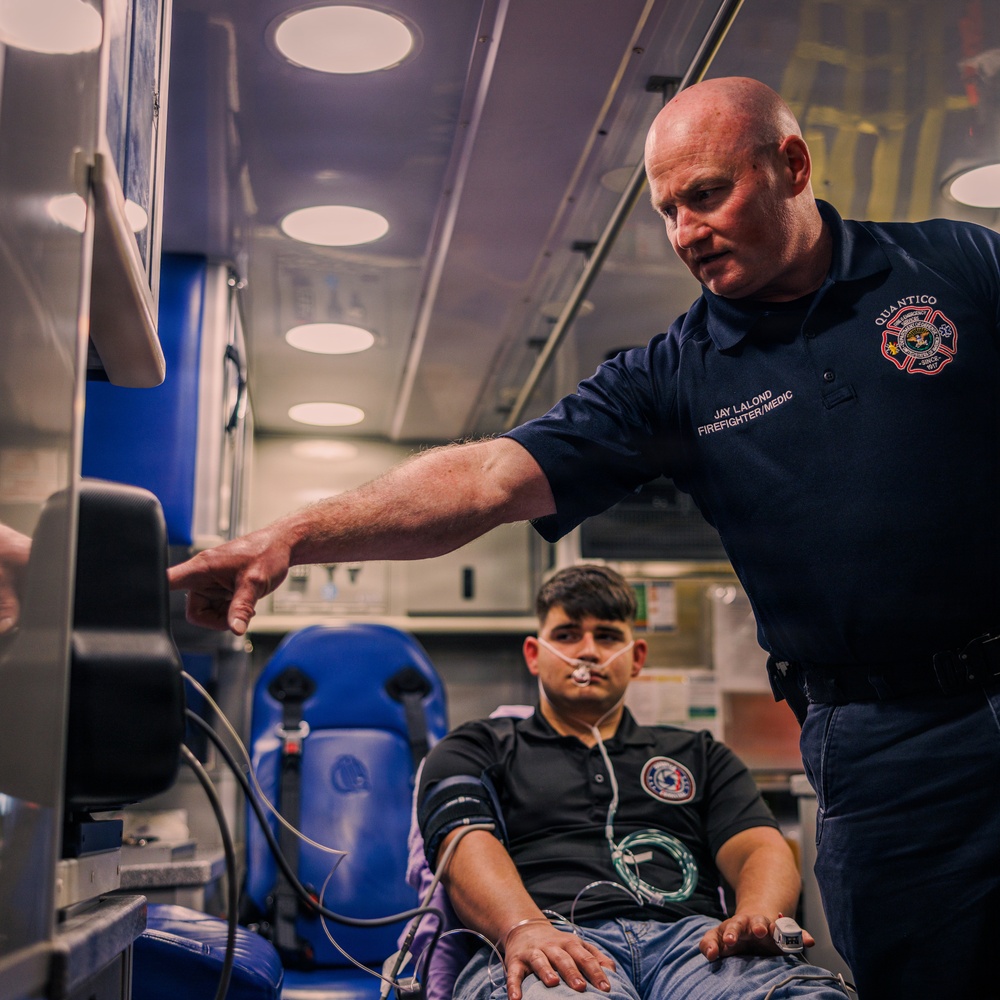
Photo By Cpl. Braydon Rogers | Jay LaLond, a firefighter/paramedic with Quantico Fire and Emergency Services Station...... read more read more
 Subscribe
MARINE CORPS BASE QUANTICO, Va. — Quantico Fire and Emergency Services has a new cardiac monitor designed to improve patient care in the field and streamline communication with receiving hospitals. The LIFEPAK 35 heart monitor/defibrillator brings expanded monitoring capabilities, such as touchscreen functionality and enhanced durability, according to Jay Lalond, a firefighter paramedic with Quantico Fire and Emergency Services.
Each of the QFES fire engines and medic units are equipped with the new device ensuring the first responders have the best tools available if they need to save a life
According to Lalond, the LIFEPAK has already made the difference when it was used to save the life of an area resident who was experiencing cardiac arrest
“It integrates into a call by doing multiple functions at once,” Lalond said. “We can monitor patients’ vital signs, their blood pressure, their oxygen saturation, and their cardiac rhythm. We can also look at their respiratory rate and their end-tidal CO2. We can do all this all at once.”
“If they have either a slow or fast heart rate, or unfortunately even when they’re in cardiac arrest, we can defibrillate them with this as well,” Lalond said. He went on to explain how advanced features are invaluable.
“When we’re running a patient that has a cardiac rhythm of some sort, we can actually do a better analysis of that cardiac rhythm versus a provider just looking at it and trying to figure that out,” he said.
The updated touchscreen is another significant upgrade. It has a simpler interface which reduces the need to search for external buttons during critical moments, which can save valuable time in emergencies.
This model has more electrode leads than the previous model. This provides a simultaneous front and back view of the heart and also enables enhanced diagnostic capabilities that allow for a more detailed simultaneous view of the hearts electrical activity. Having access to more and better information enables responders to deliver electrical therapy when needed.
Time can be critical when care providers are making decisions. The LIFEPAK 35 can also transmit patient data directly to a receiving facility while crews are en route.
“If we’re transporting to a certain hospital,” Lalond said, “We’ll actually transmit all the vital signs and cardiac rhythms ahead of us so the team at the hospital can adequately prepare for the patient that we’re bringing.”
Another key improvement involves how the monitor supports crews during cardiopulmonary resuscitation. Standard CPR protocol involves two-minute cycles before reassessing or delivering a shock if necessary. The new monitor helps automate part of that process.
“What the monitor will actually do, it will start pre-charging so that energy is ready to go once you hit that two-minute mark,” Lalond said. “Versus the old one, you’d have to initiate that manually. You’d have to wait until you’re close to that two-minute mark and then hit charge yourself.”
By preparing the shock in advance, the monitor reduces potential delays and limits opportunities for human error during high-stress situations.
The new model also differs significantly in design, user interface, and durability. The LIFEPAK 35 features reinforced glass designed to withstand the demands of emergency response. While the monitor is not used directly inside active fire environments, its construction provides confidence during routine field operations.
“It’s made with reinforced glass. It’s got Kevlar-reinforced glass, so it’s impact resistant,” he said. “It will survive a heavy drop.”
Lalond said the combination of improved analysis, streamlined controls and real-time data transmission ultimately benefits both patients and providers.
“It just makes it more efficient for us in the field and helps the hospital be more prepared when we arrive,” he said.
With the LIFEPAK 35 now in service, Quantico Fire and Emergency Services officials say the department is better equipped to deliver advanced cardiac care from the moment crews arrive on scene through transfer of care at the hospital.
| Date Taken: | 03.02.2026 |
| Date Posted: | 03.02.2026 14:32 |
| Story ID: | 559215 |
| Location: | QUANTICO, VIRGINIA, US |
| Web Views: | 73 |
| Downloads: | 0 |

This work, An Advancement for First Responders, by LCpl Jacob Parker, identified by DVIDS, must comply with the restrictions shown on https://www.dvidshub.net/about/copyright.


No keywords found.




