
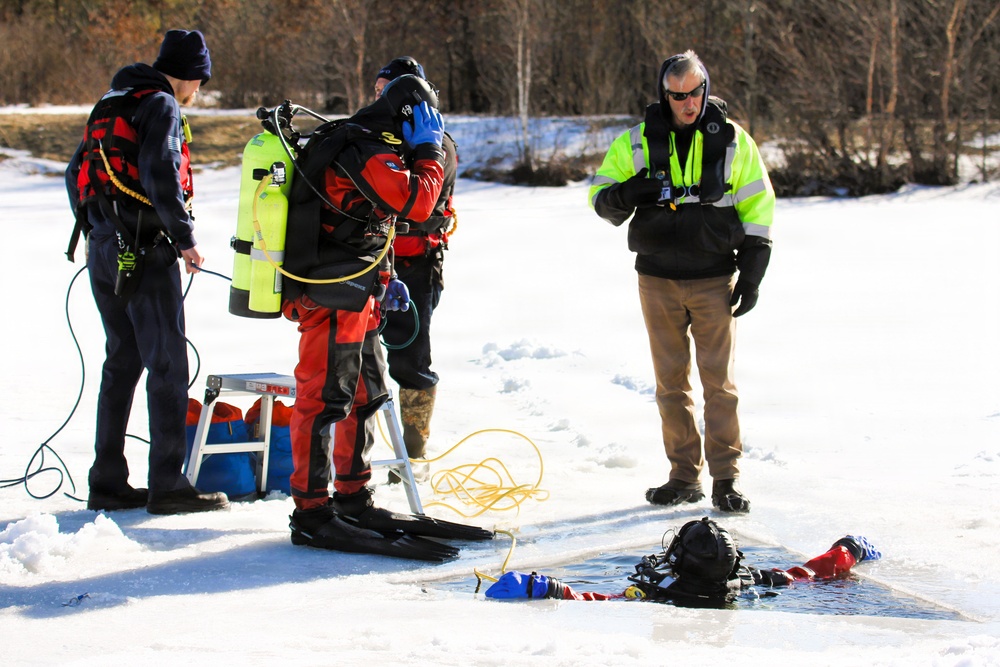
Photo By Scott Sturkol | Members of the Fort McCoy Directorate of Emergency Services Fire Department conduct...... read more read more
 Subscribe
For nearly 15 years, the Fort McCoy Directorate of Emergency Services Fire Department at the installation has had a scuba dive team that provides a special capability that few Army fire departments have for technical rescue, mutual aid support, and more.
Deputy Fire Chief Brady Brever, who’s been part of dive team’s existence for most of the time at Fort McCoy, said the team has been helpful in a wide variety of ways.
“The Fort McCoy Fire Department’s dive team provides a critical emergency response capability for the installation and our surrounding communities,” Brever said. “Their specialized skills in surface and underwater rescue and recovery are vital to ensuring the safety and security of the Total Force Training Center.”
With on-post mission readiness, Brever said the team gives a great response capability because of the many waterways at the installation.
“Fort McCoy encompasses nearly 60,000 acres, including numerous lakes, rivers, and streams,” Brever said. “These bodies of water, like Big Sandy Lake, are used for military training and recreational pursuits throughout the year. The dive team’s presence is essential for responding to water-related incidents that may occur during these training exercises and recreational activities, ensuring the safety of all service members and the installation population.”
Brever said the dive teams skills are not limited to surface rescue. They are also highly trained for complex scenarios, including underwater recovery in dark, low-visibility water, and rescues beneath the ice.
The team conducts annual training covering surface-rescue, and dive operations to maintain their skills for these high-risk, low-frequency events, practicing scenarios from surface rescue to underwater search and recovery in summer and winter conditions. A recent training example took place on Feb. 11 at Big Sandy Lake.
“This rigorous training ensures they are prepared for calls throughout the year from open water to ice rescue and recovery,” Brever said. “Our dive team is equipped with specialized gear, including dry suits, full-face masks, and wireless underwater communication systems, which allow for effective coordination between divers and surface crews.
And one of the most effective uses of the dive team the past decade and a half has been for community support through mutual aid.
“The Fort McCoy dive team is a vital regional resource and gets called upon to support local communities in neighboring counties through mutual aid agreements,” Brever said. “Many local municipalities do not have the specialized equipment or personnel for water rescue operations, making the Fort McCoy team a crucial partner in times of crisis. This partnership extends to various emergency situations, from assisting with rescue operations for witnessed water emergencies to searches for missing persons in lakes and rivers.
“The team’s ability to respond to these requests not only saves lives and aids searches but also strengthens the bond between Fort McCoy and the surrounding communities,” Brever said.
Over and over, it’s been shown military fire department scuba dive teams are critical to first responder capabilities not only due to their specialized training and equipment, which allow them to operate in challenging and hazardous conditions, but also their rapid response and specialized skills can mean the difference between life and death in water emergencies.
As Brever noted, dive team members are trained to conduct search and recovery, evidence handling, and rescue operations, and more, ensuring that they can effectively respond to emergencies involving submerged vehicles, drowning victims, and other water-related incidents. Additionally, their training and equipment are designed to handle the unique demands of public safety work, making them a vital resource for first responders.
With enhanced technical rescue skills, scuba teams complement other specialties existing capabilities with things like rope rescue, surface-to-water operations, confined space, submerged confined environments, collapse rescue, underwater structural assessment, and more.
In a 2019 news article about the Fort McCoy Fire Department dive team at https://www.dvidshub.net/news/310963/rescue-training-fort-mccoy-firefighters-learn-practice-diving-under-ice, Jeff Zilliox with the Marineland Dive Center of Onalaska, Wis., discussed what it’s like when the divers complete their training for going under the ice.
“We try to train the same way every time, so no matter what the conditions are, we are used to training with the equipment and can respond to an emergency quickly,” said Zilliox, acknowledging that it’s a “train like you fight” approach that works well.
He said in below-zero temperatures, for example, a diver who comes out of the water can have their equipment freeze instantly, so that’s why they always train to have divers go in and out of a hole in the ice that is covered by a heated tent, if possible. “We want to make sure that when the divers come out they stay warm, and we try to get them dried off as quickly as possible,” Zilliox said.
During the February 2026 training by the team, Firefighter/Emergency Medical Technician Brian Butzler said he’s proud to be a part of the dive team and what it can bring for fire department capabilities.
“It’s very unique,” Butzler said. “The real positive thing about having something like this is it’s a great resource. We can go out and help a community … and be there for a community. It’s not always the easiest thing, but it definitely gives us an opportunity to show our capabilities, help out with the community. … The opportunity to know that Fort McCoy is here and has this great resource, it definitely helps the community and the state whenever we’re called upon.”
Brady said he’s also proud they have a great team of firefighters supporting the team in every way possible.
“Their service demonstrates a profound commitment to public safety that extends far beyond the installation’s boundaries,” Brever said.
Fort McCoy’s motto is to be the “Total Force Training Center.” Located in the heart of the upper Midwest, Fort McCoy is the only U.S. Army installation in Wisconsin.
The installation has provided support and facilities for the field and classroom training of more than 100,000 military personnel from all services nearly every year since 1984.
Learn more about Fort McCoy online at [https://home.army.mil/mccoy\](https://home.army.mil/mccoy](https://home.army.mil/mccoy](https://home.army.mil/mccoy), on Facebook by searching “ftmccoy,” on Flickr at https://www.flickr.com/photos/fortmccoywi, and on X (formerly Twitter) by searching “usagmccoy.”
Also try downloading the My Army Post app to your smartphone and set “Fort McCoy” or another installation as your preferred base. Fort McCoy is also part of Army’s Installation Management Command where “We Are The Army’s Home.”
(Article prepared by the Fort McCoy Public Affairs Office and the Fort McCoy Directorate of Emergency Services Fire Department.)
| Date Taken: | 03.02.2026 |
| Date Posted: | 03.02.2026 13:35 |
| Story ID: | 559212 |
| Location: | FORT MCCOY, WISCONSIN, US |
| Web Views: | 476 |
| Downloads: | 0 |

This work, Fort McCoy’s DES Fire Department dive team brings added capability for technical rescue, more, by Scott Sturkol, identified by DVIDS, must comply with the restrictions shown on https://www.dvidshub.net/about/copyright.


No keywords found.




