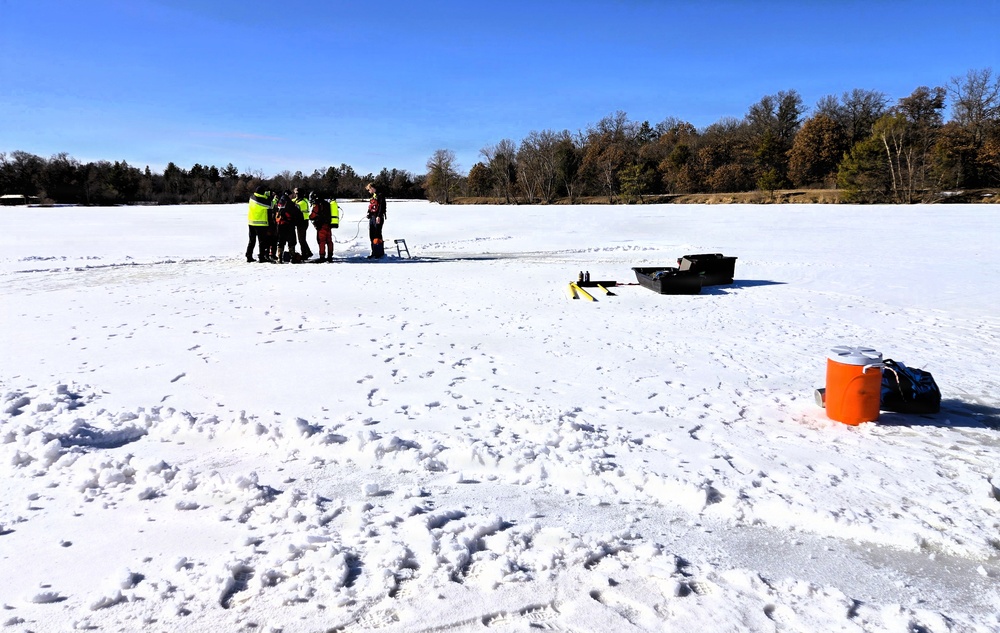
Members of the Fort McCoy Directorate of Emergency Services (DES) Fire Department took advantage of good ice conditions and completed ice rescue training Feb. 11 at Big Sandy Lake on South Post at Fort McCoy.
At the training, while standing on more than a foot of ice, Firefighter/Emergency Medical Technician and dive team member Brian Butzler described the training.
“We’re just practicing our annual ice dives,” Butzler said. “Essentially, we’re just practicing, but they (trainers) are also giving us more tools to help with the toolbox. Different dives, different things, different scenarios. That way, we're ready for almost anything that, as of right now, involves ice and ice rescue and ice recovery.”
Fort McCoy is one of the unique places in the Army that actually has a dive team. Through mutual aid, they have supported a lot of local communities, even within neighboring states, in past years. Butzler talked about the importance of having something as unique as a dive team for technical rescue, underwater rescue, and more.
“It’s very unique,” Butzler said. “The real positive thing about having something like this is it’s a great resource. We can go out and help a community … and be there for a community. It’s not always the easiest thing, but it definitely gives us an opportunity to show our capabilities, help out with the community. … The opportunity to know that Fort McCoy is here and has this great resource, it definitely helps the community and the state whenever we’re called upon.”
During their training at Big Sandy Lake, Butzler said they were diving as deep as 25 feet in the lake. He described what it felt like diving under the ice.
“It can be claustrophobic,” Butzler said. “It can be definitely daunting having 2 feet of ice on top of you, so that if something goes wrong, there’s nowhere to go. You have to go back out the same way you came in. Today we were practicing diver rescue, so if a diver gets out, comes off the line, something happens, another diver goes out and swims and picks him up.”
Butzler added that diving in Big Sandy Lake also gives them that experience of diving in darker water.
“It’s dark,” he said. “We don’t have a lot of clear water here that we’ve gone into. I’ve only gone in one clear water rescue and recovery. The rest is dark water, which means you can’t see much more than a foot, less than a foot in front of your face.”
Butzler also discussed communication when diving. He said the Fort McCoy dive team is fortunate to have communication equipment they can use underwater.
“We have comms, so we’re able to talk to each other,” Butzler said. “I can talk to my backup diver or backup diver can talk to me. We can talk to the tender. So, we’re very fortunate in that way. There are a lot of other dive companies and other divers that do rope pulls. We’re able to talk, tell them what we’re seeing, relay information, and a lot of others don’t have those capabilities, and that's kind of what makes us very unique is we kind of have those things that really enhance and make it a lot easier for us to go down and get in the water.”
The capabilities that Butzer described about the Fort McCoy dive team ae the reason they often get calls to support and incident/accident through mutual aid.
“It’s great that people actually want to use us and use our tools and resources that we have because we definitely have a lot that can help everybody,” Butzler said.
The fire department conducted the training over several days in addition to Feb. 11. Fire department leaders say ice diving is about practice, practice, practice, which is why it is practiced every year.
In this year’s training, like previous years, divers took turns going in and out of a hole cut into the ice. Each diver was tethered with a line that included the communications connection.
Divers go in with dry suits and full-face masks, so the comfort level is much higher for them when they are underwater. The divers are well-equipped, so the training helps them become well-versed in using that equipment. Divers were underwater for 15 to 20 minutes on average, completing lost diver and search scenarios.
Assistant Fire Chief Brady Brever said underwater scenarios help them learn what it’s like in case they have to assist in a real-world emergency.
“When setting up training events in high-risk, low-frequency events, the goal is to make the scenario as realistic and accurate to real events as possible,” Brever said about similar training in a past news article. “This training is a prime example of what realistic training should look like.”
Butzler said he was glad to be a part of the training and is glad be a part of the dive team.
“It’s a great job, great community, great environment with a lot of the firefighters and the dive team is always one of the things that we look forward to doing, good or bad,” Butzler said.
Fort McCoy’s motto is to be the “Total Force Training Center.” Located in the heart of the upper Midwest, Fort McCoy is the only U.S. Army installation in Wisconsin.
The installation has provided support and facilities for the field and classroom training of more than 100,000 military personnel from all services nearly every year since 1984.
Learn more about Fort McCoy online at[https://home.army.mil/mccoy](https://home.army.mil/mccoy), on Facebook by searching “ftmccoy,” on Flickr at https://www.flickr.com/photos/fortmccoywi, and on X (formerly Twitter) by searching “usagmccoy.”
Also try downloading the My Army Post app to your smartphone and set “Fort McCoy” or another installation as your preferred base. Fort McCoy is also part of Army’s Installation Management Command where “We Are The Army’s Home.”
| Date Taken: |
02.27.2026 |
| Date Posted: |
02.27.2026 16:44 |
| Story ID: |
559145 |
| Location: |
FORT MCCOY, WISCONSIN, US |
| Web Views: |
150 |
| Downloads: |
0 |
PUBLIC DOMAIN

This work, Fort McCoy DES Fire Department dive team holds February rescue training under ice, by Scott Sturkol, identified by DVIDS, must comply with the restrictions shown on https://www.dvidshub.net/about/copyright.

 Subscribe






