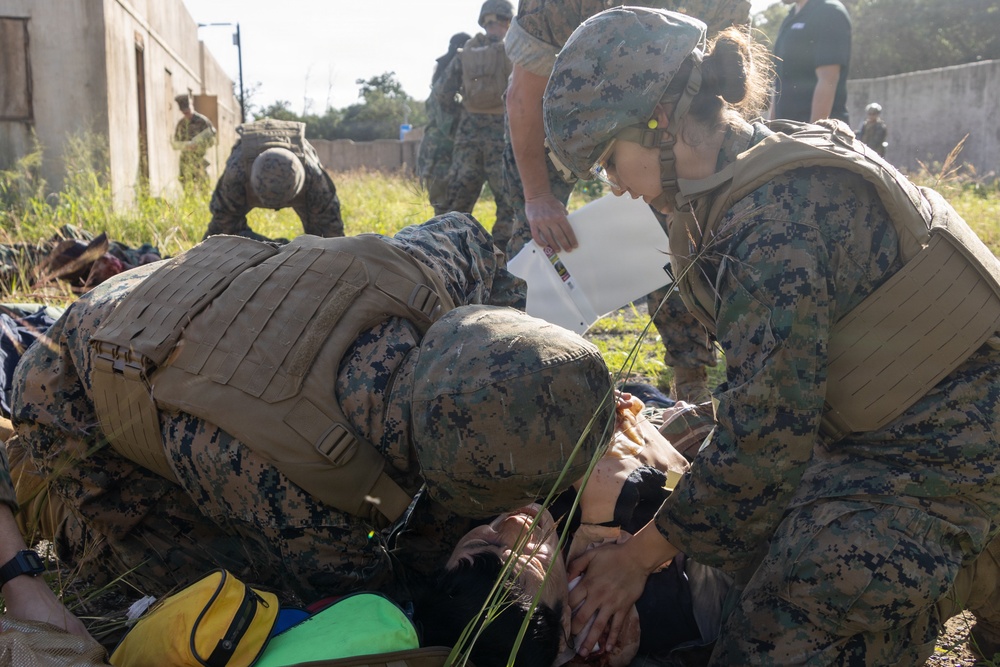
MARINE CORPS BASE HAWAI’I - U.S. Navy Sailors with 21st Dental Company, 3rd Dental Battalion, and Marines with 3rd Littoral Combat Team (LCT), 3rd Marine Littoral Regiment (MLR) trained in a collaborative effort to enhance medical readiness and coordination between infantry security forces and hospital corpsmen by responding to simulated mass casualties in an austere environment at Marine Corps Training Area Bellows (MCTAB), Marine Corps Base Hawai’i, Feb. 4, 2026.
This training scenario was a large-scale medical exercise designed to prepare Sailors and Marines to respond to casualties in a combat environment. The use of MCTAB’s Military Operations on Urbanized Terrain helped simulate complex, real-world scenarios that challenged security, movement, and medical response time.
“This is the first time I did an exercise with this magnitude, with this model and realistic elements,” said U.S. Navy Chief Petty Officer Eduardo Canales, a dental laboratory advisor with 21st Dental Company, 3rd Dental Battalion. “I’m very excited about what we’re doing here—actually training in a realistic environment.”
The scenario involved 12 role players with various injuries ranging from massive hemorrhages, blunt force trauma, respiratory distress, and shock. The chaos of battle sounds, smells, smoke machines, and role players created a real-life simulation of what to expect on the battlefield. This simulated mass-casualty event took place across two separate sites, each presenting unique tactical and medical challenges for the infantry Marines and Navy corpsmen.
Each casualty site had a unique set of challenges; one site, located along a narrow roadway, was surrounded by vendor tents, tables, and small food stands. The area was exposed, with tall buildings nearby that could conceal enemy combatants, requiring infantry Marines to maintain constant security of the area. The other simulated casualty site forced corpsmen and Marines to navigate fenced-off quadrants to reach the wounded before escorting them back to a Casualty Collection Point (CCP). Marines adjusted their formations to protect corpsmen as they moved, ensuring security while medical care was delivered.
Some casualties were immediately discovered during the initial sweep; others were specifically instructed to enter the CCP later to test response time, threat identification, and the ability to manage an influx of wounded personnel under pressure. The corpsmen assessed patients, categorizing them into four separate sections of care: immediate, delayed, expectant, and walking wounded.
This was a learning curve for both corpsmen and Marines; it took multiple movements to and from the ‘X’ to the CCP to establish clear communication and battle rhythm. The ‘X’ is defined as the initial contact area where the causalities were found.
An experienced infantryman, U.S. Marine Corps Sgt. Jeremiah Riley, a rifle squad leader with 3rd LCT, 3rd MLR, said, “It’s really important for both sides. It’s good for my Marines to know where the corpsmen should be in a stack, and it’s good for the corpsmen to know how we operate.” Riley helped guide junior Marines through the complexities of operating alongside Navy corpsmen during the scenario.
As more casualties were spotted back on the ‘X,’ Marines and corpsmen communicated together to move through the terrain and provide medical aid. Once back at the CCP the Marines would occasionally switch up their security formations to cover entry points and to ensure the safety of the casualties and corpsmen. “Without the rifleman, the medics can’t do their job … and without the medics, we can’t do our job,” said Riley.
Navy dental officers served as triage officers prioritizing care, allowing the Navy corpsmen to focus on life-saving treatment and simulated medical evacuations for further care. Navy surgical officers with Bravo Surgical Company, 3rd Medical Battalion (MedBn.), instructed and observed the corpsmen providing real-time feedback on medical techniques enhancing decision-making.
U.S. Navy Hospitalman (HN) Jesabelle Rubio, 21st Dental Company, 3rd Dental Battalion, performed a simulated cricothyroidotomy on a dummy patient, an emergency life-saving procedure that establishes an airway by placing a tube through an incision in the cricothyroid membrane. Rubio explains her assessment of the patient, stating, “They gave me a scenario where the patient couldn’t breathe at all, so the patient needed intervention immediately… You have to find your landmarks, make your incision, and find the membrane. It was nice to have feedback. He [the surgical officer, with 3rd MedBn.] would give little tips, like, if this isn’t working, this can also happen. It’s good to hear that kind of feedback from somebody who’s been doing this for years.”
Canales acknowledged and praised Rubio’s performance of her cricothyrotomy in a high-stress environment. The realistic simulation of a mass-casualty event, tested both the Marines and Sailors’ ability to manage security, assess and categorize wounds, and deliver medical care under pressure. Canales noted Rubio’s composure, professionalism, and confidence, alluding to the high expectations of a U.S. Navy Corpsman. “I was surprised by how composed she was. She knew exactly what to do,” Canales praised.
Canales reflected on how this type of training could have assisted him earlier in his career, “I wish I had something like this back then,” he stated referring to his deployment to Iraq in 2006. “If I had done this a couple times, the repetition would have helped me be less anxious and nervous… This training is corpsman-centric; in the past, training was more Marine-centric. Now, we’re being exposed to the environment as corpsmen, doing what we’re supposed to do.”
The training demonstrated the importance of realistic, corpsman-centric exercises that integrate Navy medical personnel and Marine infantry forces in a combat environment. By strengthening coordination, communication, and hands-on medical skills, the Sailors and Marines involved are better prepared to respond effectively to mass-casualty situations in future operations.
| Date Taken: |
02.04.2026 |
| Date Posted: |
02.27.2026 15:12 |
| Story ID: |
559131 |
| Location: |
MARINE CORPS BASE HAWAII, HAWAII, US |
| Hometown: |
MARINE CORPS BASE HAWAII, HAWAII, US |
| Web Views: |
88 |
| Downloads: |
0 |
PUBLIC DOMAIN

This work, Securing the scene and saving lives: Corpsmen-centric mass-casualty training enhances readiness at MCTAB, by Sgt Jade Venegas, identified by DVIDS, must comply with the restrictions shown on https://www.dvidshub.net/about/copyright.

 Subscribe





