
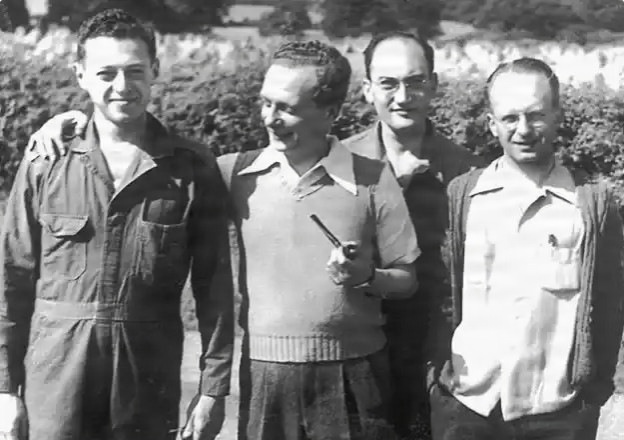
Photo By Erin Thompson | 2d Lt. Joseph Gould, left, at the TOOL training site, Ruislip, England... read more read more
 Subscribe
On Mar. 2, 1945, the two agents of the Office of Strategic Services (OSS) HAMMER mission, were dropped outside Berlin for a dangerous intelligence operation. Over the final two months of the war in Europe, they supplied the Allies with important strategic information as they advanced into Germany.
Earlier the previous year, OSS Director William Donovan had ordered the head of his Secret Intelligence (SI) Branch in England, William Casey (future director of Central Intelligence), to develop a plan to get information from inside Germany, something the Allies would desperately need as they approached the border. Casey conceived of the Faust plan, in which anti-Nazis with labor backgrounds who were exiled in England and Sweden would be dropped into Germany. There, they would blend with the local populace and collect information on industrial production, troop movements, morale, and the results of Allied bombing raids.
Responsibility for Faust was given to Arthur Goldberg (future Supreme Court justice), who led the Labor Branch in Casey’s SI unit. Ultimately, more than fifty Faust missions were launched into Germany, including five TOOL missions known as HAMMER, CHISEL, PICKAXE, MALLET, and BUZZSAW. To oversee the recruitment, training, and management of personnel for the TOOL missions, Goldberg appointed 2nd Lt. Joseph Gould, a 29-year-old New Yorker who had been a union official for the Screen Publicists Guild in his home state. Having enlisted in the U.S. Army at the beginning of the war, Gould received a commission in 1942 based on his time in the Officer Reserve Corps while studying at the Columbia Journalism School. The OSS then recruited him specifically for duty in its London-based Labor Branch.
To man the TOOL missions, Lieutenant Gould recruited agents from the Free Germany Movement, a group of German communists, socialists, and liberals living in England. For HAMMER, the first and most successful of the TOOL missions, he chose Paul Lindner and Anton “Toni” Ruh, friends who had been members of the labor underground in Germany prior to the war. After training, they were given false identification papers, detailed cover stories, money, weapons, and the latest in American communications technology—a Joan/Eleanor handheld two-way VHF radio they could use on the ground to verbally transmit their reports to an operator on an aircraft loitering outside the range of German anti-aircraft artillery.
At 2:15 a.m. on Mar. 2, Lindner and Ruh parachuted out of an A-26 light bomber just outside of Berlin. They spent nearly two months in the city, mingling with local residents and gathering intelligence. At times and locations communicated in coded messages broadcast via radio by the British Broadcasting Corporation, Lindner and Ruh filed their reports via the J/E radio to the circling aircraft. Ultimately, they provided strategic intelligence related to German troop movements, industrial production, Allied bomb damage and potential targets, ammo storage locations, civilian morale, and road and railway networks. The HAMMER agents, in near constant danger, remained in Berlin until Soviet forces encircled the city on 25 April. Upon presenting themselves as American soldiers to one of the Soviet commanders, they were arrested, relieved of their OSS codebooks, and held for two months before being turned over to an American division near Leipzig.
SI chief William Casey later wrote: “…a big breakthrough had been achieved from the intelligence yielded by the HAMMER team” from deep within Germany. For his role in this success, Gould was approved for the award of the Bronze Star in 1946 but did not receive it before being discharged from the Army. After his death in 1993, his family lobbied for the posthumous presentation of the medal, which was finally accomplished in 2010. The two HAMMER agents, shunned in the postwar anti-communist atmosphere, posthumously received Silver Star medals in 2004. Ironically, about this same time, published accounts, including one by Gould’s son, revealed the TOOL missions and their agents may have been secretly manipulated from the beginning by Soviet intelligence.
Article by Lori S. Stewart, USAICoE Command Historian. New issues of This Week in MI History are published each week. To report story errors, ask questions, request previous articles, or be added to our distribution list, please contact: TR-ICoE-Command-Historian@army.mil.
| Date Taken: | 02.27.2026 |
| Date Posted: | 02.27.2026 14:29 |
| Story ID: | 559123 |
| Location: | US |
| Web Views: | 65 |
| Downloads: | 0 |

This work, Hammer Drops Outside Berlin (2 MAR 1945), must comply with the restrictions shown on https://www.dvidshub.net/about/copyright.

No keywords found.




