
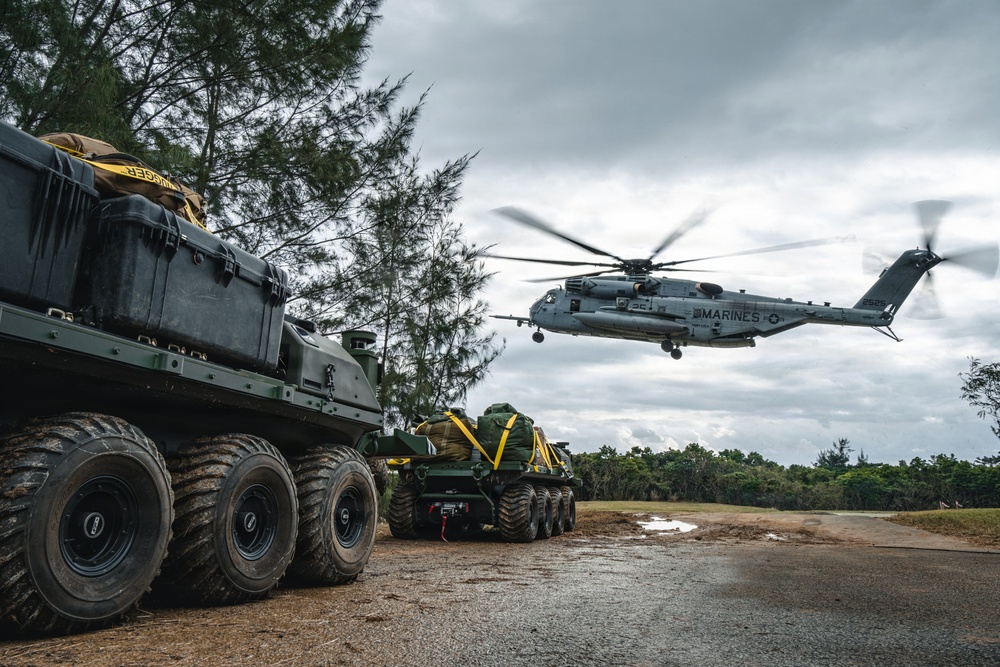
Photo By Cpl. Joaquin Carlos Dela Torre | U.S. Marines with 4th Marine Regiment, 3rd Marine Division prepare to load a Mission...... read more read more
 Subscribe
CAMP SCHWAB, Japan — For the first time in the Department of War, U.S. Marines with 4th Marine Regiment, 3rd Marine Division, airlifted a Mission Master Silent Partner (MMSP) unmanned ground vehicle aboard a CH-53E Super Stallion during 3rd Marine Divison’s combined Marine Corps Combat Readiness Evaluation on Jan. 28, 2026. This event validated a practical solution to a long-standing challenge at the regimental level: how to move and sustain a combat operations center without overburdening Marines or relying on a large vehicle-based footprint.
A regimental combat operations center, or COC, requires radios, satellite communications, servers, power generation, antennas and sustainment equipment to maintain continuous command and control. Traditionally, that capability has been transported in multiple tactical vehicles. While effective, vehicle-based COCs require fuel, drivers and security, and they create a larger visual, auditory and electromagnetic signature.
At the other end of the spectrum, Marines can attempt to operate in a fully dismounted configuration, carrying radios, batteries and mission-essential equipment in their main packs. However, the physical burden placed on individual Marines limits how long a foot-mobile COC can function and restricts the amount of equipment that can be brought forward.
The MMSP UGV provides a middle option between using multiple tactical vehicles or being fully dismounted to transport a COC, carrying communications and power equipment.. When air-inserted, the platform enables a foot-mobile COC to establish and sustain operations with fewer personnel and less reliance on large tactical vehicles.
“During Operation Iraqi Freedom and Operation Enduring Freedom, command nodes became larger and larger as the need for information became greater and greater,” White said. “We commanded air and communications superiority in perpetuity. We can no longer be guaranteed that dominance in any domain.”
As a result, he said, the Marine Corps has worked to make command nodes more agile and survivable.
“The past decade has seen an earnest effort by the USMC to make agile, low-signature, highly mobile C2 nodes,” White said.
The regiment’s experimentation with the Mission Master demonstrated what is now possible at the regimental level.
“Five years ago, a foot-mobile regimental COC would be nearly unthinkable and would only be able to sustain for a few hours with an unacceptably high visual, auditory and EM signature,” White said. “Our experimentation found that with the Mission Master, especially when air inserted, a low-signature, highly mobile, fully capable foot-mobile regimental COC that can sustain unsupported operations for multiple days is comfortably achievable.”
The Jan. 28 airlift was built on earlier validation conducted on Jan. 12 when the regiment confirmed the UGV could be transported aboard a CH-53E. The MCCRE marked the first time the platform was employed in a real-time, simulated combat scenario to support regimental command and control.
“This MCCRE combat rehearsal allowed us to integrate unmanned technology to gain advantage on the battlefield and continue to drive change forward,” said Col. Richard Barclay, commanding officer of 4th Marine Regiment.
Operating with a dispersed command structure throughout the event, this provided 4th Marine Regiment greater flexibility in decision making during the evaluation.
“The rapidly changing battlefield requires a command-and-control structure that is as resilient and adaptable as our Marines,” Barclay said. “Throughout this event, we operated in a disaggregated C2 structure, successfully commanding multiple subordinate units across a dispersed battlespace against a thinking enemy.”
By airlifting the MMSP and employing it in support of a foot-mobile COC, 4th Marines demonstrated a scalable approach to regimental command and control. This reduces the burden on individual Marines while limiting the reliance on multiple vehicles. The validation provides the regiment with an additional option to establish and sustain command and control while operating in distributed formations in the First Island Chain.
| Date Taken: | 02.24.2026 |
| Date Posted: | 02.27.2026 16:55 |
| Story ID: | 559054 |
| Location: | CAMP SCHWAB, OKINAWA, JP |
| Web Views: | 179 |
| Downloads: | 0 |

This work, 4th Marines Validate Air-Inserted UGV to Enable Foot-Mobile Regimental COC, by Cpl Daniel Granados, identified by DVIDS, must comply with the restrictions shown on https://www.dvidshub.net/about/copyright.


No keywords found.




